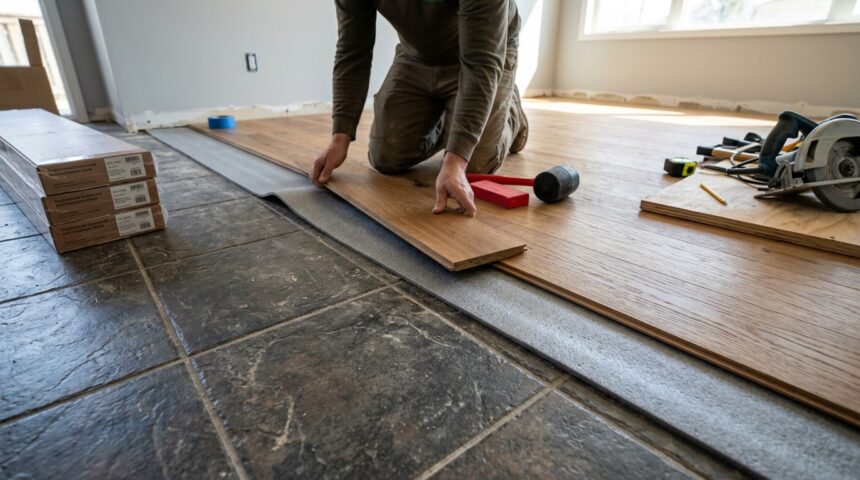
Installing new flooring is one of the most impactful home upgrades you can make, but the thought of ripping out old tile can feel overwhelming. The good news is that hardwood floors can absolutely be installed over tile in many situations.
Understanding when it works, which method to use, and what preparation is required will save you time, money, and frustration on your renovation project.
Can You Install Hardwood Floors Over Tile?
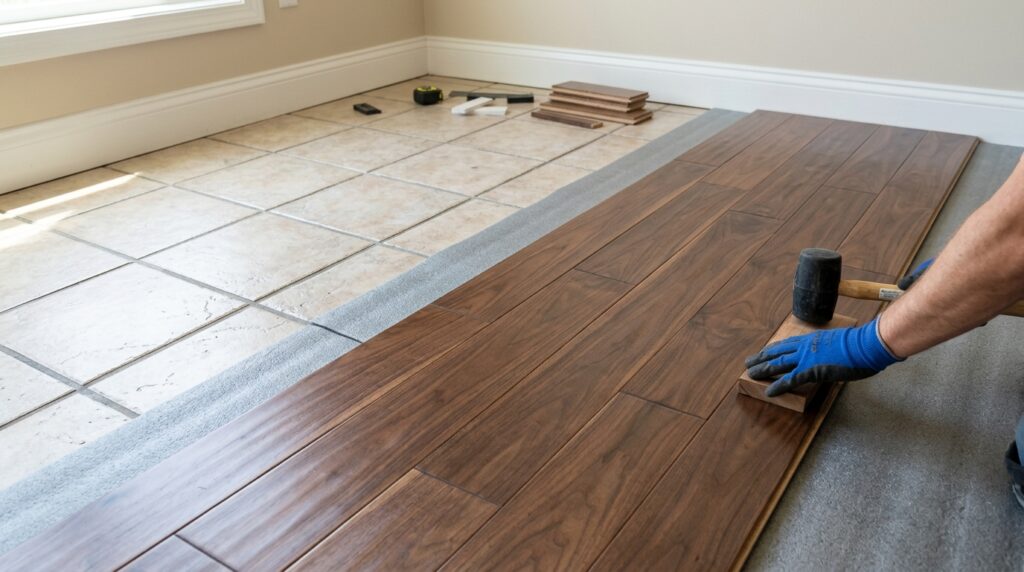
Yes, hardwood floors can be installed over tile as long as the tile is structurally stable, level, and properly prepared. The key is choosing the right type of hardwood and the right installation method for your specific subfloor condition.
Engineered Hardwood vs. Solid Hardwood Over Tile
These two products behave very differently when placed over tile, and choosing the wrong one can lead to costly problems down the road.
Engineered hardwood is made from multiple compressed wood layers with a genuine hardwood veneer on top.
This construction makes it significantly more dimensionally stable than solid wood, meaning it resists expansion and contraction caused by moisture and temperature shifts. Because tile floors — especially those on concrete slabs — tend to hold moisture and experience temperature fluctuations, engineered hardwood is the recommended choice in almost every scenario.
When Can Hardwood Floors Be Installed Over Tile?
Not every tiled room is a candidate for this approach. Several conditions must be evaluated before work begins, and ignoring even one of them can undermine your entire installation.
The Tile Must Be in Good Condition
The existing tile acts as your new subfloor, so its integrity matters enormously. Walk across the entire surface and listen for hollow sounds, which indicate tiles that have lost their bond with the substrate underneath.
Press firmly on tiles near grout lines to check for movement or flex. Any tile that is cracked, loose, or hollow needs to be repaired or removed and replaced before hardwood installation can begin.
Grout lines also deserve attention. Raised or deteriorating grout can create an uneven surface that transfers through to your new hardwood over time, causing planks to rock or creak with every step.
The Floor Must Be Flat and Level
A flat surface is non-negotiable for a successful hardwood installation. The industry standard for subfloor flatness is no more than 3/16 of an inch variation over a 10-foot span.
Anything beyond that needs to be addressed with a self-leveling compound poured over low spots, or by grinding down high spots where tiles may have settled unevenly.
Skipping this step is one of the most common reasons hardwood floors develop squeaks, gaps between planks, and premature wear patterns. An uneven base creates stress points in the flooring that compound over time.
Moisture Levels Need to Be Tested
Tile is non-porous, but the subfloor beneath it may not be. Concrete slabs, in particular, wick moisture upward and can trap it against the underside of your new hardwood. Before installation, a moisture test should be performed using either a calcium chloride test kit or a relative humidity probe inserted into the slab.
Most engineered hardwood manufacturers specify acceptable moisture thresholds in their installation guidelines.
Exceeding those limits without installing a proper moisture barrier will void warranties and risk permanent damage to your floors.
Height Gain Must Be Planned For
Adding a layer of hardwood over existing tile raises your finished floor height by anywhere from 3/8 inch to 3/4 inch or more, depending on the product and underlayment used. This seemingly small change has a ripple effect throughout the room.
| What Gets Affected | Why It Matters |
| Interior doors | May drag or not close without trimming the bottom |
| Appliances | Dishwashers, refrigerators, and ranges may not fit under countertops |
| Baseboards | May need to be removed or replaced |
| Transitions to other rooms | Height differences require threshold strips |
| Toe kicks on cabinets | Visual gap may appear at the base |
Planning for these adjustments before starting saves expensive surprises during or after installation.
How to Install Hardwood Floors Over Tile: 3 Methods
There are three recognized methods for installing hardwood over tile, and each suits different situations. Choosing the right one depends on your tile condition, the hardwood product you select, and your budget.
1. Floating Floor Installation
The floating method is the most widely used approach for hardwood over tile and is the most forgiving of minor surface imperfections.
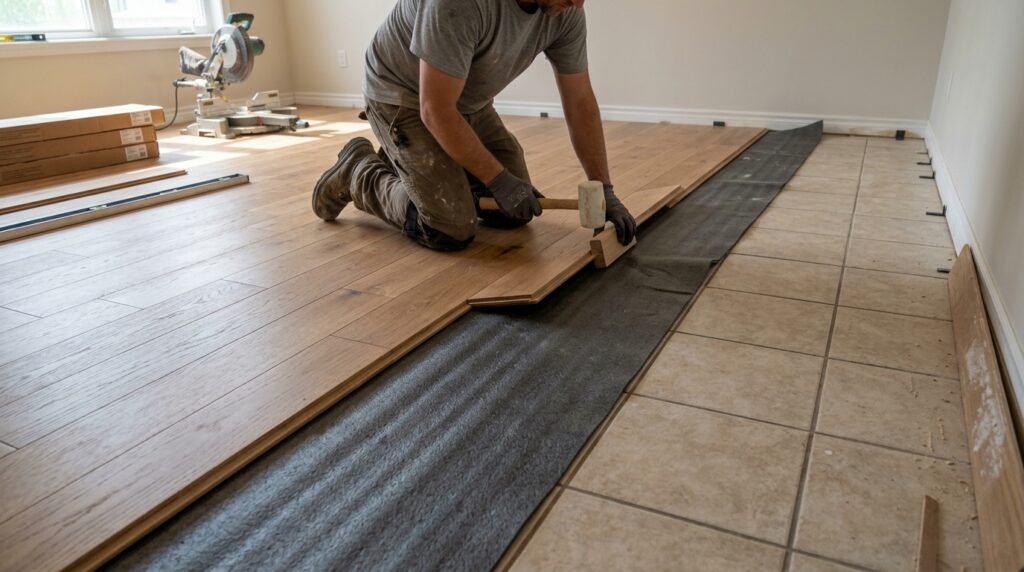
In this method, planks lock together using tongue-and-groove or click-lock profiles and are not fastened to the tile at all. Instead, the entire floor “floats” over a foam or composite underlayment that rests on top of the tile.
This method is ideal when the tile is in good condition, the floor is relatively level, and you want the flexibility to remove the flooring in the future without damaging the tile underneath.
It also installs faster than glue-down methods, which makes it a favorite for both DIY homeowners and professional installers working under time constraints.
The underlayment layer also provides meaningful sound dampening and slight thermal insulation, which improves the comfort of the finished floor.
2. Glue-Down Installation
In the glue-down method, hardwood planks are bonded directly to the tile surface using a professional-grade flooring adhesive.
This produces a floor that feels solid, dense, and quiet underfoot because there is no hollow space beneath the planks that can amplify footstep sounds.
Before gluing, the tile surface must be meticulously cleaned, degreased, and primed. Any contaminant on the tile will weaken the adhesive bond and eventually cause planks to lift or shift. This method is particularly well-suited for engineered hardwood in high-traffic areas like kitchens, hallways, and commercial spaces.
The trade-off is that removal is far more difficult if you ever want to change the flooring again, and the process requires a higher level of skill to execute correctly.
3. Nail-Down Over Plywood
The nail-down method is not used directly on tile. However, if your project requires nail-down installation — or if the tile is significantly damaged and you want to avoid a full removal — a plywood subfloor can be fastened on top of the tile first.
Once a stable plywood base is in place, hardwood planks are nailed or stapled down in the traditional manner.
This approach adds the most height to your floor and involves the most labor, but it also provides the strongest, most permanent result.
It is particularly useful in older homes where subfloor irregularities are significant and need to be fully corrected before a premium hardwood product is installed.
Benefits of Installing Hardwood Over Tile
Choosing to install over tile rather than removing it first comes with genuine advantages that go beyond simple convenience.
Cost and Time Savings — Tile removal is labor-intensive, requiring jackhammers or chisels, disposal fees for debris, and significant cleaning before any new flooring can go down. Installing over tile eliminates most of that cost and can cut days off the project timeline.
Less Structural Disruption — Removing tile from a concrete slab sometimes pulls up sections of the slab itself, requiring patching before any new floor can be installed. Leaving the tile in place avoids this risk entirely.
Warmth and Comfort — Tile feels cold and hard underfoot, particularly in winter months. Hardwood and its underlayment provide a noticeably warmer, more cushioned surface that improves the feel of the room immediately.
Design Continuity — Hardwood creates visual warmth and flow across connected spaces, making open-plan areas feel cohesive rather than segmented by different flooring materials.
Common Mistakes to Avoid
Even experienced DIYers make errors on this type of project. The following mistakes account for the majority of failed hardwood-over-tile installations.
Skipping the Moisture Test — This is the single most common and costly mistake. A floor that looks and feels dry may still be emitting enough vapor to damage hardwood over time. Always test before installing.
Not Addressing Uneven Grout Lines — High grout lines create tiny ridges under floating floors that become audible squeaks and visible waves in the finished surface. Fill or grind grout lines flush with the tile face before proceeding.
Choosing the Wrong Underlayment — Not all underlayments are compatible with all products. Some engineered hardwoods require specific underlayment types to maintain their warranty, and using the wrong one can cause locking mechanisms to fail under foot traffic.
Ignoring Acclimation — Engineered hardwood must be acclimated to the room’s temperature and humidity before installation. Most manufacturers recommend leaving sealed boxes in the room for 48 to 72 hours. Skipping this step causes planks to expand or contract after installation, leading to gaps or buckling.
Underestimating Height Changes — Measuring and planning for every door, appliance, and transition before ordering materials prevents last-minute surprises that delay project completion.
Best Rooms for Hardwood Over Tile
This installation method works better in some spaces than others, and knowing where it performs best helps you make a smarter decision.
Kitchens are a strong candidate because existing tile is common, and homeowners often want the warmth of wood without committing to a full renovation.
Engineered hardwood’s moisture resistance makes it practical here when proper barriers are used. Living rooms and dining rooms benefit most from the floating method, which provides excellent acoustic comfort and a premium feel without the permanence of glue-down installation. Hallways and entryways, which often feature tile for durability, are transformed by engineered hardwood that handles foot traffic while adding elegance.
Commercial settings including offices and retail spaces benefit from the speed of the over-tile method, which minimizes business disruption during renovation.
Bathrooms and laundry rooms are generally not recommended for this approach due to excessive moisture exposure, even with engineered hardwood.
FAQs
Does hardwood over tile feel hollow underfoot?
With a floating installation it can feel slightly less solid than a glue-down floor, but the right underlayment significantly reduces this. Glue-down installations feel virtually identical to floors installed directly on a slab.
Will the grout lines show through?
If the floor is properly leveled and grout lines are filled or sanded flush, they will not telegraph through the hardwood planks.
Can this be done as a DIY project?
Floating installations are manageable for an experienced DIYer. Glue-down installations require more skill and are better left to professionals.
How long does installation take?
A typical room with a floating installation can be completed in one to two days once preparation is finished.
Conclusion
Installing hardwood floors over tile is a practical, cost-effective solution when the right conditions are met. The tile must be stable, level, and moisture-tested. Engineered hardwood is the appropriate material choice in nearly every scenario, and the floating or glue-down method should be selected based on your specific subfloor and performance requirements.
Avoid skipping preparation steps, plan carefully for height changes, and always follow manufacturer guidelines for acclimation and underlayment. When done correctly, hardwood over tile delivers a beautiful, long-lasting floor without the expense and disruption of a full demolition
Related Articles
How to Repaint Kitchen Cabinets: Complete DIY Guide with Costs, Tips & Mistakes to Avoid
How to Measure a Ceiling Fan: The Complete Size Guide for Every Room
Why Does My Bathroom Smell Like Sewage? Causes, Fixes & Prevention Tips
How to Hang a Rug on the Wall: Step-by-Step Methods for Every Rug Type
How Long Does It Take to Do a Bathroom Renovation? Timelines, Phases & What to Expect