

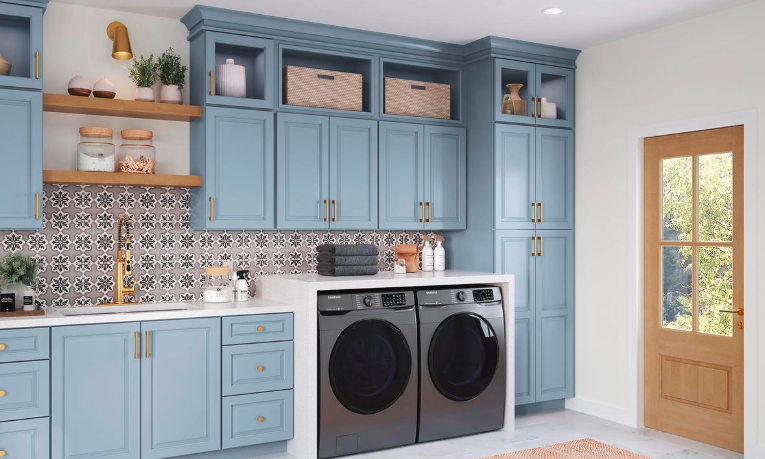
Most laundry rooms share the same problem — too much stuff and not enough space. Detergents stack on top of each other, clean towels end up on the floor, and every laundry session turns into a hunt for what you need.
The right laundry room cabinets fix all of that. Whether you are working with a small closet-sized laundry nook or a full dedicated room, smart cabinet choices can double your storage, reduce clutter, and make daily laundry tasks feel effortless — while making the space look polished at the same time.
In this guide, you will discover the best laundry room cabinet types, how to choose the right option for your specific space and budget, which materials hold up best against moisture and daily use, and expert organization tips to get the most from every inch of storage.
Why Do Laundry Room Cabinets Matter?
A disorganized laundry room does not just look messy — it actively slows you down. When detergents, fabric softeners, cleaning supplies, and laundry baskets have no fixed home, they pile up quickly and turn a simple chore into a frustrating experience.
Laundry room cabinets solve this by giving every item a designated space, so you spend less time searching and more time actually getting things done.
Beyond organization, cabinets dramatically improve how your laundry room functions. They make use of vertical wall space, underutilized corners, and the area above appliances that typically goes to waste.
For smaller laundry rooms especially, adding even one or two well-placed cabinets can feel like gaining a completely new storage area — without any renovation required.
Types of Laundry Room Cabinets
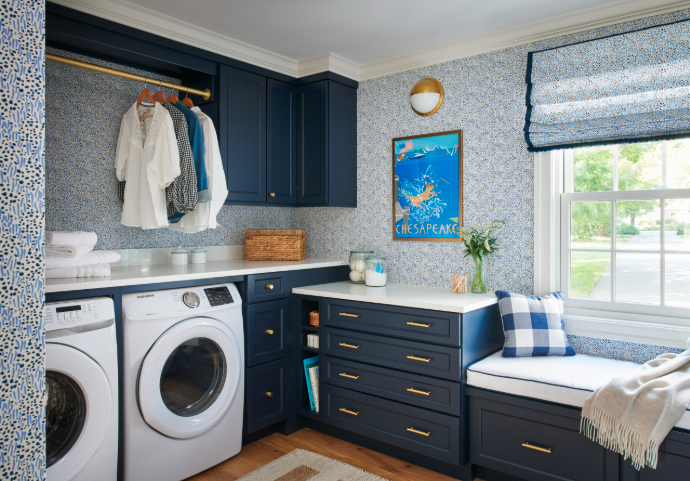
Not all laundry room cabinets are built the same, and the type you choose can make a dramatic difference in how useful your space becomes. Here are the six most practical cabinet types — and what each one does best.
1. Wall-Mounted Laundry Room Cabinets
Wall-mounted cabinets are installed directly above your washer, dryer, or countertop to capture vertical space that would otherwise be wasted.
They are the most popular first addition to any laundry room because they keep daily essentials — detergents, dryer sheets, stain removers — right at arm’s reach without taking up any floor space.
In small laundry rooms, wall cabinets can be a game-changer for keeping the space open and easy to move around in.
2. Base Cabinets with Countertops
Base cabinets sit below a countertop and create two benefits in one: hidden storage underneath for supplies, baskets, and bulky items, and a flat working surface above for folding clothes or sorting laundry.
If your laundry room currently lacks a dedicated workspace, adding a run of base cabinets with a countertop is one of the highest-impact upgrades you can make.
3. Tall Utility Storage Cabinets
Tall utility cabinets run floor to ceiling, making them the most storage-efficient option per square foot of floor space. They comfortably hold mops, brooms, vacuums, ironing boards, and bulk supply purchases in one organized unit.
If your laundry room doubles as a utility or cleaning closet, a tall utility cabinet can consolidate everything that would otherwise clutter the room.
4. Open Shelving Cabinets
Open shelving skips the cabinet doors entirely, giving you instant, unobstructed access to the items you reach for every day. Neatly folded towels, labeled baskets, and coordinated containers look stylish on open shelves while staying practical.
This style works especially well in modern and Scandinavian-inspired interiors, and it costs less than closed cabinet systems — making it a strong budget-friendly option.
5. Sink Cabinets for Laundry Rooms
Sink cabinets are purpose-built to house a utility or laundry sink, which is used for hand washing delicate items, soaking stained fabrics, or rinsing mop heads.
The cabinet base conceals plumbing and creates useful under-sink storage for brushes, soaking buckets, and cleaning tools. If you spend any time doing hands-on laundry care, a sink cabinet setup makes that work more comfortable and organized.
6. Pull-Out Hamper Cabinets
Pull-out hamper cabinets integrate sliding baskets or fabric bins directly into the cabinet design, so dirty laundry has a proper home instead of a pile on the floor.
Many models feature two or three separate compartments, making it easy to sort by color — whites, darks, colors — or by family member before laundry day even starts. The result is a much tidier-looking room and a noticeably faster laundry routine.
Best Laundry Room Cabinet Ideas for Small Spaces
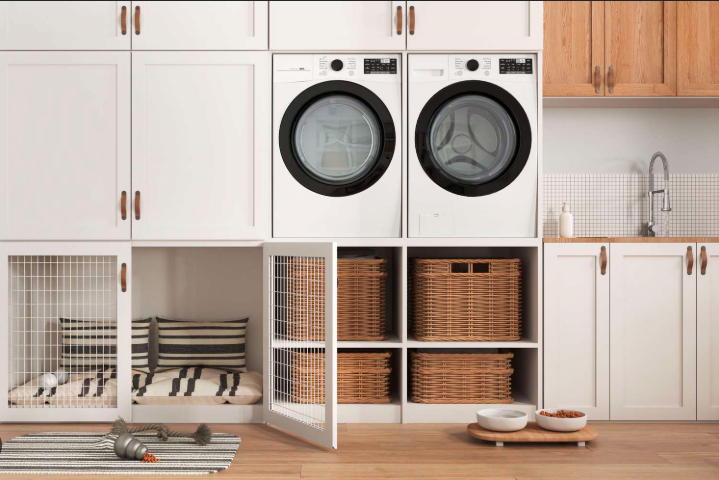
Small laundry rooms are where cabinet planning matters most. A few smart choices can genuinely transform a cramped utility closet into a clean, efficient space. Here are five of the most effective cabinet strategies for tight layouts — each one proven to add meaningful storage without making the room feel smaller.
Install Cabinets Above Washer and Dryer
The wall space above your washer and dryer is the single most underused area in most laundry rooms. Installing cabinets here captures prime real estate for your most-used supplies — detergents, fabric softeners, dryer sheets — and puts them exactly where you need them without requiring you to walk across the room.
For stacked washer-dryer units, this approach is especially effective since the full wall height becomes available.
Use Vertical Storage Solutions
When floor space is scarce, the answer is to go vertical. Tall cabinets that reach close to the ceiling deliver far more storage than squat base units while using the same footprint.
If full-height cabinets are not possible, stacked shelving units with adjustable shelves let you customize height spacing for different item sizes — keeping the layout flexible as your storage needs change.
Add Corner Cabinets
Corners are typically dead space in laundry rooms — awkward to access and easy to ignore. Corner cabinets, including lazy-Susan-style rotating units, reclaim this space for practical use without blocking traffic flow.
They are excellent for storing items you reach for less often: spare supplies, seasonal cleaning products, or equipment you need monthly rather than daily.
Combine Open and Closed Storage
Mixing open shelves with closed cabinets is one of the smartest design decisions you can make in a small laundry room. Open shelves display the items you use every day and create a sense of openness; closed cabinets conceal the things that look untidy — bulk supplies, cleaning chemicals, miscellaneous tools.
The contrast between the two also adds visual interest and makes the room look intentionally designed rather than purely functional.
Choose Sliding or Pocket Cabinet Doors
Standard cabinet doors swing outward and can quickly become an obstacle in tight spaces — especially if the room is narrow or shared with appliances. Sliding and pocket-style cabinet doors solve this completely by moving sideways along a track.
Beyond saving clearance space, they give the room a cleaner, more modern look and make the overall layout feel much less cramped.
How to Choose the Right Laundry Room Cabinets
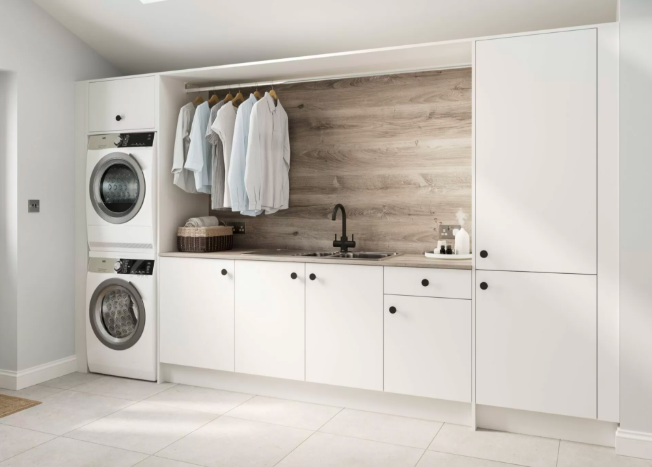
Before you buy, it pays to think through a handful of key factors. The wrong cabinet can waste money, create awkward clearance issues, or simply not hold what you actually need. Work through the following checklist to make a confident, well-informed decision.
1. Measure Your Laundry Room Carefully
Before ordering anything, measure your wall width, ceiling height, appliance dimensions, and door or vent clearance requirements.
Cabinet manufacturers use standard sizes, but laundry rooms often have non-standard layouts — low ceilings, protruding pipes, or angled walls — that trip up unprepared buyers. A 10-minute measuring session can prevent a very expensive return trip.
2. Consider Your Storage Needs
Take stock of everything you currently keep in your laundry area: detergents, fabric softeners, stain removers, ironing equipment, spare towels, cleaning tools, and bulk supplies.
A household of four or more will need meaningfully more storage depth than a single person, and families with young children often need child-safe locking cabinet options for keeping chemicals out of reach.
3. Match Cabinets with Your Interior Style
Laundry rooms are increasingly treated as design spaces — not just utility rooms — and your cabinet choice should reflect that. Flat-front cabinets in white or light grey suit modern and minimalist interiors.
Shaker-style doors with warm wood tones feel at home in farmhouse or transitional designs. Two-tone cabinets with a different color for upper and lower units are a growing trend that adds visual depth to even small spaces.
4. Select Moisture-Resistant Materials
Humidity is the silent enemy of laundry room cabinets. Washing machines release steam, dryers expel warm moist air, and occasional spills are inevitable. Any cabinet material that is not moisture-resistant will swell, warp, or grow mold within a few years.
Prioritize PVC, laminate, stainless steel, or properly sealed solid wood — and avoid raw MDF or particleboard with low-grade lamination in high-humidity zones.
5. Prioritize Easy Maintenance
Laundry rooms accumulate detergent drips, lint dust, and occasional bleach splashes. Choose cabinet finishes with smooth, sealed surfaces that wipe down with a damp cloth and resist staining. Avoid textured or deeply grooved door profiles in high-humidity areas — they trap moisture and grime and become difficult to keep clean over time.
Best Materials for Laundry Room Cabinets
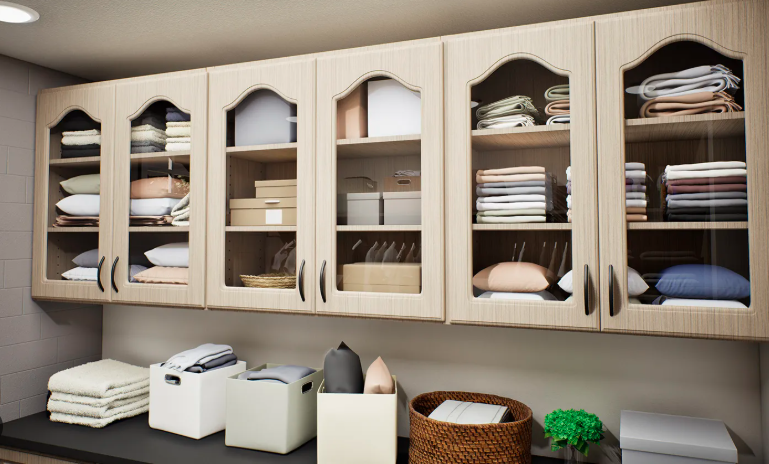
The material your cabinet is made from determines how long it will last, how it handles moisture, and how much maintenance it will need. Laundry rooms present tougher conditions than most rooms — high humidity, cleaning chemical exposure, and heavy daily use. Here is how the most common cabinet materials compare in this demanding environment.
| Material | Moisture Resistance | Durability | Maintenance | Best For |
| Laminate (HPL) | High | High | Very Easy | Most laundry rooms — best value |
| PVC | Excellent | High | Minimal | High-humidity or poorly ventilated rooms |
| Stainless Steel | Excellent | Very High | Easy | Utility-forward or industrial-style rooms |
| Solid Wood (sealed) | Moderate | High | Moderate | Well-ventilated rooms where aesthetics matter |
| MR-MDF (sealed) | Moderate | Medium | Moderate | Budget builds in moderate-humidity spaces |
Laminate Cabinets
Laminate cabinets are the most widely chosen option for laundry rooms. They offer a smooth, moisture-resistant surface at an affordable price point, are available in dozens of colors and finishes — including wood-effect options — and are genuinely easy to wipe clean.
High-pressure laminate (HPL) is the more durable tier worth choosing if you expect heavy use or frequent moisture exposure.
PVC Cabinets
PVC (polyvinyl chloride) cabinets are the most moisture-resistant option available and the closest thing to a maintenance-free cabinet material. They will not warp, swell, or rot even in persistently damp conditions — making them the top recommendation for laundry rooms without adequate ventilation.
Newer thermofoil PVC finishes have improved considerably in appearance and are no longer the purely utilitarian option they once were.
Stainless Steel Cabinets
Stainless steel cabinets deliver industrial-grade durability and a distinctive modern aesthetic. They are virtually immune to moisture, rust, and staining, and their non-porous surface is among the easiest to sanitize.
The main drawback is cost: stainless steel cabinetry runs significantly more expensive than laminate or PVC alternatives, but for a utility-forward laundry room, the investment is hard to beat.
Solid Wood Cabinets
Solid wood cabinets bring warmth and a premium look that no other material can match. Properly sealed hardwoods like oak, maple, or cherry can hold up well in moderately humid laundry rooms.
The critical requirement is sealing: untreated or poorly sealed wood will absorb moisture and eventually crack or warp. For well-ventilated spaces where aesthetics matter, solid wood is a beautiful long-term investment.
MDF and Plywood Cabinets
Moisture-resistant MDF (MR-MDF) and properly sealed plywood can work in laundry rooms when finished with waterproof laminate or paint. The key is to avoid standard (non-MR) MDF or cheap particleboard, which absorb moisture rapidly and degrade within a year or two in laundry environments. Always confirm the moisture rating before purchasing MDF-based cabinetry for a laundry room application.
DIY vs Custom Laundry Room Cabinets
Both DIY (stock) and custom cabinets can produce excellent results — the right choice depends on your budget, how unusual your laundry room dimensions are, and how much storage efficiency matters to you.
As a general rule: if your laundry room has standard wall dimensions and a modest budget, stock or semi-custom cabinets will serve you well. If you have an irregular layout, very specific storage needs, or you are treating the laundry room as a genuine design space, custom cabinetry pays for itself in long-term usability.
| Feature | DIY / Stock Cabinets | Custom Cabinets |
| Cost | Budget-friendly ($100–$300/linear ft) | Higher investment ($500–$1,200+/linear ft) |
| Installation | Self-installed or simple setup | Professionally designed and installed |
| Design Options | Standard styles and sizes | Fully personalized to your exact layout |
| Storage Efficiency | Basic storage solutions | Maximized for your specific needs |
| Material Quality | Varies by brand and price | Typically higher-grade materials |
| Lead Time | Available immediately | Requires planning and production time |
| Best For | Standard rooms, tighter budgets | Unique layouts, premium finishes |
Laundry Room Cabinet Organization Tips
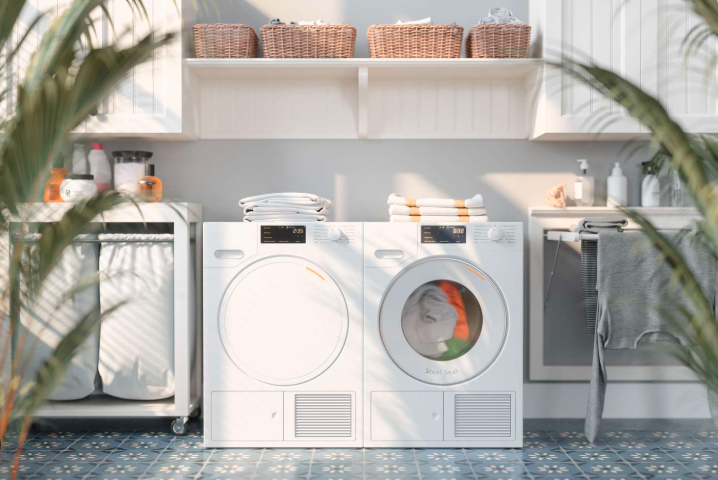
Even the best cabinets become chaotic without a system behind them. The following organization strategies take minutes to implement but make a noticeable difference every single laundry day.
Use Storage Bins and Labels
Uniform storage bins are one of the simplest and most effective upgrades you can make to your cabinet interiors. Choose bins that fit your shelf depth, then label each one clearly — Detergents, Stain Removers, Dryer Supplies, Spare Towels, and so on. Matching labels and bins also give the interior of your cabinets a polished, intentional look that is satisfying to maintain.
Keep Daily Supplies Within Reach
Store the items you use every single laundry session — detergent, fabric softener, dryer sheets, and lint rollers — at eye level or below in your most accessible cabinet. Reserve higher shelves and back-of-cabinet space for items you reach for weekly or less. This simple zoning principle cuts down the time you spend at the cabinet on every laundry cycle.
Store Bulky Items Efficiently
Large or awkward items — spare laundry baskets, backup supply purchases, ironing boards, and extra towels — should go in your tallest or deepest cabinets where smaller items would be hard to retrieve anyway. Stackable clear bins are particularly useful for bulk supplies because they protect contents from humidity while letting you see at a glance when you are running low.
Separate Cleaning Products Safely
Cleaning chemicals, bleach, and concentrated detergents should be stored in a dedicated cabinet — ideally with a child-resistant latch — well away from food items, clothing, and pet supplies. Accidental chemical mixing is a real safety hazard; keeping these products in one designated place reduces that risk and makes it easier to do a quick safety check before any deep cleaning session.
Common Mistakes to Avoid with Laundry Room Cabinets
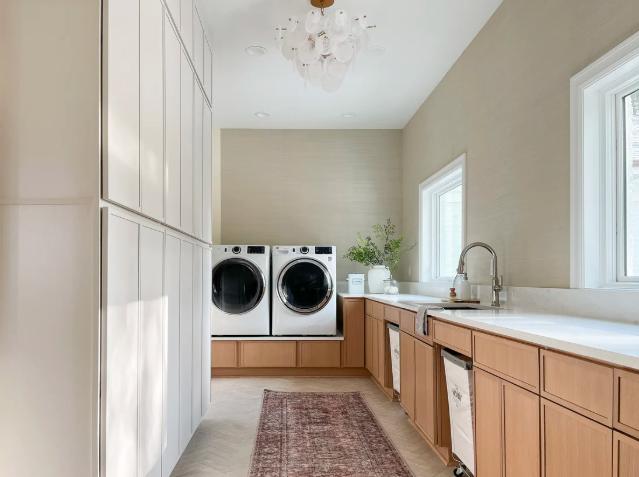
Even carefully planned laundry rooms can end up disappointing if a few common mistakes slip through. Here are the five most frequent cabinet planning errors — and how to avoid each one before you commit to a purchase.
Ignoring Ventilation Space
Washing machines and dryers generate heat, steam, and vibration during every cycle. Cabinets installed too close to these appliances without adequate clearance can trap moisture and accelerate mold growth — both in the cabinet material and behind the units. Check your appliance manual for recommended clearance distances and build these into your cabinet layout before finalizing measurements.
Choosing Cabinets That Are Too Deep
Standard kitchen base cabinets are 24 inches deep — a dimension that often proves excessive for laundry rooms.
Cabinets deeper than 16 to 18 inches tend to create a frustrating problem: small items like detergent pods and stain remover pens disappear to the back and become practically unreachable.
In narrow laundry rooms, deeper cabinets also eat into what little floor space you have. Opt for shallower depths unless you have a specific reason to go deeper.
Using Non-Waterproof Materials
The most expensive cabinet mistake you can make in a laundry room is choosing beautiful cabinetry in the wrong material. Standard particleboard and untreated MDF can begin deteriorating within 12 to 18 months in a humid laundry environment — swelling at edges, delaminating at corners, and eventually becoming structurally weak.
Always verify the moisture rating of any cabinet material before purchasing, and treat cut edges with waterproof sealant before installation.
Poor Lighting Placement
Laundry rooms are often the most poorly lit rooms in a house — and dark cabinets are not just inconvenient, they make mistakes more likely. Consider under-cabinet LED strip lights to illuminate work surfaces, and motion-activated interior cabinet lights for deeper storage. For new installations, plan lighting alongside your cabinet layout rather than as an afterthought.
Lack of Counter Space
If your laundry room has no counter space at all, you are missing one of the most useful additions you can make. A countertop above a run of base cabinets provides a dedicated folding surface, a place to set items during sorting, and a home for frequently used supplies like the lint brush or stain stick. Even a small 24-inch countertop section noticeably improves the daily workflow of a laundry room.
How Much Do Laundry Room Cabinets Cost?
Cabinet pricing varies widely based on material grade, customization level, and whether you handle installation yourself or hire a professional. The table below covers average costs per linear foot in the United States as of 2024. Note that installation typically adds $50 to $150 per linear foot on top of material costs.
| Cabinet Type | Avg. Cost Per Linear Foot | Key Features |
| Stock Cabinets | $100 – $300 | Pre-made designs, affordable, fast installation |
| Semi-Custom Cabinets | $200 – $600 | More size/style options, moderate customization |
| Custom Cabinetry | $500 – $1,200+ | Fully personalized, premium materials, maximum storage |
Are Laundry Room Cabinets Worth It?
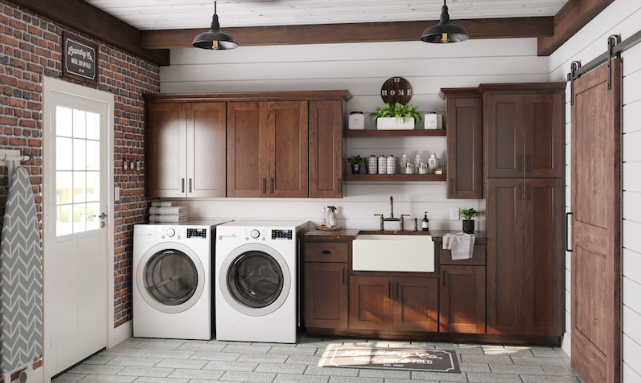
Yes — and the return on investment is higher than most homeowners expect. Laundry rooms are used almost daily, which means any improvement to the room’s organization and workflow pays dividends every week.
Well-chosen cabinets reduce time spent searching for supplies, eliminate visual clutter that makes the space feel stressful, and extend the lifespan of your cleaning products by storing them properly.
From a resale perspective, a clean and well-organized laundry room with built-in cabinetry is increasingly viewed as a desirable feature by homebuyers — not just a utility afterthought. In competitive real estate markets, it is the kind of detail that makes an impression.
Frequently Asked Questions
What type of cabinets are best for a laundry room?
Wall-mounted cabinets above appliances are the most practical starting point for most laundry rooms. If you also need a folding surface, pair them with base cabinets and a countertop. For rooms with high humidity, PVC or high-pressure laminate cabinet materials perform best.
How deep should laundry room cabinets be?
Wall-mounted cabinets are typically 12 to 14 inches deep, which is sufficient for detergent bottles, cleaning sprays, and folded items. Base cabinets are usually 16 to 21 inches deep. Avoid standard kitchen-depth (24-inch) base cabinets unless you have a specific need for them, as the extra depth makes smaller items harder to retrieve.
Can I add laundry room cabinets to a rental property?
Yes — freestanding utility cabinets and modular shelf units require no installation and can move with you when you leave. Wall-mounted options require drilling and are best suited for homes you own. Always check your lease agreement before making any permanent modifications.
What is the most durable cabinet material for a laundry room?
PVC cabinets offer the best moisture resistance and require the least maintenance in high-humidity environments. Stainless steel is the most structurally durable. For most homeowners, high-pressure laminate (HPL) offers the best balance of durability, aesthetics, and cost.
How do I organize laundry room cabinets on a small budget?
Start with uniform storage bins and a label maker — these cost very little and immediately make existing cabinets look and function better. Add a tension rod under a wall cabinet to hang spray bottles by their triggers, freeing up shelf space. Stackable acrylic containers are inexpensive and let you see contents at a glance without opening every cabinet.
Conclusion
A well-planned laundry room cabinet setup transforms one of the hardest-working rooms in your home from a chaotic utility space into a clean, efficient, and even satisfying place to spend time in. The right combination of cabinet types, materials, and organization strategies does not just store your supplies — it changes how the entire laundry routine feels.
Start with your biggest pain point: not enough storage, no folding surface, too much visual clutter — and let that guide your first cabinet decision. From there, the improvements build naturally. Whether your budget runs to stock laminate cabinets or fully custom built-ins, the investment will pay back every time laundry day comes around.
Related Articles
Best Primer for Painting Kitchen Cabinets – Complete Easy Guide for Smooth & Durable Cabinets
Can You Paint Roof Shingles? Pros, Cons, and Best Practices
How to Measure a Ceiling Fan: The Complete Size Guide for Every Room
Complete Guide to Roof Ventilation for Metal Roofs: Types, Benefits, Installation & Maintenance