

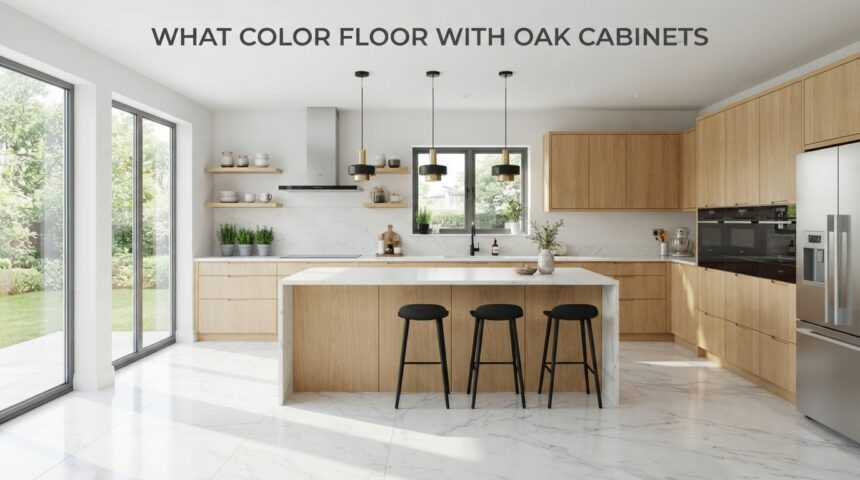
Choosing what color floor with oak cabinets works best comes down to one thing: the undertone sitting inside your cabinet doors. Honey and golden oak look their best beside medium-to-dark browns, greige, or charcoal, because those shades calm the orange glow.
Red oak needs a neutral brown or cool grey-brown to cancel its pink cast. White oak is the easiest to work with and accepts nearly any floor, from pale blonde planks to matte black tile. Dark-stained oak wants a lighter floor underneath it so the room does not feel closed in. The floor should never copy the cabinet color, only balance it.
Know Your Oak Before You Pick a Floor
Oak is not a single color, which is why generic flooring advice fails so often. Identify which of these four types you own, and the rest of the decision becomes far simpler.
Golden or Honey Oak
This is the warm, yellow-orange oak installed in millions of homes between the mid-1980s and late 1990s. Its finish has usually ambered further with age, pushing the tone even warmer. It needs a floor that pulls attention away from that glow rather than echoing it.
Red Oak
Red oak carries a faint pink or salmon cast that becomes obvious next to anything cool. The grain is open and strongly patterned, so busy floors compete with it. Neutral, quiet flooring restores balance to the room.
White Oak
Despite the name, white oak reads beige-to-greige rather than white, with a tighter, calmer grain. It has almost no clashing undertone, which makes it the most flexible base you can own. Nearly every floor shade works, so the choice comes down to style alone.
Stained or Painted Oak
Cabinets refinished in walnut stain, white, grey, or navy behave differently from raw oak. The paint or stain now controls the undertone, not the wood underneath. Treat these cabinets as the color you see, not as oak.
Quick identification test: hold a plain sheet of white printer paper flat against a cabinet door in daylight. Whichever color jumps forward — orange, pink, or beige — is your true undertone.
Three Rules That Make Any Pairing Work
These rules apply to every oak type and every flooring material. Follow them and you eliminate most of the guesswork.
Rule One: Match the Undertone Direction
Warm cabinets belong with warm or genuinely neutral floors, not with icy blue-grey ones. A cool floor beside golden oak makes the cabinets look sharply orange by comparison. When in doubt, neutral greige is the safest bridge between the two temperatures.
Rule Two: Contrast the Value
Value simply means how light or dark something is. If your cabinets are mid-tone, the floor should be clearly darker or clearly lighter. Similar values sitting together blur the line between cabinet and floor, which flattens the entire room.
Rule Three: Keep a Two-Shade Gap
Stand a flooring sample against the cabinet door and step back three metres. If you struggle to tell where one ends and the other begins, the gap is too small. Aim for at least two or three visible shades of separation.
Best Floor Colors for Each Type of Oak
Once you know your undertone, the shortlist narrows quickly. The table below gives the fastest overview, and the sections beneath explain the reasoning.
| Cabinet Type | Strongest Choices | Shades to Skip |
| Golden / honey oak | Walnut, espresso, greige, charcoal slate | Cherry, matching golden planks, icy grey |
| Red oak | Neutral brown, grey-brown, taupe tile | Pink-toned wood, terracotta, mauve |
| White oak | Blonde, white-washed, medium brown, matte black | Heavy orange-toned wood |
| Dark stained oak | Blonde, light grey, cream stone-look | Anything equally dark |
Floors for Golden or Honey Oak
Medium-to-dark brown flooring in walnut or espresso is the most dependable partner here, because the depth of the floor gives the eye somewhere else to rest. Greige and grey-brown planks are the modern alternative, softening the orange without introducing a cold clash. Charcoal or slate tile also works beautifully in kitchens with strong natural light.
Floors for Red Oak
A neutral brown floor with no red in it will quietly settle the pink tone in the cabinets. Grey-brown planks go one step further and actively counteract it, which suits homeowners who dislike the pink cast. Cream and taupe tile is the softer route, keeping the room light without drawing attention to undertone at all.
Floors for White Oak
Pale blonde or white-washed floors create the airy Scandinavian look that suits white oak best and makes small kitchens feel larger.
Medium warm brown adds gentle definition if you want the cabinets to stand out as a feature. Matte black or deep charcoal delivers a sharp, contemporary contrast without ever looking mismatched.
Floors for Dark Stained or Painted Oak
Dark cabinets absorb light, so the floor has to give some back. Blonde wood, light grey plank, or cream limestone-look tile prevents the room from feeling like a cave. With white painted oak, you have complete freedom, though a mid-tone wood floor stops the space from feeling clinical.
Choosing by the Look You Want
Two people with identical cabinets can want completely different results. Use this table to match your flooring to the atmosphere you are aiming for.
| Desired Look | Floor Direction | Why It Works |
| Modern and clean | Greige plank, charcoal tile | Cools the wood and sharpens edges |
| Warm and traditional | Walnut, chestnut, deep brown | Reinforces the natural richness of oak |
| Farmhouse and rustic | Wide wire-brushed oak, reclaimed brown | Texture matters more than exact shade |
| Small or dim kitchen | Light-to-mid tone, low sheen | Bounces light and expands the space |
| Easy resale | Mid brown or greige LVP | Neutral enough for most buyers |
Flooring Materials Worth Considering
Color is only half the decision. The material determines how the floor survives spills, chair legs, and daily foot traffic.
Luxury Vinyl Plank
LVP is fully waterproof, comfortable underfoot, and available in an enormous range of realistic wood tones. It is usually the best value option for a kitchen that sees heavy use. Choose a thicker wear layer if you have pets or children.
Engineered Hardwood
This gives you genuine wood on the surface with far better moisture stability than solid planks. It can often be refinished once, extending its life considerably. Expect a higher price than vinyl but a stronger effect on resale value.
Wood-Look Porcelain Tile
Porcelain is the most durable option available and will not scratch, stain, or swell. Modern printing makes the wood effect convincing from standing height. The main trade-offs are a harder, colder surface and a more involved installation.
How to Test Colors at Home
Never commit to a floor based on a photograph or a small chip. Order the largest samples the supplier offers and bring them into the actual room before deciding anything.
Lay each sample flat on your existing floor, directly beneath the cabinets rather than held up against them. Check the pairing in three separate conditions: morning daylight, late afternoon light, and under your kitchen lights at night. Undertones shift noticeably between them, and a floor that looks perfect at noon can turn grey and lifeless in the evening.
Photograph the samples as well. A camera flattens color and often reveals a clash your eye had adjusted to. Finally, leave the samples down for three or four days. Your honest reaction on day four is far more reliable than your first impression.
Mistakes That Ruin the Pairing
Most flooring regrets come from the same handful of errors, all of which are avoidable:
- Matching the floor to the cabinets, which creates a flat brown box with no definition.
- Choosing icy blue-grey planks beside warm oak, which intensifies the orange dramatically.
- Ignoring adjoining rooms, so the new floor stops abruptly against an older one.
- Selecting high-gloss finishes, which show every crumb, scratch, and footprint.
- Deciding from an online photo where lighting and screen settings distort the color.
- Forgetting to confirm the return policy before ordering a full quantity.
Pulling the Whole Room Together
The floor never works alone. Countertops, backsplash, and wall color all influence whether the pairing feels deliberate or accidental, so plan them as one set of choices.
A dependable formula for honey oak is a dark walnut floor, white or light grey quartz countertops, a simple white backsplash, and soft warm-white walls. For white oak, pair blonde flooring with pale stone counters and warm greige walls. For dark stained cabinets, combine a light floor with a mid-tone counter so the room has three distinct layers rather than two competing ones.
Frequently Asked Questions
Do grey floors go with oak cabinets?
Yes, provided the grey leans warm. Greige and grey-brown flatter oak, while cool blue-grey fights it.
Should floors be lighter or darker than cabinets?
Either works as long as there is clear separation. Darker floors ground a bright kitchen; lighter floors open up a dark one.
What flooring makes oak cabinets look modern?
Greige LVP, charcoal tile, and low-sheen wide planks update oak fastest, especially alongside new hardware and lighting.
Can I keep my oak cabinets and still look current?
Absolutely. A considered floor, matte black or brushed brass handles, and fresh wall color modernise oak without replacement.
Conclusion
Work out your undertone, contrast the value, and keep a visible gap between floor and cabinet. Those three rules solve almost every pairing problem on their own. Order generous samples, live with them for a few days in real light, and trust what you see rather than what a showroom promised.
Related Articles
Why Is My Basement Flooding: Complete guide 2026
Electrician for Flickering Lights: Complete Guide 2026
Standard Shower Curtain Size: Complete Guide to Sizes, Types & Measurements
Why Is My Basement Flooding? Causes, Fixes & Prevention Tips
How to Test for Asbestos in Popcorn Ceiling: Complete Homeowner Guide