

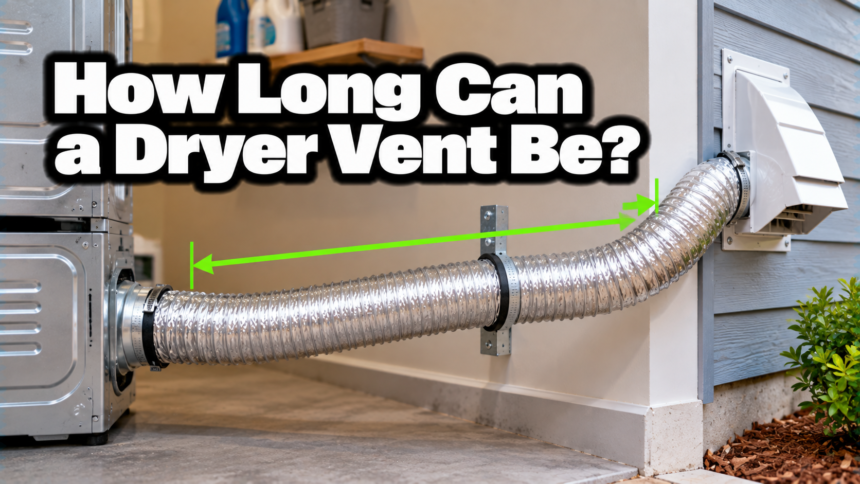
A dryer vent can be up to 35 feet long. That is the standard limit in the residential building code, measured along the whole path the air travels from the back of the dryer to the spot where it leaves your house. Every turn in the run shortens that limit. A 90-degree elbow takes 5 feet off the total, and a 45-degree elbow takes 2.5 feet off. So a vent with two sharp turns has about 25 feet of straight duct to work with, not the full 35.
There is one big exception, and it matters. Your dryer’s own installation manual can allow a longer run, and when it does, the manual wins. The rest of this guide shows how to measure your run, how to count the turns against the limit, when you can safely go past 35 feet, and how to keep the whole thing working the way it should.
What is the maximum dryer vent length?
The maximum is 35 feet of developed length. Developed length is the real distance the air moves through the duct, following every straight section and every bend, not the straight-line distance across the room. If your dryer sits 6 feet from an outside wall but the duct runs up, over, and across before it exits, you measure the full path the air takes, not the 6 feet between the machine and the wall.
This 35-foot figure applies to a standard 4-inch duct, which is the size nearly every household dryer uses. It is the number a building inspector checks against, and it exists for a plain reason. The longer and more twisted the path, the harder your dryer has to push warm, wet, lint-filled air out of the house. Push it too far and the air slows down, moisture stays behind, and lint settles on the duct walls instead of blowing outside.
The limit is about airflow, not just distance. A short run with four tight turns can choke a dryer as badly as a long straight one. That is why the code counts your turns against the 35 feet, which is the next thing to work out.
Treat 35 feet as the ceiling, not a target. Local codes can be stricter than the national rule, so if you are planning a new run, a quick call to your local building department settles the exact number for your area before you buy any duct.
How to measure your vent’s developed length
Before you can tell whether a run is legal, you need its developed length. Here is how to work it out.
- Follow the duct from the back of the dryer to the outdoor vent cap, and add up the length of every straight section along the way.
- Count each turn in the run, and note whether it is a 90-degree elbow or a gentler 45-degree elbow.
- Take 5 feet off your total for each 90-degree elbow, and 2.5 feet off for each 45-degree elbow.
- Compare the result against 35 feet. If you are under, the run passes. If you are over, you need fewer turns, a shorter path, or a booster fan.
How do turns and elbows shorten the limit?
Every bend adds resistance, so the code makes you subtract from the 35 feet for each one. You are trading straight-run length for turns. Here is what each fitting costs on a 4-inch duct.
| Fitting on a 4-inch duct | Length deducted |
| 90-degree elbow | 5 feet |
| 45-degree elbow | 2.5 feet |
To find your usable straight length, start at 35 feet and subtract the cost of every turn in the run. A worked example makes it clear.
Say your duct leaves the dryer, turns 90 degrees to climb the wall, then turns 90 degrees again to run through the ceiling toward the outside. That is two 90-degree elbows, which is 10 feet gone. You now have 25 feet of straight duct to play with. Add a third 90-degree elbow for a run that has to cross the house, and you are down to 20 feet.
Here is a run that fails. A basement dryer has to reach an outside wall about 30 feet away, and the path takes three 90-degree turns to get there. Three 90s cost 15 feet, so the run is allowed only 20 feet of straight duct, but it needs 30. That run is over the limit and calls for a shorter route, fewer turns, or a booster fan.
Swap one sharp turn for a 45-degree elbow and you keep more room, since a 45 costs only 2.5 feet instead of 5. This is why a good vent path uses as few turns as it can, and favors gentle turns over sharp ones. Two smooth 45-degree elbows often do the same job as one tight 90 and cost less against your limit. Smooth, factory-made elbows also beat crimped or mitered ones, because the cleaner the inside of the bend, the less lint it grabs.
When can a dryer vent be longer than 35 feet?
You can go past 35 feet when your dryer’s installation manual says so. The code lets the manufacturer set both the duct size and the maximum length, because the maker knows how much pressure that specific blower can handle. Many newer dryers are rated for longer runs, and some print their own elbow deduction chart in the manual. Check that chart before you assume 35 is your ceiling, and follow its number if it is different. The manual is usually inside the drum when the dryer is new, and the maker keeps a copy on its website under the model number.
The second way to reach farther is a dryer duct booster fan. This is a small inline fan that adds push to the airflow, and it is built for runs that would otherwise be too long. A booster usually switches on with the dryer and needs its own power and a little upkeep, so it is a real installation, not a quick clip-on part. Match the fan to your duct size and run length, and mount it where you can reach it, since an inline fan collects lint the same way the duct does. If your floor plan forces a long path, a booster is the safe way to make it work.
What you should not do is run a longer duct and hope. A run past the rated limit is the single most common reason a dryer needs two or three cycles to finish one load.
What counts toward the length, and what doesn’t?
You measure from where the duct connects behind the dryer to where it ends outside. The vent hood or cap on the exterior wall is the finish line, and the measurement ends at the very tip of that hood, so a cap that sticks out past the siding adds those inches to your total. Everything in between counts, including all the elbows.
The short, flexible piece right behind the dryer is the transition duct, and it has its own rules. It should be a single length, listed and labeled to the UL 2158A safety standard, and no longer than 8 feet. It also has to stay out in the open where you can see it, never buried inside a wall or ceiling. This transition piece is what connects the dryer to the permanent duct that runs through the house.
The permanent duct, the part inside your walls, ceiling, or floor, is what the 35-foot rule is really about. Keep that part as short and straight as the layout allows, and everything downstream gets easier: better airflow, faster drying, and less lint to clean out.
What makes the rest of the vent run safe?
Length is only part of a good vent. The material and the way it is put together matter just as much.
Use rigid metal duct, at least 0.0157 inch thick, with a smooth inside surface. Smooth walls let air and lint slide straight through. The thin foil hose and the plastic ribbed hose trap lint in every ridge and are a known fire risk, so they do not belong in the permanent run. Aluminum or galvanized steel is the right call.
- Point the duct with the airflow. The male end of each section should face the way the air is moving, so lint does not catch on the joint edges.
- Skip the screws. Do not join sections with screws that poke more than 1/8 inch into the duct, because every screw tip grabs lint. Use foil tape or clamps instead.
- Vent outside, always. The duct has to end outdoors, never in an attic, crawl space, or garage. Dumping warm, damp air inside invites mold and wood rot.
- Keep the exit clear. The outdoor end needs a backdraft damper that opens when the dryer runs and closes when it stops. Do not put a screen or mesh over it, since a screen catches lint and clogs fast.
- Give the exit room. Place the outdoor cap at least 3 feet from any window, door, or air intake.
Slope helps too. If part of the run is horizontal, a slight downward tilt toward the outside lets any moisture drain out instead of pooling in a low spot inside the duct.
What happens if a dryer vent is too long?
A vent that runs too far, or turns too many times, causes trouble long before it fails outright. The first sign is drying time. Clothes come out damp, and you run a second cycle to finish them. That extra run wastes energy and wears the machine faster.
The bigger issue is lint. When airflow slows, lint drops out of the air and coats the inside of the duct. That layer builds up, chokes the airflow even more, and traps heat. Lint catches fire easily, and a hot, clogged duct is how dryer fires start. Clothes dryers are tied to roughly 15,000 house fires a year in the United States, and restricted airflow from a long or dirty vent is one of the leading causes. You can read more about the safety side on InterNACHI’s dryer vent safety page.
Other warning signs are a dryer that feels hot to the touch, a burning smell during a cycle, or a laundry room that turns humid when the machine runs. Any of these means the air is not getting out the way it should. Shortening the run, removing a turn or two, switching to smooth rigid metal, or cleaning the duct usually fixes it, and a duct on a long run is worth cleaning at least once a year. A vent brush kit handles a short, straight run, but a long path with several turns is usually a job worth handing to a duct-cleaning service.
Conclusion
A dryer vent can run up to 35 feet of developed length on a 4-inch duct, minus 5 feet for every 90-degree turn and 2.5 feet for every 45-degree turn, so a path with two sharp bends leaves about 25 feet of straight duct.
Your dryer’s manual can allow more, and a booster fan can stretch a long layout safely. Use smooth rigid metal, keep the turns few, vent it outside, and a good result is simple: clothes that dry in one cycle.
Frequently asked questions
How long can a dryer vent be with two 90-degree elbows?
About 25 feet of straight duct. You start at the 35-foot maximum and subtract 5 feet for each 90-degree elbow, so two of them take 10 feet off the total.
Can a dryer vent be 50 feet long?
Only if your dryer’s installation manual rates it for that distance, or you add an inline booster fan. A standard duct without either is capped at 35 feet minus your turns.
Does the flexible hose behind the dryer count toward the length?
Yes. The transition hose behind the dryer counts, and it should be a single UL 2158A listed piece no longer than 8 feet, left out in the open, not hidden inside a wall.
What size should a dryer vent be?
Four inches in diameter for almost all household dryers. Use rigid metal duct with a smooth interior, since it moves lint out better and is far safer than foil or plastic hose.
How do I make a long dryer vent work?
Cut the number of turns, use gentle 45-degree elbows instead of sharp 90s, run smooth rigid metal, and add a dryer duct booster fan if the path is still too long for your machine’s rating.
Related Articles
How to Install a Dryer Vent Hose?
How to Caulk a Toilet the Right Way?
Are Solar Attic Fans Worth It? A Straight Cost and Savings Look