
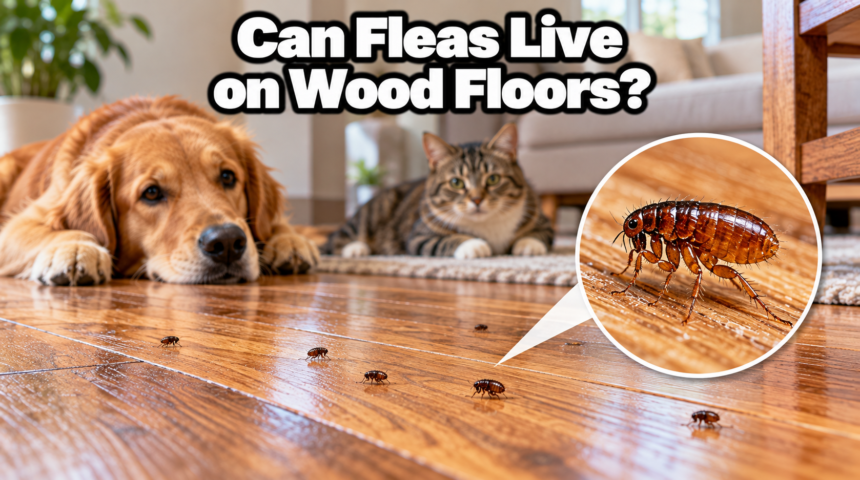
Adult fleas do not want to live on your wood floor. They want to live on a warm-blooded host, your cat, your dog, or in a pinch, you. But the answer most people are really after is darker than that: the eggs, larvae, and cocoons that keep an infestation going can absolutely shelter in the cracks and gaps of a wood floor. So the floor itself is rarely the home, but it can be the nursery.
That difference matters, because it changes how you clean. Below is what actually lives where, how long it lasts, and the floor-by-floor plan to clear it out.
Why fleas do not actually “live” on the wood itself
A flea is built to stay on an animal. Once an adult flea finds a host and takes its first blood meal, it tends to stay put, feeding and breeding on that animal, and a female can start laying eggs within about a day. Bare, open wood gives a flea none of what it wants: no blood, no warmth, no fur to grip.
An adult flea knocked onto a hard floor is in trouble, not at home. With no host to feed on, a newly emerged flea survives only a short time, and one that has already been feeding and then gets stranded usually dies within a few days. So you will rarely find a colony of happy adult fleas sitting on open floorboards. What you find instead is the part of the life cycle you cannot easily see.
This is the single most useful thing to understand about any flea problem. The adults you notice biting your ankles or jumping off the dog are only a small slice of the total population. The vast majority exists as eggs, larvae, and cocoons tucked into the environment around the host. Clear away a few visible adults and the problem looks solved, but the hidden stages are still maturing on their own timetable, ready to replace them. On a wood floor, “the environment” means the dark, sheltered spaces you walk over every day without a second look.
What hides in the cracks: eggs, larvae, and cocoons
Most of any flea problem is not the biting adults. The egg, larva, and pupa stages develop off the host, in the environment, and that environment includes the seams of a wood floor. Here is how each stage ends up there.
Eggs
Flea eggs are laid on the pet, but they are not sticky, so they roll off wherever the animal walks, sleeps, and scratches. On a wood floor they slide straight into the gaps between boards and along the baseboards. A single female lays around 27 eggs a day on average, and up to 40 to 50 at her peak, so the numbers add up fast.
Larvae
Eggs hatch into tiny, worm-like larvae in roughly 1 to 10 days. Larvae hate light, so they burrow away from it, deep into carpet fibers, under furniture, and down into floor cracks where it is dark and still. They feed on organic debris and on the dried blood that adult fleas leave behind, which collects in exactly those same gaps.
That dried blood has a name you may have seen already: flea dirt. It looks like scattered black pepper, and if you wipe it with a damp white cloth it smears reddish-brown. Finding little dark specks in the seams of your floor, or in your pet’s bedding, is a strong sign the larvae have a food source and the life cycle is running under your feet. It is also a handy way to tell real flea activity from ordinary dust.
Cocoons (pupae)
After about 5 to 11 days, a larva spins a sticky cocoon that quickly gets coated in dust and debris, which makes it nearly invisible wedged in a seam. This is the tough stage. A flea can stay dormant inside its cocoon for up to six months, waiting for a sign that a host is near, warmth, a footstep vibration, or the carbon dioxide you breathe out. That is why a flea problem can seem to vanish and then explode weeks later when you walk back into an empty room.
Key point: the floor crack is not where fleas live, it is where they wait. Clear the hidden stages and the adults have nothing to replace them with.
Does the type of floor matter?
Yes, and this is good news if you have hard floors. The type of surface changes how easily fleas can complete their life cycle.
| Floor type | How friendly is it to fleas? | Where they hide |
| Hardwood | Low, unless it is old or humid. Sealed, smooth boards give larvae little debris and no deep cover. | Gaps between planks, baseboards, under rugs |
| Laminate & vinyl | Low. Tight seams and a smooth surface leave few hiding spots. | Expansion gaps at edges, under furniture |
| Tile | Very low. Hard and easy to clean, but grout lines can hold eggs. | Grout, corners, edges |
| Carpet | High. Deep fibers hold humidity, debris, and larvae perfectly. | Throughout the pile, especially pet areas |
The reason comes down to humidity and food. Flea larvae are fragile. They need moisture, and prolonged humidity below about 50 percent dries them out and kills them. A smooth, sealed wood or laminate floor holds very little moisture and very little of the organic dust that larvae eat. Carpet does the opposite, trapping both. Wood floors in damp climates are the exception worth watching, since the cracks in humid-climate hardwood can hold enough moisture to let larvae develop.
Age and condition of the floor matter too. New, tightly fitted, well-sealed boards leave almost nowhere for an egg to settle. Old floors with wide gaps, worn finish, and dust packed into the seams are a different story, because those gaps collect exactly the moisture and debris larvae need. The same goes for the edges of laminate and vinyl, where the expansion gap meets the wall, and for the grout lines in a tiled room. If you have hard floors but still keep finding fleas, those seams and edges are the first place to look.
How long can fleas survive on a bare wood floor?
It depends entirely on the stage.
- Adults: A newly emerged adult with no host can last 1 to 2 weeks in ideal conditions, but on a dry floor at normal room humidity it is often just a few days. One that was already feeding on a pet usually dies within 2 to 4 days once stranded.
- Eggs: These hatch in 1 to 10 days if conditions are warm and humid. In a dry room, many simply dry out before they ever hatch.
- Larvae: They live about 5 to 11 days, but only if there is enough humidity and debris. On a clean, dry wood floor, many do not make it.
- Cocoons: This is the long one. A pupa can sit protected in its cocoon for up to six months, which is why patience and repeat cleaning beat a single blitz.
Add it up and the pattern is clear. On open wood, the free-living stages struggle. In the sheltered cracks, they can hold on for months. Your cleaning needs to reach the cracks.
How to get rid of fleas on wood floors
The goal is simple: remove the hidden stages faster than they can mature, and keep going long enough to outlast the cocoons. Here is the order that works.
Step 1: Treat your pet first
This is non-negotiable. The floor is a symptom; the pet is the source. Use a vet-recommended flea treatment, and keep it up. If you clean the floor but skip the pet, fleas keep raining fresh eggs back down. Match the product to your pet’s species and weight, and for safe use, the EPA’s advice on flea and tick products is a good guide.
Step 2: Vacuum, daily, and get into the gaps
Vacuuming is your most powerful tool. It lifts eggs and larvae out of the cracks and the vibration can even coax adults out of their cocoons so your treatment can reach them. Use the crevice tool along every seam and baseboard, under furniture, and under rugs. Empty the canister or seal and bin the bag outside right after, so nothing crawls back out.
Step 3: Sprinkle salt or baking soda into the cracks
For stubborn gaps, work fine salt or baking soda into the seams with a soft broom, leave it overnight, then vacuum thoroughly. It dries out eggs and larvae in the places a vacuum nozzle cannot fully reach. Keep it off unsealed wood and wipe up any residue so it does not scratch the finish.
Step 4: Steam or damp-mop the surface
Heat kills fleas at every stage. If your floor finish allows it, a steam pass over the boards is very effective. If steam is not safe for your floor, a well wrung damp mop with a mild cleaner still removes surface eggs and debris. Never soak a wood floor; water in the seams can warp the boards.
Step 5: Wash all the soft stuff nearby
Pet beds, throw rugs, cushion covers, and any washable fabric in the room go in the hot wash, above 60 C where the care label allows. These soft items, not the wood, are usually the real reservoir in a room with hard floors.
Step 6: Repeat for at least two to three weeks
One cleaning will not do it, because cocoons keep hatching on their own schedule. Vacuum every day or two and repeat the deeper steps weekly until you have gone two to three weeks with no new fleas. That is how you outlast the dormant stage.
How to keep them from coming back
Once the room is clear, a few habits keep it that way. Keep your pet on year-round flea prevention, since one untreated animal restarts the whole cycle. Vacuum the floor and the cracks once a week as normal upkeep, and wash pet bedding often. Keeping indoor humidity low helps too, because the drier your home, the harder it is for any stray larvae to survive. Fleas are worth staying on top of for health reasons, not just comfort, and the CDC’s page on fleas explains why. For a serious or repeat infestation that will not clear on its own, a licensed pest-control service can treat the whole home directly.
Conclusion
So can fleas live on wood floors? Not really as adults, but the eggs, larvae, and cocoons that fuel an infestation can hide and wait in the cracks for months, especially in a humid home. Wood, laminate, and tile are far less flea-friendly than carpet because they hold less moisture and debris. Treat your pet, vacuum deep into every seam, add salt or steam for the gaps, and keep it up for two to three weeks. Do that and the floor has nothing left to shelter.
Frequently asked questions
Can fleas lay eggs on hardwood floors?
Not directly in a useful way for them, but eggs laid on your pet fall off onto the floor and slide into the cracks between boards. Those gaps are where eggs, and later larvae, actually settle and develop.
Do fleas prefer carpet or hardwood?
Carpet, by a wide margin. Deep fibers trap the humidity, warmth, and debris that larvae need. Hardwood and other hard floors are much harder for fleas to breed in, which is why they are easier to clear.
Will mopping get rid of fleas on wood floors?
Mopping helps remove surface eggs and debris, but it will not reach the cracks or kill cocoons. Pair a damp or steam mop with daily vacuuming of the seams, and always treat your pet as well.
How long do fleas live on floors without a pet?
Adults usually last only a few days to two weeks without a host. Eggs and larvae survive days in the right conditions, but cocooned pupae can lie dormant for up to six months waiting for a host.
Does steam cleaning kill fleas on wood floors?
Yes. The high heat kills fleas at every stage, including eggs and larvae in the gaps. Only steam floors whose finish can handle it, and avoid leaving moisture sitting in the seams.
Related Articles
How Do You Install Joist Hangers? A Simple Step-by-Step Guide
What Is a Three-Quarter Bathroom? A Complete Guide
How to Cut Ceiling Tiles: A Step-by-Step Guide for Mineral Fiber and Fiberglass Panels