

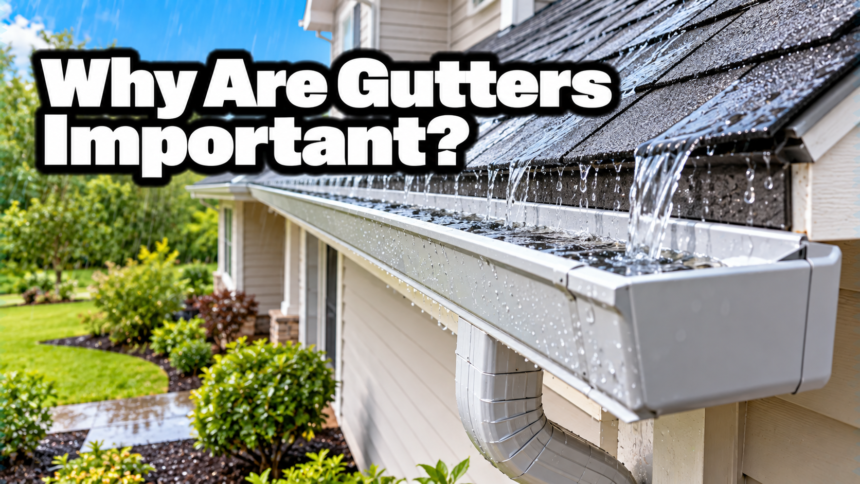
Gutters are important because they take the water off your roof and move it away from your house, and that one job protects the parts of your home that cost the most to fix. A roof sheds a surprising amount of water in a single storm. Without gutters, all of it drops straight down along your walls and collects against the foundation. With gutters, it runs into a downspout and lands a safe distance away. That is the whole point, and it is why nearly every house has them.
Here is what gutters protect, what it costs when they fail, and the few cases where a home can get by without them.
How much water does a roof really shed?
More than most people picture. One inch of rain falling on a 1,000 square foot roof produces about 620 gallons of water, going by the University of Arizona’s rainwater figures. A normal storm can drop an inch or two, so a single roof can shed well over a thousand gallons in a few hours.
All of that water has to go somewhere. On a bigger house, the numbers grow fast: a 2,000 square foot roof in a two-inch storm sheds close to 2,500 gallons. Take the gutters away and that same water sheets off the eaves and hits the ground in a narrow line right next to your walls, again and again, every time it rains. Concentrating that much water in one thin strip of soil is exactly what causes the damage below.
How a gutter system works?
A gutter system is simple, which is part of why it is so effective. The gutter is the open channel that runs along your roof edge and catches water as it comes off the shingles. It is hung at a slight slope, about a quarter inch of drop for every ten feet, so water always runs toward an outlet instead of standing still. That outlet feeds a downspout, the vertical pipe that carries water down the side of the house.
At the bottom, an elbow and a splash block or extension pipe push the water out and away from the wall. Most gutters are aluminum, which resists rust and is light and affordable, though vinyl, steel, and copper are all used too. The parts matter less than the path: roof, gutter, downspout, and out to a spot where the water can soak away safely.
How gutters protect your foundation?
This is the big one. Water that collects against your foundation soaks the soil, and wet soil pushes on the concrete. That force, called hydrostatic pressure (the pressure water puts on a surface it rests against), can crack foundation walls, make them bow inward, or push moisture through tiny gaps. In clay-heavy soil the problem is worse, because clay swells when it gets wet and shrinks when it dries. That constant movement shifts the foundation and opens cracks over the years.
The early signs are easy to miss. Hairline cracks in the basement wall, doors and windows that start to stick, or a floor that feels slightly off level can all trace back to soil that keeps getting soaked next to the house. By the time these show up, the fix is usually a big one.
Foundation repair runs about $5,200 on average, and most jobs land between roughly $2,200 and $8,100, based on recent HomeAdvisor cost data. A set of gutters costs a small fraction of that. Keeping the soil around the house dry is the single best thing gutters do for you.
Keeping your basement and crawl space dry
Wet soil around the foundation is also how water gets into a basement. When the ground next to your walls stays soaked, moisture seeps through cracks and porous concrete, which shows up as damp floors, puddles after a storm, and a musty smell that never fully clears. A crawl space does the same thing out of sight, trapping humidity under the house where it can warp floors and rot framing.
Drying a basement back out is expensive. Basement waterproofing averages around $5,200 and often climbs well into the thousands. If the basement is finished, the bill grows again, since flooring, drywall, and anything stored down there can be ruined by a single wet season. Gutters plus a downspout that carries water several feet from the wall keep the soil drier in the first place, which is far cheaper than sealing a basement after the water is already getting in.
Saving your siding, fascia, and roofline
Without gutters, water pours off the roof edge and runs straight down the face of the house. Siding stays wet long after the rain stops, paint blisters and peels, and wood trim begins to rot. The fascia, the flat board your gutters attach to along the roofline, sits right where the water comes off, so it is one of the first things to go soft. The soffit, the panel tucked under the overhang, can rot too once water works its way in.
Falling water also splashes dirt and mud up onto the lower walls, leaving stains that are hard to scrub off brick, stucco, and siding. A gutter over a doorway does double duty here, since it stops the sheet of water that would otherwise fall right where you walk in and out. Gutters catch the runoff at the edge, so it never touches the wall at all, and that keeps paint and trim looking new for years longer.
Protecting your yard, soil, and walkways
Roof runoff hits the ground with real force. Without gutters it carves channels through flower beds, washes away mulch and topsoil, and drowns any plants set close to the house. Over time it can wear away the soil that supports your patio, driveway, or front walk, which then cracks or settles unevenly.
It also throws muddy water and stains across concrete and pavers near the house. Left alone, that runoff can undercut the edge of a driveway or slab until it cracks and settles, which is its own repair bill. Gutters gather the water and let it out at set points, so you decide where it goes instead of the storm deciding for you. That control is what keeps a graded, planted yard from slowly washing toward the foundation.
Cutting down on mold, mildew, and pests
Standing water and damp wood invite problems you do not want. Moisture held against the house feeds mold and mildew on walls, in the basement, and under the eaves, which is both a repair issue and a health one. Damp, softened wood draws pests, since termites and carpenter ants go for wood that has already started to rot. Pooled water near the foundation also gives mosquitoes a place to breed close to your doors and windows.
Moving water away quickly takes away the damp conditions all of these need. Dry wood and dry soil are simply far less inviting. It is a quiet benefit, since you never see the infestation or the mold that did not happen, but it is one of the reasons a dry perimeter keeps a house healthy over the long run.
What about winter?
Gutters keep working in cold weather, and the water they handle can do extra damage when it freezes. Water that pools in a foundation crack expands as it turns to ice, and that pressure widens the crack a little more with each freeze and thaw. Runoff that would normally drain away can instead freeze into sheets near the foundation and along walkways.
There is a catch worth knowing. When gutters are packed with leaves and ice, melting snow has nowhere to go and can back up under the roof shingles, a problem called an ice dam. The fix is the same as the rest of the year: keep the gutters clear so water can move through them and out, rather than sitting, freezing, and forcing its way into the house.
What clogged or missing gutters can cost you?
The value of a gutter is easiest to see next to the repair bills it helps you avoid. Here are two of the most common water-damage jobs and what they typically run.
| Water problem | Typical range | Average |
| Foundation repair | $2,200 to $8,100 | about $5,200 |
| Basement waterproofing | $2,500 to $8,200 | about $5,200 |
A gutter system costs a small share of any one of these. That is why gutters are best thought of as cheap, ongoing insurance rather than an optional add-on.
Rule of thumb: point every downspout so water lands at least 4 to 6 feet from the foundation. A short splash block or extension pipe does the job.
Does every house need gutters?
Most do, but not all. A few homes can skip them, or use fewer of them, without much risk:
- Very dry, arid climates such as parts of Arizona, Nevada, and inland California, where heavy rain is rare.
- Wide roof overhangs, roughly 10 inches or more, that already throw water clear of the walls.
- Fast-draining sandy or gravelly soil, or a lot that slopes away from the house, so water never sits against the foundation.
- Homes with another drainage system already in place, like a French drain or a graded swale that carries runoff away.
You do not have to go all or nothing, either. Some homes run gutters only on the sides that face the worst weather or over doorways and low spots, and leave the rest bare. That said, if you get regular rain, have clay soil, or your foundation sits close to ground level, full gutters are worth having. When in doubt, the safe assumption is that your home needs them, because the cost of being wrong sits in that repair table above.
Gutters only work when they are clear
A gutter full of leaves does none of this. When gutters clog, water backs up, spills over the edge, and falls against the house exactly as if there were no gutters at all. Worse, water trapped in a blocked gutter sits against the fascia and can seep under the edge of the roof.
Cleaning them out once or twice a year, and more often if you have trees overhead, keeps them working. Gutter guards can cut down on how often you climb the ladder. The idea is simple: gutters protect your home only while water can flow through them freely, so a little upkeep is what keeps all these benefits real.
Conclusion
Gutters matter because they control where a roof’s water goes, and that protects the most expensive parts of your home. They keep water off your foundation and out of your basement, save your siding and trim from rot, stop your yard from washing away, and cut down on mold and pests. Keep them clear and aimed a few feet from the house, and they quietly prevent repairs that can run into the thousands. For most homes, they are worth every dollar.
Frequently asked questions
What happens to a house without gutters?
Roof water drops straight along the walls and collects at the foundation. Over time that can crack the foundation, leak into the basement, rot siding and trim, erode the yard, and feed mold and pests.
Do gutters really protect the foundation?
Yes. They carry roof water away before it soaks the soil against your foundation. Drier soil puts less pressure on the concrete, which lowers the risk of cracks, bowing, and leaks that cost thousands to repair.
How far should gutter water drain from the house?
Aim for at least 4 to 6 feet from the foundation. Use downspout extensions or splash blocks so the water lands well clear of the walls instead of running back toward them.
Can a house ever be fine without gutters?
Sometimes. Homes in very dry climates, with wide roof overhangs, fast-draining sandy soil, or ground that slopes away from the house may not need them. Most homes in rainy areas with clay soil still do.
How often should gutters be cleaned?
Once or twice a year for most homes, and more often with trees nearby. Clogged gutters overflow and pool against the house, which cancels out the protection they are meant to give.
Related Articles
How to Caulk Baseboards: A Simple Step-by-Step Guide
How to Use Mirrors in Interior Design