
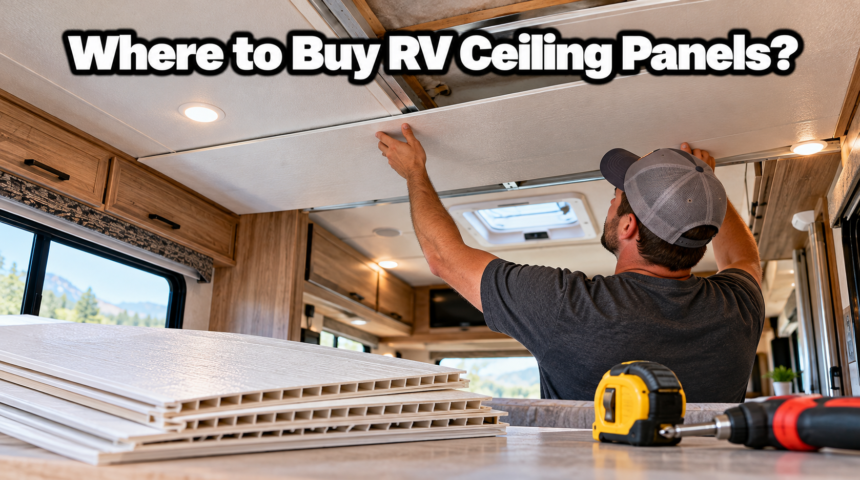
You can buy RV ceiling panels from five main places: RV specialty retailers like RecPro, big-box building supply stores such as Home Depot and Lowe’s, Amazon, your RV dealer’s parts counter, and RV salvage yards. The right place depends on the material you need. A soft vinyl headliner comes from an RV supplier, while a sheet of luan or FRP sits in the lumber aisle at a home center.
Below is where each type of panel comes from, what it costs, how it installs, and how to order the right amount the first time. The order you shop in matters too: figure out your material before you open a single store page, because the same job sends you to very different places depending on what is over your head right now.
What are RV ceiling panels made of?
RV ceiling panels are usually one of a few lightweight materials: thin plywood (often luan), a padded vinyl headliner, fiberglass reinforced panel (FRP), PVC or plastic ceiling tiles, or a fabric-covered foam board. Weight matters in an RV, so almost everything up top is thin and light rather than heavy like a house ceiling.
Knowing your material is step one, because it decides where you shop. Pull a vent trim ring or a light fixture and look at the edge of the existing panel. If it is a smooth printed surface over thin wood, that is laminated luan. If it is soft and padded, that is a vinyl headliner glued to foam.
Each material trades off weight, cost, and how it handles water. Luan is cheap and takes paint well, but it swells and stains if it gets wet. A vinyl headliner looks finished straight away and hides small dents, though it can sag over the years as old glue lets go. FRP is the toughest around moisture and wipes clean, but it is heavier and costs more. PVC tiles are light and waterproof, yet they feel more decorative than structural. Pick the one that fits your climate and how hard your rig gets used.
Quick check: press on the ceiling. A firm panel is wood or FRP. A soft, slightly spongy surface is a padded vinyl headliner, which is bought and installed differently.
Where to buy RV ceiling panels (the 5 main places)
Here are the five sources, from the most RV-specific to the most general, with what each one is best for.
1. RV specialty retailers (best for headliner and exact-match parts)
Online RV parts stores carry materials made for the job, which big-box stores do not. RecPro sells a soft-touch padded vinyl headliner that is 50 inches wide and 3/8 inch thick, in rolls of 5, 10, 15, or 20 feet, and the kit ships with the spray adhesive you need. This is the closest thing to a drop-in replacement for a sagging factory ceiling.
2. Building supply centers (best for wood and FRP sheets)
Home Depot, Lowe’s, and local lumber yards stock luan plywood, FRP sheets, and PVC panels by the 4×8 sheet. This is the cheapest route if your ceiling is rigid board and you are comfortable cutting sheets to fit. Call ahead, since luan is not always on the floor.
3. Amazon (best for tiles, fabric, and small patches)
Amazon is handy for PVC ceiling tiles, marine vinyl by the yard, foam-backed headliner fabric, and adhesives. Shipping a full 4×8 rigid sheet is awkward and often not offered, so Amazon works best for rolled or tile materials and for a small repair rather than a whole roof.
4. Your RV dealer’s parts counter (best for an exact factory match)
If you want the same panel the factory used, the parts counter at an RV dealer can order it by your rig’s make, model, and year. This is the priciest option and can take a week or two, but it is the way to get a printed pattern or a curved panel that matches the rest of the coach.
5. RV salvage yards (best for odd sizes and discontinued parts)
Salvage yards pull panels from wrecked or retired RVs and sell them cheap. For an older or discontinued model, this is sometimes the only place to find a panel that fits a strange opening. Many take phone orders and ship, so you are not limited to yards near you. Have your model and year ready, and ask for a photo of the exact piece before you pay, since used panels can carry their own stains or cracks.
Which material should you buy?
Match the material to how your ceiling is built and how much damage it has. The table below pairs each common panel with the best place to buy it and what it suits.
| Material | Best for | Where to buy |
| Padded vinyl headliner | Sagging or torn factory ceiling; a soft, finished look | RV specialty retailer (RecPro) |
| Luan plywood | A rigid, paintable base on a budget | Building supply center |
| FRP panel | Wet areas; a wipe-clean, mold-resistant surface | Building supply center |
| PVC / plastic tiles | A light, waterproof decorative finish | Amazon, home centers |
| Fabric over foam board | Matching a padded original panel | Amazon, RV dealer |
| Exact factory panel | A perfect color and shape match | RV dealer, salvage yard |
If your old ceiling is soft and padded, a vinyl headliner is the simplest swap. If it is a firm board that has water stains or is delaminating, a luan or FRP sheet from a home center is cheaper and sturdier. FRP is the pick for a bathroom ceiling or any spot that gets damp, because it shrugs off water.
How much do RV ceiling panels cost?
Cost depends almost entirely on the material and the size of the area. Here is a realistic range for each common option so you can budget before you shop.
- Padded vinyl headliner: around $115 for a 50-inch-wide kit with adhesive from an RV retailer, with price rising for longer rolls.
- Luan plywood: roughly $20 to $40 per 4×8 sheet at a building supply store.
- FRP sheet: about $35 to $60 per 4×8 sheet, plus trim and adhesive.
- PVC ceiling tiles: commonly sold in multi-packs; budget by the square foot you need to cover.
- Factory-match panel from a dealer: the most expensive route, since you pay for the exact part plus shipping or special order.
For a small patch under a vent or light, you may spend under $50. For a full travel-trailer ceiling, plan on more once you add adhesive, trim pieces, and a few extra feet of material for mistakes. The hidden costs are the extras: a quality spray adhesive, new trim strips where panels meet the walls, and replacement butyl tape if you pull a vent or fixture. Build those into your budget so the project does not stall halfway through for one more trip to the store.
Buying in person at a home center saves shipping, which is a real factor on rigid 4×8 sheets that are expensive to send. Rolled vinyl and tiles ship fine, so for those the convenience of ordering online usually wins.
How each panel goes up
Your material also decides the install, and that can change what you buy. Here is the short version for each type so there are no surprises.
- Vinyl headliner: roll it out, spray adhesive on both the panel and the ceiling, let it tack up, then smooth it on from the center outward to push out bubbles.
- Luan or FRP sheets: cut each sheet to fit, dry-fit it first, then glue and screw or use trim to hold the edges. Cutouts for vents and lights are marked and cut before the panel goes up.
- PVC tiles: most are peel-and-stick or glue-up over a flat, clean surface, and they trim with a utility knife.
If the surface behind the old panel is damaged or wet, fix that first. A new ceiling glued over soft, water-stained decking will not hold, and the stain can bleed through a light-colored finish.
How to measure and order the right amount
Measure the whole ceiling, not just the damaged spot, then add a margin. Follow these steps so you order once.
- Measure the length and width of the ceiling area you plan to cover, in inches.
- Add about 6 inches to each dimension so you have material to trim at the edges.
- For a vinyl headliner sold in rolls, divide your length by the roll width (usually 50 inches) to see how many rolls or feet you need.
- For rigid sheets, work out how many 4×8 panels cover the area, rounding up.
- Buy one extra sheet or a few extra feet. A cutting mistake on the last piece is common, and dye lots on vinyl can differ between orders.
Tip: snap a photo of the back of your old panel before you remove it. Any factory part number there helps a dealer or salvage yard find the exact match.
What to check before you buy
A few checks save you from a panel that fits but fails. Confirm these before you pay.
- Width: make sure a rolled headliner is wide enough to cross your ceiling with as few seams as possible.
- Weight: keep it light. A heavy house-grade panel strains the roof structure and your installation adhesive.
- Moisture resistance: choose FRP or PVC for any area near a roof leak, a bathroom, or a kitchen.
- Adhesive: check whether glue is included. The right spray adhesive matters as much as the panel itself.
- Return policy: for a special-order or salvage part, confirm you can return it if it does not fit.
If you are leaning toward a finished, soft ceiling, the padded vinyl option on the RecPro RV headliner page shows the widths and roll lengths side by side, which makes the measuring math easy.
Conclusion
Buy RV ceiling panels from the source that matches your material: an RV specialty store for padded vinyl headliner, a building supply center for luan or FRP sheets, Amazon for tiles and small patches, a dealer for an exact factory match, and a salvage yard for odd or discontinued sizes. Identify your current panel first, measure the full ceiling with a few inches to spare, and order a little extra. Do that, and the panel fits the first time with no second trip.
Frequently asked questions
Can I buy RV ceiling panels at Home Depot or Lowe’s?
Yes, for rigid materials. Both carry luan plywood, FRP sheets, and PVC panels in the building supply aisle. They do not sell padded RV vinyl headliner, which you get from an RV specialty retailer instead.
What is the easiest RV ceiling panel to install yourself?
A padded vinyl headliner is usually easiest. It comes in a wide roll, goes up with spray adhesive, and hides small flaws in the surface underneath. Rigid sheets need accurate cutting to fit.
How do I know what my RV ceiling is made of?
Remove a vent ring or light fixture and look at the panel edge. A smooth printed surface over thin wood is laminated luan. A soft, padded surface is a vinyl headliner glued to foam.
Do I need a factory panel, or will a generic one work?
A generic sheet or headliner works for most repairs and costs less. Order a factory panel from a dealer only when you need an exact color, a printed pattern, or a curved shape to match the rest of the coach.
How much material should I buy for a full ceiling?
Measure the ceiling, add about 6 inches to each side, and buy one extra sheet or a few extra feet. Mistakes on the final cut are common, and vinyl colors can vary between separate orders.
Related Articles
How to Sharpen Japanese Kitchen Knives: A Complete Beginner’s Guide
What Is a Three-Quarter Bathroom? A Complete Guide
Do Gutter Guards Cause Ice Dams? The Truth Homeowners Need to Know