

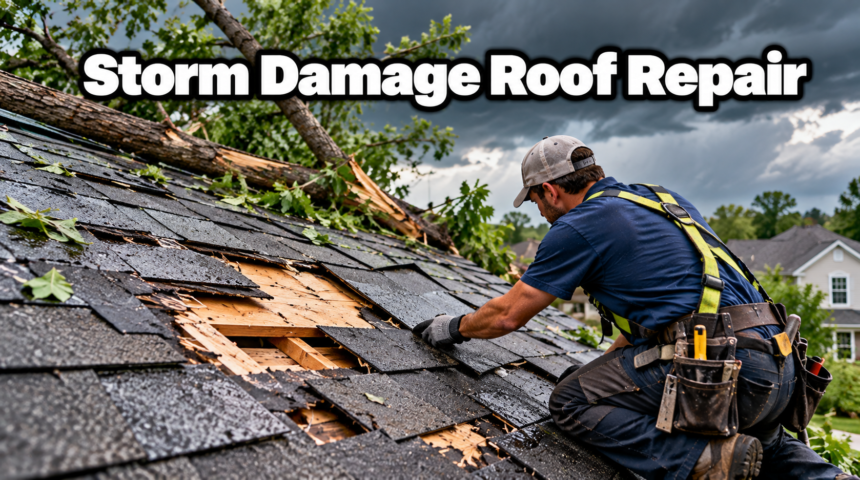
Storm damage roof repair is the work of finding and fixing what a storm does to your roof, from shingles that lift or tear off in high wind to the dents and cracked seals that hail leaves behind. The goal is simple. Stop water from getting in, and keep a small problem from spreading. The timing matters more than anything. A loose shingle costs little to replace today, but the leak it causes can soak your attic, ceilings, and walls within weeks.
This guide covers what storm damage looks like, how to check for it safely, what the repair involves, what it tends to cost, and how to handle an insurance claim so you are not left paying for all of it yourself.
What counts as storm damage to a roof?
Storm damage is any harm a weather event does to your roof’s ability to shed water. Four forces cause most of it.
Wind lifts and peels. Strong gusts get under the edges of shingles, break the seal that holds them down, and can tear them off completely. This is the catch with wind. Shingles that still look fine from the ground may have lost their seal, which leaves them free to flap and let rain underneath the next time it blows.
Hail bruises and cracks. Hailstones knock the protective granules off asphalt shingles and leave soft, dented spots where the mat underneath is weakened. Quarter-size hail, about one inch across, is the point where damage usually turns serious, and golf-ball hail at around 1.75 inches can crack shingles outright. You can see how hail is sized and how it forms at NOAA’s hail basics.
Debris hits and punctures. Falling branches, blown roofing from a neighbor, and anything the wind picks up can gouge the surface, knock loose shingles, or crack the wood deck below.
Water finds the gaps. Heavy rain alone does not usually hurt a sound roof. But once wind or hail opens a path, driven rain pushes through it, and on a flat or low-slope roof, water that pools instead of draining works into every weak seam it can reach.
How do you spot storm damage on your roof?
Start from the ground, then check inside, and only go higher if it is safe. Most damage can be caught without ever climbing up.
From the ground, walk the whole house and look up at each slope. Watch for shingles that are missing, curled, cracked, or lying in the yard. Look for bare patches where the color looks darker or shinier than the rest, which means the granules are gone. Check the gutters and downspouts for a buildup of granules that look like coarse black sand, a common sign of hail. Scan the metal flashing around chimneys and vents for dents or lifted edges, and look for dents in the gutters and on soft metal like vent caps, since those show the hail was big enough to matter.
Hail and wind rarely hit every slope the same way. Note which direction the storm came from, because the slopes that faced it usually take the worst of it, and that is where you and the roofer should look hardest. Doors, screens, window frames, and the air conditioner’s metal fins show damage too, so dents there are a good clue about how hard your roof was hit.
Inside, take a flashlight up to the attic, ideally after the next rain. Look for damp or matted insulation, dark water stains on the underside of the roof deck, and any pinpoints of daylight coming through. Then check your ceilings and the tops of walls for fresh brown rings or bubbling paint, which mean water is already getting in.
Stay off the roof. A wet or storm-hit roof is slippery and may be weak underfoot. A licensed roofer will inspect it for you, often at no charge, and most insurers want a professional report anyway.
If you do use a ladder, keep both feet on the rungs and only look at the edge. Leave the walking around up top to a pro with the right footing and harness.
What should you do first after a storm?
Your first job is safety and stopping more water from getting in, not fixing the roof itself. Work through these steps in order.
- Check for danger. Stay clear of downed power lines, sagging ceilings, and standing water near outlets. If the structure feels unsafe, leave and call for help.
- Document everything. Take clear photos and video of the roof, the attic, and any damage inside before you touch or move anything. Write down the date of the storm.
- Stop the water. Move furniture out of the way, put down buckets, and if it can be done safely, have a tarp secured over the opening. A temporary cover now protects both your home and your claim.
- Call your insurer. Report the damage promptly and ask how they want you to proceed. Keep every receipt for tarps, emergency repairs, and anything you buy to limit the damage.
- Get a professional inspection. A licensed roofer can tell you how bad it really is and give you a written estimate you can hand straight to your insurer.
Keep temporary repairs temporary. A tarp or a quick patch is meant to hold until the real repair happens. It is not a substitute for fixing the roof properly.
How does roof storm damage get repaired?
Repair starts with a full inspection, then matches the method to the damage. A roofer checks the shingles, the flashing, the seals, the vents, and the deck underneath, because the worst harm is often the part you cannot see from the ground.
For wind damage, the crew replaces missing and torn shingles and re-seals any that lifted. They pay close attention to the ridges and the edges of the roof, where wind does the most work and where new leaks tend to start.
For hail damage, they replace shingles that are cracked, bruised, or stripped of granules. A few dented shingles can be swapped out on their own. Bruising spread across the whole roof usually points to redoing the field of shingles rather than chasing one spot at a time.
For flashing and seals, they fit new flashing around chimneys, skylights, and vents, and reseal the joints where most leaks begin. When the waterproof layer under the shingles is torn, that underlayment gets replaced too, not just the shingles on top.
For the deck, if branches or long-standing water have cracked or rotted the wood under the shingles, that section is cut out and replaced before any new shingles go on. Laying shingles over a soft deck only buries the problem for a season or two.
Matching new shingles to old ones is part of the job and not always possible. On an older roof the colors may no longer line up, which is one reason a badly hit roof sometimes makes more sense to replace than to patch.
Should you repair or replace the roof?
Repair when the damage is limited and the roof still has good years left. A dozen missing shingles, a patch of hail dents on one slope, or damaged flashing are all normal repairs. If the roof is under about 15 years old and the harm sits in one area, fixing it is the cheaper and sensible choice.
Replace when the damage is widespread or the roof was already near the end. The signs that point to replacement include hail bruising on every slope, large sections of missing shingles, a roofline that sags, or a roof already past 20 years. Most asphalt roofs last about 20 to 25 years, so a storm that hits an old roof hard is often the push to replace it. Your insurer’s inspection and your roofer’s report, read together, usually make the answer clear.
What does storm damage roof repair cost?
Most storm repairs land between $500 and $1,500, though the range is wide because it depends on the damage and the roof. Small fixes, like sealing a leak and swapping a few shingles, can run as little as $150. Major work that reaches the deck or rafters can climb to $3,000 or more, and a full replacement goes well beyond that.
Roofers often price by the square, which is a 10 by 10 foot area, or 100 square feet of roof. Here is a rough guide to what different jobs run.
| Type of repair | What it covers | Typical cost |
| Minor | A leak plus a few replacement shingles | $150 to $400 |
| Moderate | Shingles and flashing across a section | $400 to $1,000 |
| Major | Deck repair, large areas, structural work | $1,500 to $3,000+ |
| Shingle work | Per square (100 sq ft), installed | $100 to $500 |
Labor usually adds about $70 to $100 an hour on top of materials. A few things push the price up. A steep or tall roof is slower and riskier to work on, hard-to-match shingles cost more, and demand spikes right after a big storm, when every roofer in town is booked solid. If insurance covers the work, your real out-of-pocket cost is usually just your deductible, which changes the math a lot.
The roofing material matters too. Asphalt shingles are the cheapest to fix, which is why most of the ranges above assume them. Metal, wood shake, tile, and slate all cost more to repair, partly for the material and partly because fewer crews know how to work on them. Tile and slate also break under foot traffic, so even the inspection takes more care.
Does insurance cover storm damage, and how do you claim?
Most standard homeowners policies cover sudden storm damage from wind and hail. That is good news, since the repair is often more than people expect. What you get back depends on your policy and your deductible.
Two terms decide your payout. Replacement cost value (RCV) pays what it costs to replace the damaged roof at today’s prices. Actual cash value (ACV) pays that amount minus depreciation for the roof’s age, so an older roof returns less. Check which one your policy uses before you file, because the gap between them can be thousands of dollars on an old roof.
To file a claim, work through these steps.
- Report the damage to your insurer as soon as you safely can. Many policies expect prompt notice.
- Share your photos, your video, and the roofer’s written estimate.
- Meet the insurance adjuster at the inspection, and have your roofer there too if you can arrange it.
- Review the settlement against your roofer’s estimate, and ask questions if the numbers do not match.
- Keep every receipt and all of your paperwork together in one place.
Do not wait too long to file. Policies set deadlines for storm claims, and an old claim with little proof is easy to deny. For a plain-language walkthrough of how a claim is handled, the Insurance Information Institute is a good place to start. Report real damage promptly, but do not let anyone pressure you into filing for damage that is not actually there.
How long does storm damage roof repair take?
The repair work itself is usually quick. A small fix, like replacing a patch of shingles and resealing some flashing, often takes a few hours to a day. A larger repair that reaches the deck can run a day or two, and a full replacement on an average home is commonly two to three days once the crew starts.
The waiting is the slow part. After a widespread storm, good roofers get booked for weeks, and an insurance claim adds time for the adjuster’s visit and the settlement. This is exactly why a temporary tarp matters. It buys you a dry house while you wait for the real repair to come up in the queue, so the delay does not turn into water damage inside.
How do you choose a roofer after a storm?
Pick a local, licensed, insured roofer with a track record you can check. After a big storm, out-of-town crews often knock on doors promising fast work and a free roof. Be careful with anyone who pushes you to sign on the spot, asks for a large payment up front, or offers to handle your entire insurance claim for you.
Get the estimate in writing, confirm the license and insurance are current, and ask for a few local references you can call. A fair roofer is happy to wait while you check them out.
Conclusion
Storm damage roof repair comes down to acting fast and getting it right. Check your roof after any strong wind or hail, document what you find, cover any opening to stop water, and call both a licensed roofer and your insurer. Catch the damage early and the repair is often a few hundred dollars and a quick visit. Let it sit and a hidden leak can cost far more. A good result is a dry, sound roof and a claim settled fairly.
Frequently asked questions
How long do I have to file a storm damage roof claim?
Most policies set a deadline, often one year from the date of the storm, but it varies by insurer and state. File as soon as you can. The longer you wait, the harder it is to prove the storm caused the damage.
Can I repair storm damage myself?
You can place a temporary tarp if you can do it safely, but leave the real repair to a pro. Roof work is dangerous, and a do-it-yourself fix can void your warranty or weaken your insurance claim.
Will filing one claim raise my insurance rate?
It can, though a single weather claim usually affects your rate less than an at-fault one. Weigh the repair cost against your deductible. If the fix is close to or below the deductible, paying out of pocket may be the smarter move.
How do I know if hail actually damaged my roof?
Look for dented or bruised shingles, bare spots where the granules are gone, and a pile of granules in your gutters. Dents on soft metal like vent caps and gutters are a clear sign the hail was big enough to matter.
How fast should I get storm damage repaired?
As soon as you can. Even small openings let water in, and one day of heavy rain can turn a cheap shingle fix into attic and ceiling repairs. Cover the area right away and schedule the full repair quickly.
Related Articles
How to Regrout Tile Floor: A Complete Step-by-Step Guide
Best Primer for Painting Kitchen Cabinets – Complete Easy Guide for Smooth & Durable Cabinets