

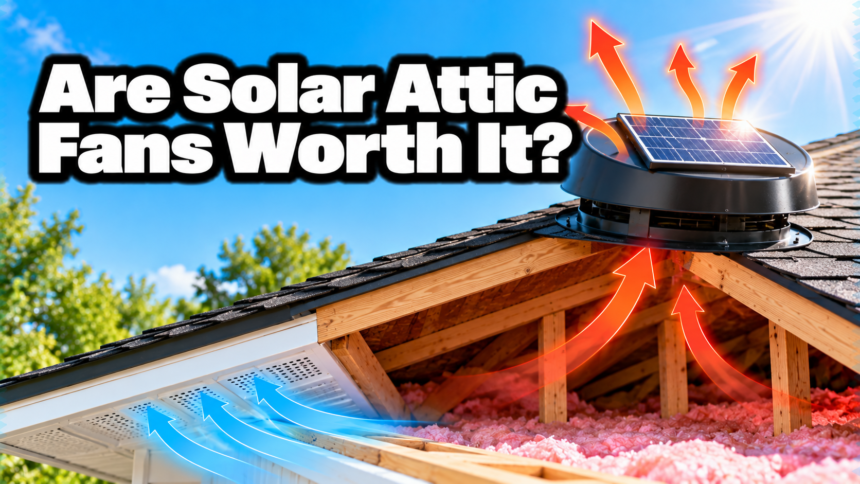
Solar attic fans are worth it for some homes and a waste of money for others. They pay off best in hot, sunny places when your attic floor is already sealed and you have enough vent openings under the eaves to feed them. In a mild climate, or when air leaks up from the rooms below, your money does more good somewhere else.
Here is the full picture so you can tell which group your house is in: what one costs, what it really does to your attic, how much it trims off your power bill, and one recent change to the tax credit that most price quotes still get wrong.
What a solar attic fan actually does?
A solar attic fan is a small exhaust fan that sits on your roof or gable end and runs on its own solar panel. It pulls hot air out of the attic and pushes it outside, while cooler outside air gets drawn in through the soffit vents under your eaves. There is no wiring to your panel and no power meter ticking. When the sun shines, it runs.
The reason this matters is heat. On a hot afternoon a roof surface can hit 150 degrees, and the attic under it can climb past 130. That heat soaks into your ceilings and makes your air conditioner work harder to hold the rooms below at a comfortable temperature. Moving the hot air out drops the attic temperature and takes some of that load off your AC.
A working fan can pull the attic down by more than 20 degrees on a hot day. Panels usually run from about 16 watts on a small unit that moves around 800 cubic feet of air a minute (CFM), up to 35 watts or more on larger models that move 1,500 CFM and beyond.
The benefit is not only summer cooling. In winter, warm damp air from the house drifts up into the attic and settles on cold surfaces, which over time feeds mold and rots the wood. Steady airflow carries that moisture out before it causes trouble, so the fan earns part of its keep in the cold months too.
How much does a solar attic fan cost?
Expect to pay about $500 to $1,500 installed for one fan. The fan itself runs roughly $200 to $500, and installation adds another $150 to $700, depending on your roof pitch, height, and how easy the attic is to reach.
Bigger attics need more air moved, and sometimes more than one fan. A simple way to size it is to allow about 0.7 CFM for every square foot of attic floor on a normal roof, 0.84 on a steep one, and add 15 percent if your roof is a dark color. So a 2,000 square foot attic needs roughly 1,400 CFM, which is often one large fan or two smaller ones.
| Attic size | Airflow needed | Fans (typical) |
| 1,000 sq ft | about 700 CFM | 1 fan |
| 1,500 sq ft | about 1,050 CFM | 1 fan |
| 2,000 sq ft | about 1,400 CFM | 1 to 2 fans |
| 2,500 sq ft | about 1,750 CFM | 2 fans |
One more number that decides whether the fan even works: intake. A fan can only push out as much air as it can pull in. Divide the fan’s CFM by 300 to get the square feet of soffit or gable vent you need. A 1,200 CFM fan wants about 4 square feet of intake vent. Starve it of intake and it just strains against a sealed box.
You can buy a fan and fit it yourself if you are comfortable on a roof and know how to flash a penetration, which saves the labor cost. For most people, paying a roofer or installer is the safer call. A fan is only as good as the seal around it, and a poorly flashed hole becomes a future leak. If your roof is steep, tall, or old, that is another reason to let a pro handle it.
After the install, running cost is zero. That is the real selling point over a wired attic fan, which adds its own draw to your bill every hour it runs.
Do they really lower your energy bill?
Yes, but the savings are usually modest, not the big cut you might hope for. In a home with a well sealed attic floor, the cooling part of your electric bill tends to drop by a few percent, often somewhere between 5 and 12 percent through the hottest months. The larger figures only show up in ideal conditions: a very hot climate, a dark roof, weak existing ventilation, and a tight ceiling below.
There is a catch worth understanding before you buy. A fan pulls air, and if your attic floor has gaps around light fixtures, the attic hatch, or plumbing, it will happily pull cooled air out of your living rooms and up through those gaps. Your AC then has to cool fresh outdoor air to replace it, which cancels out the benefit. In a house with a gas water heater, a strong pull can even tug combustion gases back down the flue. Sealing and insulating the attic floor comes first, always. Do that well and the fan helps; skip it and the fan can quietly cost you money.
Rule of thumb: seal and insulate the attic floor first. A solar attic fan is the finishing touch, not the fix.
Climate is the biggest factor. In a place like Phoenix or Houston the attic stays hot for most of the year, so the fan has plenty of heat to move and plenty of daylight hours to do it. In a cooler or cloudier region there is simply less heat to remove, and the savings shrink toward nothing. A radiant barrier, the reflective layer some homes have under the roof deck to bounce heat away, shifts the result too. A home that already has one sees smaller fan savings, while a home without one can see more, since the fan is doing more of the heat removal on its own.
The other limit is simple. A solar fan runs on sunlight, so it slows down late in the day and stops after dark. That is often the exact window when your attic is still hot and your AC is working hardest. Some units add a small battery or a thermostat switch to stretch the runtime, but a plain solar fan gives you its best work at midday and little at 9 p.m.
The tax credit changed, and it changes the math
For years, a solar attic fan counted as solar electric property and earned the 30 percent federal Residential Clean Energy Credit, which knocked a big chunk off the installed price. That credit ended for equipment put into service after December 31, 2025. If you install a solar attic fan in 2026, you cannot claim the 30 percent federal credit on it. You can confirm the current status on the IRS page for the federal Residential Clean Energy Credit.
This matters because most payback estimates you will see were built around that 30 percent discount. Without it, the full price sits on your side of the ledger, and the years it takes to earn back get longer. Some states and utilities still run their own rebate programs, so it is worth a quick check of what your area offers before you decide.
When a solar attic fan is worth it?
A solar attic fan earns its price when several of these are true:
- You live in a hot, sunny climate where the attic bakes for months at a time.
- Your attic floor is already air sealed and well insulated, so the fan is not fighting leaks.
- You have enough soffit or gable intake vent area to feed the fan (fan CFM divided by 300).
- Your attic holds moisture in winter, and you want to cut the damp that leads to mold and wood rot.
- You want to protect your roof, since a cooler attic is easier on shingles and the wood deck under them.
In that setup, a fan that costs nothing to run and needs no wiring is an easy, low fuss upgrade that helps year round: cooler in summer, drier in winter.
When it is not worth it?
Skip it, or fix something else first, when any of these fit your home:
- You are in a mild or often cloudy climate, where the attic rarely gets hot enough to matter.
- Your attic floor leaks air from the rooms below. Air sealing and insulation give you far more comfort per dollar, and the fan can make a leaky attic worse.
- You expect it to slash your whole AC bill. The real cooling savings are modest.
- You have few or no soffit vents. With no intake, the fan starves and moves almost nothing.
In these cases the same money spent on sealing gaps, adding insulation, or improving passive ridge and soffit vents will do more for comfort and cost less to keep up.
Solar vs electric vs passive venting
It helps to see where a solar fan sits between the two other options. A wired electric attic fan moves more air and runs day or night, but it adds to your power bill and needs an electrician. Passive vents (ridge, soffit, and gable openings) cost the least and never break, but they only move air when the wind and heat happen to drive it.
A solar fan lands in the middle. It moves real air like a powered fan, costs nothing to run like a passive vent, and installs without new wiring. The trade is that it only works well in daylight and moves less air than a strong electric unit. For many homes in hot climates with decent insulation, that middle spot is the sweet spot. You can see the range of sizes and mounts on a maker’s own page, such as this solar attic fan lineup, before you match one to your attic.
How long do they last, and what upkeep is needed?
A good solar attic fan lasts a long time with almost no attention. The solar panel typically keeps working for 20 to 25 years, and the fan motor for roughly 10 to 15 before it may need replacing. There are no filters to change and no power bill to watch.
Once or twice a year, glance at the panel and clear off leaves, dust, or bird mess so it keeps getting full sun, and check that the roof flashing around it still looks sound. That is close to the whole maintenance list. Because it runs on sunlight and has few moving parts, the long-term cost of owning one is very low, which is why the upfront price is the main number that decides whether it pays off.
Conclusion
Solar attic fans are worth it when your home is a good fit: a hot, sunny climate, an attic floor that is already sealed and insulated, and enough intake vents to feed the fan. In that case you get a cooler summer attic, less winter moisture, and no running cost, for around $500 to $1,500 installed. If your attic leaks air or your climate is mild, seal and insulate first and put the fan lower on the list. Fit decides the payoff, not the fan.
Frequently asked questions
Do solar attic fans work at night?
No. A standard solar attic fan runs only while its panel gets sunlight, so it slows in late afternoon and stops after dark. Some models add a small battery or thermostat to run a little longer, but most give their best cooling at midday.
How many solar attic fans do I need?
Size the airflow at about 0.7 CFM per square foot of attic floor, then match that to the fans’ CFM ratings. A 1,000 square foot attic usually needs one fan; a 2,000 to 2,500 square foot attic often needs two.
Can a solar attic fan cause roof leaks?
It can if the roof penetration is not flashed and sealed properly. A careful install with correct flashing rarely leaks. This is the main reason to have it fitted by someone who knows roof work rather than mounting it yourself.
Will a solar attic fan lower my air conditioning bill a lot?
Usually not a lot. In a well sealed home the cooling part of the bill often drops a few percent, roughly 5 to 12 percent in hot months. Air sealing and insulation give bigger savings before a fan does.
Do solar attic fans still get a federal tax credit in 2026?
The 30 percent federal Residential Clean Energy Credit ended for equipment placed in service after December 31, 2025, so a fan installed in 2026 does not qualify. Check your state and local utility programs, which may still offer rebates.
Related Articles
How to Switch On Gas Fireplace: A Simple Step-by-Step Guide
How Much Does It Cost to Build a Pavilion?