

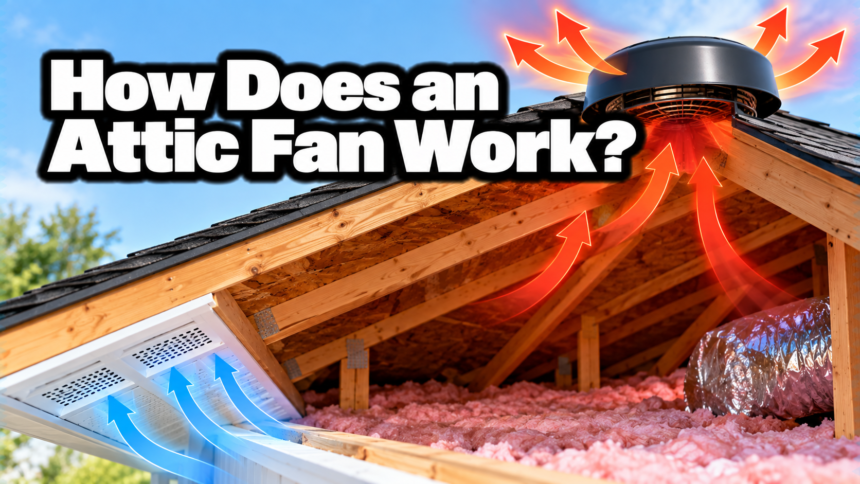
An attic fan is a powered vent that pulls hot air out of your attic and blows it outside. A thermostat turns it on when the attic heats up, usually somewhere between 100 and 110 degrees Fahrenheit. As the fan pushes the hot, stale air out, fresh outdoor air gets pulled in through the vents near the bottom of the roof, so the attic keeps trading hot air for cooler air.
That steady swap is the whole idea, and it is simple once you see the parts. Below is how the fan works, what it is doing up there, and the one detail that decides whether it helps you or quietly runs up your power bill.
What is an attic fan?
An attic fan is a fan that lives in your attic with one job: get rid of the heat that builds up there. On a sunny day an attic can climb past 120 degrees Fahrenheit, far hotter than the air outside. That trapped heat soaks down into the ceiling below and makes your air conditioner work harder to keep the rooms comfortable.
The fan sits either on the slope of the roof or high up on a gable wall, and it moves that hot air out of the space. One thing to keep in mind from the start: an attic fan cools the attic, not the rooms you live in. That difference matters, and it comes up again later.
How does an attic fan work?
An attic fan works by pushing hot attic air outside and letting fresh air take its place. It sounds basic, but the airflow follows a clear chain of events:
- The thermostat senses heat. A built-in thermostat watches the attic temperature. Most units switch on between 100 and 110 degrees, and the dial usually adjusts anywhere from about 60 to 120 degrees.
- The motor starts and the blades spin. Once the attic hits the set temperature, the motor runs and the fan blades push warm air out through the vent housing to the outside.
- A slight vacuum forms. Blowing air out lowers the air pressure inside the attic a little. That small drop in pressure is what pulls replacement air in, and it is the key to the whole system.
- Fresh air flows in through the low vents. Outside air gets drawn in through the intake vents near the base of the roof, usually the soffit vents tucked under the eaves. Cooler air comes in low, hot air goes out high.
- The cycle repeats until it cools down. The fan keeps swapping air until the attic drops below the set temperature, then the thermostat shuts it off.
Hot air already wants to rise and escape at the top of the roof, a natural pull sometimes called the stack effect. A powered fan just speeds that up so the attic clears heat much faster than it would on its own. Some fans add a humidistat too, which turns the fan on when the attic gets damp, not only when it gets hot. That helps in colder months when moisture can collect under the roof. For safety, most units include a fusible link or a high-temperature cutoff that kills the power if the attic ever gets hot enough to signal a fire.
The part most people miss: where the fresh air comes from
This is the detail that makes or breaks an attic fan. The fan can only blow air out if the same amount of air comes back in from somewhere. Where that somewhere is decides everything.
If your attic has enough intake vents, the fan pulls fresh outdoor air in through the soffits, and the system does exactly what it should. If the intake vents are too small or blocked, the fan still has to replace that air, so it takes the path of least resistance and pulls cooled air up out of your house. It sneaks through the gaps around light fixtures, the attic hatch, and small cracks in the ceiling. Now your air conditioner is paying to cool air that gets sucked straight into the attic and thrown outside.
That is why a powered attic fan can end up using more electricity than it saves. Testing by the Florida Solar Energy Center found this happening in homes where the replacement air was pulled from the cooled living space instead of outside. It is also why powered attic fans are not listed by ENERGY STAR, and why some places, including the state of Georgia, allow only solar-powered versions.
There is a safety angle as well: a fan pulling air out of the house can drag combustion gases like carbon monoxide back down from a furnace or water heater if one of them is venting poorly. The U.S. Department of Energy’s write-up on attic ventilation fans covers the building-science side in more depth. The takeaway is short: a fan is only as good as the intake vents feeding it.
The rule to remember: an attic fan needs about one square foot of intake vent for every 300 CFM it moves. Get the intake right and the fan earns its keep. Get it wrong and it works against you.
What a working attic fan does for your home?
When the intake is right, a well-sized attic fan pays off in a few concrete ways:
- Lower attic temperature. It brings a 120-plus degree attic much closer to the outdoor temperature, so less heat radiates down into your rooms.
- Less strain on your air conditioner. A cooler attic means the ceiling below stays cooler, so the AC does not have to fight a heat load pressing down from above.
- Less trapped moisture. Moving air out keeps humidity from building up under the roof, which is where mold, mildew, and slow wood rot start.
- A little help for the roof. A roof deck that is not baking as hard puts less heat stress on the shingles above it over the years.
Attic fan vs. whole-house fan
People mix these two up constantly, but they are different machines built for different jobs. The quick way to keep them straight is what each one actually cools:
| Feature | Attic fan | Whole-house fan |
| What it cools | The attic only | The whole house |
| Where it sits | Roof or gable wall | In the ceiling between the top floor and attic |
| How you use it | Runs on a thermostat, hands-off | You open windows and switch it on, usually in the evening |
| What it moves | Attic air out to the outside | Cool outdoor air through your rooms, then out the attic |
An attic fan clears heat out of the attic. A whole-house fan pulls cooler evening air in through your open windows, moves it through the living space, and pushes it out through the attic vents. If your goal is to feel cooler in the rooms downstairs, a whole-house fan is the tool for that. If your goal is a cooler attic, the attic fan is the one.
Types of attic fans
Attic fans come in a few forms. The main differences are how they mount and where they get their power:
- Roof-mounted fans sit on the slope of the roof, usually near the ridge, and vent straight up and out.
- Gable-mounted fans bolt to the vent opening on a gable wall and blow air out the side of the attic.
- Solar attic fans run off a small solar panel, so they cost nothing to operate and need no wiring, though they move less air and mostly work while the sun is out.
- Wind-driven turbine vents, the spinning metal caps you see on roofs, are a passive cousin. They have no motor and turn with the breeze, so they move far less air than a powered fan.
How to size an attic fan?
An attic fan is rated in CFM, which stands for cubic feet of air moved per minute. To find the size you need, measure your attic floor in square feet and multiply by 0.7. A 1,000 square foot attic needs a fan rated around 700 CFM. If your roof is dark or steep it soaks up more heat, so raise that figure to about 0.805 per square foot, which brings the same attic to roughly 805 CFM. Most home attic fans land between 800 and 1,600 CFM.
Then size the intake to match, because the fan is close to useless without it. Take the fan’s CFM and divide by 300 to get the square feet of net free intake vent area you need. A 700 CFM fan needs about 2.33 square feet of intake, which works out to around 336 square inches of open soffit venting.
If you cannot add that much intake, pick a smaller fan rather than starve the one you have. The Home Ventilating Institute’s attic ventilation guidance runs through the same math with worked examples for larger attics.
When should an attic fan run?
An attic fan should run on hot afternoons, which is exactly what the thermostat handles for you. Set the cut-on point between 100 and 110 degrees and leave it alone. The fan kicks in during the hottest stretch of the day and switches off once the attic cools.
If your unit has a humidistat, it can also run in winter to clear damp air before it turns into mold or rot under the roof. There is no need to run it around the clock. Doing that just wears out the motor and makes the intake problem worse, since a fan running when the attic is already cool has nothing useful to pull out.
Timing matters more than most people think. The attic is hottest in the late afternoon, a few hours after the sun peaks, so that is when the fan does its best work. Running it overnight, when the outdoor air is already cool and the attic has calmed down, does little except add to your electric use and pull on the house through any gaps in the ceiling. A thermostat, and a humidistat if you have one, keeps the fan honest by running it only when there is heat or moisture to clear.
How much does an attic fan cost?
Installing an attic fan usually runs somewhere between $200 and $1,300. The spread depends on the type, the size, and whether an electrician has to run new wiring to the unit. A basic gable-mounted electric fan sits near the low end, while a roof-mounted or solar model with professional installation lands higher up the range.
The fan itself is cheap to run, since a single motor does not pull much power. The bigger cost is the hidden one described earlier: if the intake venting is short and the fan starts pulling cooled air out of your house, your air conditioning bill can climb by more than the fan ever costs to spin. That is why the venting, not the fan price, is what really decides whether an attic fan saves you money.
Conclusion
An attic fan works by blowing hot air out of your attic and drawing cooler air in through the low roof vents, all triggered automatically by a thermostat around 100 to 110 degrees. Done right, it takes real strain off your attic and your air conditioner.
The catch is the intake: the vents have to be big enough to feed the fan outside air instead of the cooled air from your house. Size the fan to your attic, match the intake to the fan, and it will do its job quietly for years.
Frequently asked questions
Does an attic fan cool the house?
Not directly. An attic fan cools the attic by removing trapped heat, which eases the load on your air conditioner. To cool the living space itself, you want a whole-house fan, which pulls outdoor air through your rooms.
What temperature should I set my attic fan thermostat?
Between 100 and 110 degrees Fahrenheit is the usual range. That lets the fan run during the hottest part of the day and shut off on its own once the attic cools, so it does not run longer than it needs to.
Do attic fans use a lot of electricity?
A single fan draws a modest amount of power. The catch is that if your attic lacks enough intake venting, the fan pulls cooled air from your house, which makes your AC work harder and can cost more than the fan saves.
Are solar attic fans worth it?
They cost nothing to run and need no wiring, which is a real plus. The trade-off is weaker airflow, and they mostly work while the sun is shining. For a small or moderate attic with good soffit vents, they can be a solid, low-cost pick.
Can an attic fan run all year?
Yes, if it has a humidistat. In summer the thermostat runs it to clear heat, and in winter the humidistat can run it to clear damp air that would otherwise lead to mold or rot. Without a humidistat, most attic fans only run in warm weather.
Related Articles
How to Caulk a Toilet the Right Way?
Are Solar Attic Fans Worth It? A Straight Cost and Savings Look