
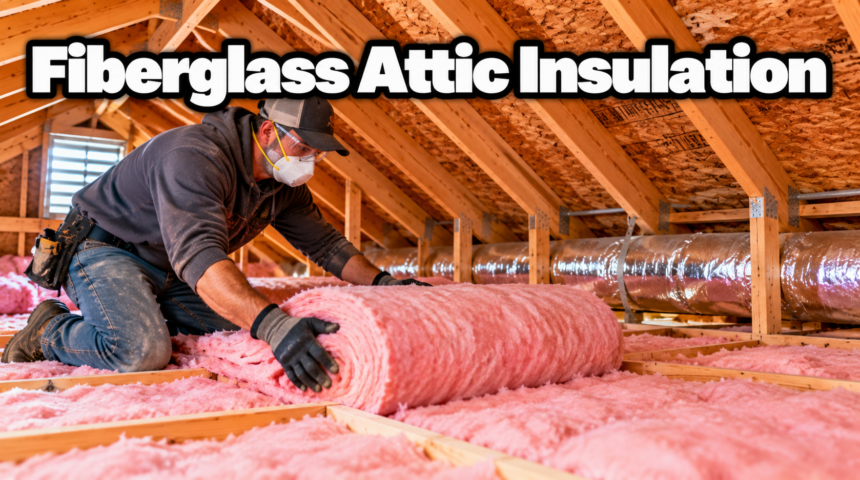
Fiberglass attic insulation is spun glass fiber laid over your attic floor to slow heat moving in and out of your home. It comes two ways: batts, which are rolls or panels you lay down, and blown-in, which is loose fluff a machine spreads into an even layer. It is the most common attic insulation because it is cheap, easy to fit, and does not burn. Get the depth right and it pays for itself in lower heating and cooling bills. Here is how much you need, what it costs, and how to choose between batts and blown-in.
What is fiberglass attic insulation?
Fiberglass is made from fine glass threads packed with tiny air pockets. Those air pockets are what slow heat down. The more still air a material traps, the harder it is for warmth to pass through it. In the attic, fiberglass shows up in two forms.
Batts are pre-cut rolls or panels you lay between and across the ceiling joists. They work best in open attics with standard joist spacing and few pipes or wires in the way. You can buy them faced, with a paper or foil backing that acts as a vapor barrier, or unfaced for layering on top of insulation that is already there.
Blown-in fiberglass is loose material blown through a hose into an even blanket. It settles into gaps, odd corners, and the spots around wiring and framing that batts tend to miss. That full coverage is why it is the usual pick for an attic that already has a thin layer in place.
Whichever form you use, the number that matters is R-value. R-value measures how well a material resists heat flow. A higher R-value means more resistance, which keeps your house warmer in winter and cooler in summer for less energy.
Fiberglass has a few traits that make it the default. It does not burn, so it adds a layer of fire safety over your ceiling. It does not soak up water the way paper-based insulation can, so a brief bit of damp will not ruin it. And it softens sound from outside and between floors, which is a quiet bonus you tend to notice after an upgrade.
How much R-value does your attic need?
For most of the United States you want R-49 to R-60 in the attic. In the hottest southern states, R-30 to R-49 is usually enough. These targets come from Department of Energy guidance, and you can confirm your own climate zone on ENERGY STAR’s recommended R-value map.
Here is a quick guide by climate:
| Climate | Example areas | Recommended attic R-value |
| Hot (Zone 1-2) | South Florida, Hawaii, south Texas | R-30 to R-49 |
| Mild (Zone 3) | Georgia, Arizona, coastal California | R-49 to R-60 |
| Cold (Zone 4-8) | Most of the Midwest, Northeast, and mountains | R-60 |
If your attic already has some insulation, you do not rip it out and start over. You add enough on top to reach the target. An attic with an old R-19 layer in a cold zone, for example, needs roughly R-41 more to hit R-60. Measuring what you already have is the first real step, and it is easy: push a ruler down to the drywall and read the depth in inches, then multiply by the R-value per inch in the next section. If the insulation sits level with the top of the joists or below them, you almost certainly need more.
How thick does fiberglass need to be?
Fiberglass gives you about R-3 to R-3.4 per inch for batts, and about R-2.2 to R-2.7 per inch for blown-in. Blown-in rates lower per inch, so it needs more depth to reach the same number. A fiberglass maker’s own depth chart, such as the one from Knauf, lines up with the figures below.
Use this as a rough target when you are checking or adding depth:
| Target R-value | Fiberglass batts | Blown-in fiberglass |
| R-30 | about 9 to 10 inches | about 12 to 14 inches |
| R-38 | about 11 to 13 inches | about 14 to 17 inches |
| R-49 | about 14 to 16 inches | about 18 to 22 inches |
| R-60 | about 18 to 20 inches | about 22 to 26 inches |
Depth is easy to underestimate. If blown-in insulation settles over time or gets flattened under storage boxes, its R-value drops with it. Keep the layer fluffy and level, and staple a simple depth ruler to a joist so you can glance at it during your yearly check.
What does fiberglass attic insulation cost?
Expect to pay about $1.25 to $2.75 per square foot installed for fiberglass, with materials and labor together. Batts run around $1.60 to $2.40 per square foot for a full-depth job, and less when you are only topping up a layer that already exists.
For a whole attic, the installed cost usually lands in these ranges:
| Attic size | Typical installed cost |
| 1,000 sq ft | $1,250 to $2,750 |
| 1,250 sq ft | $1,565 to $3,440 |
| 1,500 sq ft | $1,875 to $4,125 |
Fiberglass is one of the cheaper ways to insulate. Spray foam, for comparison, runs about $3.80 to $6.75 per square foot. Your final price moves with a few things: the size of the attic, the R-value you are aiming for, how easy the space is to move around in, and local labor rates. A low, cramped attic costs more to do because the crew works slower in it. Clearing stored items and old, damaged insulation before the crew arrives can shave a little off the quote. It is also worth getting two or three bids, since prices for the same attic can swing by hundreds of dollars.
Batts or blown-in: which should you pick?
Pick blown-in for most attic upgrades, and batts for simple, open attics or a hands-on DIY job. Both are fiberglass and both work, so the right answer comes down to your attic and who is doing the work.
Blown-in covers better. It flows into gaps, around wires, and into the tight angles where the roof meets the attic floor, so you end up with fewer cold spots and drafts. It also layers cleanly over an old batt layer, which makes it the easy choice when you are adding to what is already there.
Batts make sense when the attic floor is wide open, the joists sit at standard spacing, and you want to do the work yourself without renting a machine. They are also simple to pull up and put back later if you ever need to reach wiring or a junction box. One more point in favor of batts: with no machine to rent, the only gear you need is a utility knife and a straightedge.
A common and sound approach is blown-in over existing batts. Laying loose fiberglass on top of old batt insulation is fine and raises your total R-value without removing anything, as long as the new layer is unfaced so no paper backing gets trapped in the middle.
How fiberglass compares to cellulose and spray foam
Fiberglass is the middle-ground choice: cheaper than spray foam and a little drier and lighter than cellulose. Knowing the trade-offs helps you feel sure about the pick.
Cellulose is blown-in insulation made from recycled paper, treated to resist fire. It rates about R-3.2 to R-3.8 per inch, a touch higher than blown-in fiberglass, and it packs tightly around obstacles. The downsides are that it settles more over the years and it soaks up water, so a leak can mat it down and cut its value until it dries.
Spray foam is the top performer for resistance and air sealing, at about R-6 to R-6.5 per inch for the closed-cell type, and it seals leaks as it expands. It also costs the most by a wide margin and usually needs a pro. For a standard attic floor, that extra cost rarely pays back compared with the money you would spend on fiberglass plus a careful round of air sealing.
For most homeowners insulating an attic floor, fiberglass hits the sweet spot of price, safety, and ease. Spray foam earns its keep mainly when you are sealing a cathedral ceiling or turning the attic into living space.
Can you install fiberglass attic insulation yourself?
Yes, both batts and blown-in are doable as DIY, and loose-fill can cut your cost by around half because labor is the biggest part of the bill. Many home centers lend or rent a blowing machine when you buy the bags, which makes blown-in realistic for a weekend project.
Before you add any insulation, do two things in order. First, air seal. Caulk and foam the gaps where air leaks into the attic, around light fixtures, the attic hatch, and pipe openings, because insulation slows heat but does little to stop moving air. Sealing first is what makes the new insulation actually perform.
Second, protect the airflow. Fit baffles at the eaves so the soffit vents stay open and the attic can breathe. Good venting carries off moisture, which keeps the insulation dry and the roof deck healthy.
Fiberglass irritates skin, eyes, and lungs while you handle it, so wear a long-sleeve shirt, gloves, safety glasses, and an N95 mask. Walk only on boards laid across the joists, never on the drywall between them, or you will put a foot through the ceiling. Keep insulation a few inches clear of recessed lights unless the fixtures are rated to be covered.
For a large attic, a tricky roofline, or any doubt about ventilation, a pro is worth the money. A crew can usually finish a typical attic in a few hours and will get the depth even end to end. They also bring a blower that packs loose fiberglass to a steady density, which is hard to match by hand and matters for hitting the R-value you paid for.
Does fiberglass lose R-value over time?
Fiberglass can last 50 years or more, but its performance depends on staying dry and fluffy. The glass itself does not rot, settle into dust, or break down with age.
Three things pull its R-value down: moisture, compression, and settling. Wet fiberglass loses most of its resistance until it dries out, so a roof leak is worth fixing fast. Boxes and foot traffic flatten it, so build a small raised platform if you need attic storage rather than stacking straight on the insulation. Blown-in settles a little in its first months, which is why installers blow in extra depth from the start.
Check the attic about once a year. If the layer looks thin, matted down, or stained, top it up or track down the leak before it spreads.
Signs your attic needs more insulation
The clearest sign is a thin layer you can see sitting at or below the top of the ceiling joists. If the joists are poking above the insulation, there is room and reason to add more.
Your comfort and bills tell the story too. Rooms that run hot upstairs in summer and cold in winter, big swings from one room to the next, and heating or cooling bills that climb each year all point to heat slipping through the ceiling. Drafts near the attic hatch are another tell.
In cold climates, ice dams are a strong warning. When warm air escapes into the attic, it melts snow on the roof, which refreezes at the cold eaves and backs water up under the shingles. More insulation and better air sealing keep the roof deck cold and stop the cycle.
If you spot several of these, measure the depth first, then plan how much fiberglass to add to reach your zone’s target.
Conclusion
Fiberglass attic insulation is the simple, low-cost way to cut your energy bills. Aim for R-49 to R-60 across most of the country, choose blown-in for full coverage or batts for an open DIY job, and budget around $1.25 to $2.75 per square foot installed. Air seal first, keep the vents clear, and guard the layer against moisture and crushing. Do that, and a one-time job keeps paying you back for decades.
Frequently asked questions
Is fiberglass or blown-in insulation better for an attic?
Blown-in fiberglass covers gaps and odd corners better, so it suits most attics and any that already have insulation. Batts are fine for open attics with even joists and for DIY work.
How many inches of fiberglass do I need for R-49?
About 14 to 16 inches of fiberglass batts, or roughly 18 to 22 inches of blown-in fiberglass. Blown-in needs more depth because it rates a little lower per inch.
Can I put new fiberglass over old attic insulation?
Yes. Laying fresh batts or blown-in fiberglass over old insulation adds R-value and is a common upgrade. Use unfaced material on top so no paper backing traps moisture in the middle.
Is fiberglass attic insulation safe?
It is safe once installed and left alone. While you handle it, the fibers irritate skin and lungs, so wear gloves, glasses, long sleeves, and an N95 mask during the job.
How much does it cost to insulate an attic with fiberglass?
Around $1,250 to $4,125 for a typical 1,000 to 1,500 square foot attic installed, or about $1.25 to $2.75 per square foot. Doing it yourself can cut that figure roughly in half.
Related Articles
How to Measure a Ceiling Fan: The Complete Size Guide for Every Room
Why Does My Bathroom Smell Like Sewage? Causes, Fixes & Prevention Tips