
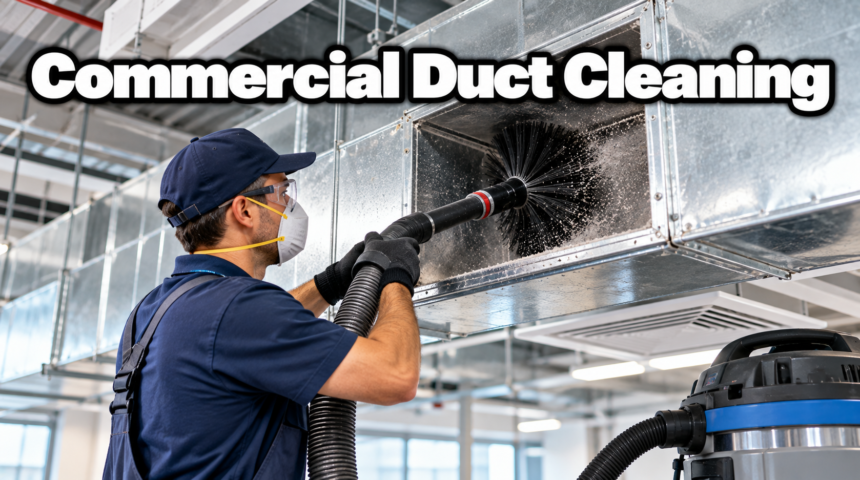
Commercial duct cleaning is the deep cleaning of the ductwork, coils, registers, and air-handling parts inside a building’s HVAC system, done to pull out the dust, debris, and other buildup that collects there over time.
A crew seals the system, loosens the grime with brushes or compressed-air tools, and draws it out through a powerful vacuum so it ends up in a sealed collection unit instead of blowing back into the space.
For an office, a warehouse, a restaurant, or a clinic, it is a maintenance job you book when the system shows real buildup, not a chore you run on a fixed calendar. Here is what the work covers, when it is worth doing, how it is done, and what you should pay.
What a commercial duct cleaning actually covers
A full cleaning reaches far more than the metal duct runs. A proper commercial job covers the supply and return ducts, the diffusers and grilles, the air-handling unit, the blower, the heating and cooling coils, and the drain pan under the coils. Those are the spots where dust, dirt, and moisture settle and where airflow slows down first. Cleaning the ducts while leaving a caked coil in place undoes much of the point, so the two go together.
Scale is what separates commercial work from a house. A home runs one or two small systems. A commercial building can run several large rooftop units feeding hundreds of feet of duct across multiple floors, often above hard ceilings or inside tight mechanical rooms.
The equipment is bigger, access is harder, and the work usually happens after hours so it does not disturb staff or customers. That is why a real commercial cleaning starts with an inspection of the whole system rather than a quick look at a few vents. The crew opens access panels, checks each major component, and only then decides what needs cleaning and how to reach it.
One service worth separating out is grease exhaust. The kitchen hood ducts in a restaurant carry grease, not ordinary dust, and they fall under a different cleaning job with its own fire-safety rules. A standard HVAC duct cleaning covers the ventilation and air-conditioning ductwork, so if your building has a commercial kitchen, treat the hood system as its own task on its own schedule.
Signs your commercial ducts need cleaning
The clearest reasons to clean are things you can see or measure, not a date on a calendar. This lines up with the EPA’s guidance on air ducts, which flags three situations worth acting on. The first is visible mold growth on the hard surfaces inside the ducts or on other parts of the system. The second is an infestation of rodents or insects living in the ductwork. The third is ducts so clogged with dust and debris that particles actually blow out of the supply registers into the room.
In a working building, a few other signs point the same way. Dust that returns on desks and shelves within a day of cleaning, a musty smell when the system kicks on, uneven airflow between rooms, or grilles coated in grime all earn an inspection. Buildings that run heavy foot traffic, cooking, sanding, printing, or any dusty process load their ducts faster than a quiet office does. A recent renovation is another trigger, since drywall dust and construction debris get pulled straight into open ductwork and settle there.
There is also an airflow signal. When ducts and coils load up with debris, the system has to push harder to move the same air, so you may notice weaker output at the vents, longer run times, or rooms that never reach their set temperature. Those symptoms can point to a dirty coil as much as a dirty duct, which is one more reason the inspection looks at both. If none of these show up and a visual check comes back clean, the ducts probably do not need a full cleaning yet.
How often should commercial ducts be cleaned?
There is no single correct interval, because buildings differ too much. The honest answer is to inspect on a schedule and clean on condition. A yearly inspection of the HVAC system, folded into regular preventive maintenance, tells you what shape the ducts are in and whether a cleaning is due. Many commercial systems need a full cleaning every three to five years, but that range shifts with how the building is used.
Facility type drives most of the difference. A standard office with good filters and light traffic can go several years between cleanings. A restaurant, a gym, a manufacturing floor, a pet facility, or a medical building fills its ducts much faster and may need attention every year or two.
Filters are the cheapest lever you have here. A higher-rated filter, in the MERV 8 to 13 band common in commercial buildings, catches more dust before it ever reaches the ducts, and a strict change schedule keeps that protection working. A building that treats filter changes as an afterthought will dirty its ducts far faster than the calendar suggests.
Certain events reset the clock no matter when the last cleaning was. A renovation, a roof or ceiling repair, a pest problem, water intrusion, or a long vacancy can each load or contaminate ducts quickly, and every one of them is a reason to inspect right after it happens rather than waiting for the next scheduled check.
Inspect every year, and clean when the inspection shows buildup. That one habit prevents both neglected ducts and money wasted cleaning a system that was already fine.
How the cleaning process works
The recognized method is source removal. The idea is simple: put the ductwork under negative pressure with a large vacuum, then knock the debris loose so the airflow carries it into the vacuum and out of the building. Done right, nothing you dislodge ends up back in the occupied space. A typical commercial job runs in this order.
- Inspect and plan. The crew opens access panels, checks the ducts and coils, and notes any mold, moisture, or damage. The system is also checked for asbestos before anyone cuts into older ductwork.
- Set up containment. The technicians connect a HEPA-filtered vacuum so the system runs under negative pressure, and protect floors and furnishings near the work area.
- Agitate the debris. Soft-bristled brushes, air whips, and compressed-air nozzles loosen dust and dirt off the duct walls. Fiberglass-lined ducts get soft brushes so the lining is not torn.
- Clean the components. The coils, blower, drain pan, grilles, and air-handling unit are cleaned along with the ducts, since a dirty coil cancels out much of the benefit of clean ducts.
- Seal and verify. Any access holes cut during the work are closed and re-insulated so they are airtight, and the crew confirms every surface is visibly clean before the system runs again.
Verification is the part that separates a real job from a quick pass. A thorough crew records the system before and after with photographs, confirms the coils and drain pan are clean, and runs the equipment in both heating and cooling modes to check it works properly.
That record is also what you keep on file for building management or any compliance requirement. Chemical biocides and sealant coatings are not part of a standard cleaning. An antimicrobial is applied only when active mold growth is reasonably suspected, and it is never a substitute for physically removing the buildup.
What commercial duct cleaning costs
Commercial pricing usually runs by the square foot of the building served, in the range of $0.30 to $0.60 per square foot. A small commercial system often lands between $600 and $2,000, while large facilities get a custom quote after a walkthrough. As a worked example, a 6,000 square foot space at $0.45 per square foot comes to about $2,700 when the work is done after hours. Crews that bill by the hour tend to charge $90 to $150 per technician.
| Pricing basis | Typical range |
| Per square foot | $0.30 to $0.60 |
| Small commercial system | $600 to $2,000 |
| Per technician, hourly | $90 to $150 |
| 6,000 sq ft example, after hours | about $2,700 |
Four things move the price most: the number of HVAC systems and duct runs, how high and how reachable the ductwork is, whether the job has to run after hours or on a weekend, and any safety or regulatory rules the site has to meet. A single rooftop unit over an open warehouse is cheap to reach. A dozen systems above a finished office ceiling, cleaned overnight, is not. Always get written quotes from at least three providers so you can compare the scope, not just the bottom-line number.
Does it improve air quality and energy use?
This is where plain facts matter more than sales talk. Cleaning the ducts has not been shown to prevent health problems, and the evidence does not clearly prove that dirty ducts raise the particle levels in the air you breathe or that cleaning lowers them. Everyday sources like cooking, foot traffic, and outdoor air usually add more to indoor dust than the ducts do. So a cleaning is not a cure for a building’s air quality problems on its own.
What a cleaning does reliably is remove visible buildup, clear out mold or pests when they are present, and restore ducts that are genuinely clogged. There is also reasonable support for cleaning the cooling coils, fans, and heat exchangers to help the system run more efficiently, since a coated coil makes the equipment work harder. The efficiency case is strongest for the coils and air handler, not the bare duct walls.
Some buildings have more at stake than others. In a clinic, a food plant, or a space with vulnerable occupants, mold or moisture inside the ductwork is a real concern, and clearing it is worth doing promptly. In a dry, well-filtered office, the same urgency rarely applies. Matching the response to the building keeps you from overspending on a system that is basically fine. Treat duct cleaning as one part of good HVAC upkeep, alongside filter changes and regular service, rather than a fix for every complaint.
How to hire a commercial duct cleaning company
Pick a contractor by the standard they work to and the way they quote, not by the loudest promise. The industry reference is ACR, the NADCA Standard for assessment, cleaning, and restoration of HVAC systems, and a serious commercial provider cleans to it and verifies the result with an inspection and a written report. NADCA’s commercial cleaning checklist is a useful tool for vetting a bid: it calls for mechanically cleaning the full duct system to remove visible contaminants, cleaning the coils and condensate drains, and applying antimicrobials only when active fungal growth is suspected.
Be careful with a few sales tactics. Step past any provider who promises broad health cures, pushes cleaning on a fixed routine whether the system needs it or not, or claims to be certified by a government agency. No federal body certifies duct cleaners.
A good quote spells out exactly which components are included, confirms the coils and air handler are part of the job, and ends with a report and before-and-after verification. Get at least three written estimates, and read them for scope rather than price alone, since the cheapest bid often skips the coils and the checks that make the work worth doing.
Conclusion
Commercial duct cleaning clears dust, debris, mold, and pests from a building’s ducts, coils, and air handlers using source removal under negative pressure. Book it when an inspection shows real buildup, not on a fixed schedule, and expect to pay roughly $0.30 to $0.60 per square foot.
Hire a contractor who cleans to the NADCA standard, includes the coils, and verifies the result in writing. Done that way, you get a genuinely cleaner system and spend money only where it does something.
Frequently asked questions
How long does a commercial duct cleaning take?
It depends on the size and access of the system. A small commercial unit can be done in a few hours, while a large multi-system building often takes a full night or several overnight visits so the work does not disrupt operations.
Do I need to close the building during cleaning?
Usually not. Most commercial jobs are scheduled after hours or on weekends so staff and customers are not affected. The crew seals the system and contains dust, so the space is normally ready for use the next day.
Will duct cleaning lower my energy bills?
It can help, mainly by cleaning the coils, fans, and air handler, which lets the equipment run more efficiently. Cleaning the bare duct walls alone has little proven effect, so treat it as part of overall HVAC upkeep rather than a guaranteed saving.
What is the difference between residential and commercial duct cleaning?
Scale and access. Commercial systems are larger, run more ductwork across more floors, and are harder to reach, so the job needs bigger equipment, more time, and usually after-hours scheduling. Pricing is typically by the square foot rather than per system.
How do I know the cleaning was done properly?
Ask for before-and-after photos, a written report, and confirmation that every component, including the coils and drain pan, is visibly clean. A contractor working to the NADCA standard will inspect and document the result as part of the job.
Related Articles
Do You Need Gutters with a Metal Roof?
How Long Does It Take to Install a Garage Door?
How Do You Hang Wall Cabinets? A Complete Step-by-Step Guide