
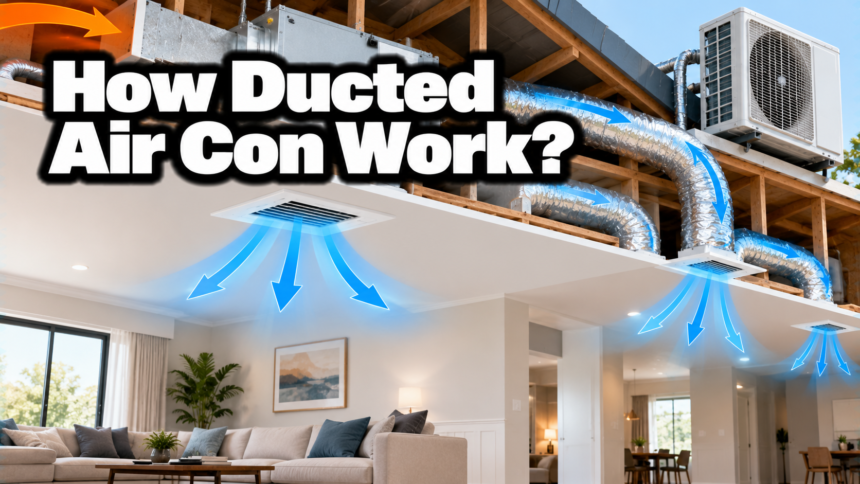
Ducted air conditioning cools and heats your whole home from a single hidden unit. That unit sits in your roof space or under the floor, and it pushes treated air through a network of insulated ducts to vents in every room. You get one system, one controller, and even temperatures across the house. Here is what each part does and what actually happens when you switch it on, along with what it costs and how it compares with a split system.
What is ducted air conditioning?
Ducted air conditioning is a central system that treats the air for your whole home from one spot, then shares it out through hidden ducts. Most of the machine is out of sight. You only see slim vents in the ceilings or floors and a small controller on the wall.
This is the big difference from a split system, where a separate wall-mounted unit hangs in each room. A ducted setup swaps all those boxes for one larger indoor unit and a run of ducts. The result is a quieter, tidier look, since the working parts are tucked into the roof or under the floor.
The main parts of a ducted system
A ducted system is really two machines linked by pipes and ducts. One machine sits outside, one sits hidden inside, and the ducts carry the air to your rooms. Here are the main parts and what each one does.
| Part | What it does |
| Outdoor unit | Holds the compressor and condenser coil. It releases heat to the outside air and drives the refrigerant around the system. |
| Indoor unit (fan coil) | Hidden in the roof or under the floor. Its coil treats the air and a fan pushes it into the ducts. |
| Ductwork | Insulated tubes that carry treated air from the indoor unit out to each room. |
| Supply vents | The outlets in each ceiling or floor that let the treated air into the room. |
| Return air grille | A large grille that pulls household air back to the indoor unit to be treated again. |
| Controller | The wall panel or app where you set the temperature and turn zones on or off. |
| Zone dampers | Motorised flaps inside the ducts that open or close to send air only where you want it. |
Refrigerant lines link the two units, a filter cleans the air on its way through, and a small drain carries away the moisture that the system pulls out of your rooms.
How ducted air conditioning cools your home?
Ducted air conditioning does not make cold. It moves heat out of your home and dumps it outside. A liquid called refrigerant does the carrying, changing between liquid and gas as it goes. The cycle runs in four steps, and it repeats over and over.
- Warm air from your rooms passes over the indoor coil, called the evaporator. The refrigerant inside soaks up the heat and boils into a cool, low-pressure gas. The air that comes out the other side is now cold.
- That gas travels outside to the compressor, which squeezes it into a hot, high-pressure gas.
- In the outdoor coil, the condenser, a fan blows air across the hot refrigerant. The heat escapes to the outside, and the refrigerant cools back into a liquid.
- The liquid passes through an expansion valve, which drops its pressure and temperature fast. Now cold again, it returns to the indoor coil to pick up more heat.
This loop never really stops while the system runs. The refrigerant keeps ferrying heat from inside to outside, and your rooms keep getting cooler until they reach the temperature you set.
As the indoor coil pulls heat from the air, it also pulls out moisture. That is why a running system dries the air a little and drips water outside through its drain, and why a room feels fresher and less sticky once the air conditioning has been on for a while.
Where the air goes: supply and return
Cooling the air is only half the job. The system also has to keep the air moving in a loop. Treated air leaves the indoor unit, travels through the ducts, and blows into your rooms through the supply vents.
At the same time, a large return air grille, usually in a hallway or central spot, pulls the same amount of air back toward the indoor unit. On the way in, that air passes through a filter that traps dust, pollen, and other bits. The unit then treats this air again and sends it straight back out.
Because the system mostly recycles indoor air, it stays efficient. Some setups add a fresh air intake to bring in outside air when you want it, but many simply clean and reuse the air that is already inside.
A quick tip: keep internal doors open, or fit door grilles, so return air can flow back to the grille. Starve the return and the whole system works harder for less.
Zoning: cool only the rooms you use
One of the best features of ducted air conditioning is zoning. Zoning splits your home into separate areas that you control on their own, so you can cool the lounge in the evening without wasting energy on empty bedrooms.
It works through the motorised dampers inside the ducts. When you switch a zone off at the controller, its damper closes and air stops flowing to that part of the house. Open it again and the air comes back.
This is where a lot of the savings come from. Running only the zones you are actually using can cut a system’s energy use by around 25 to 40 percent, because the unit is treating a smaller space. Many systems let you set a timer or schedule for each zone as well, so the bedrooms cool down before bedtime while the rest of the house stays off.
Reverse cycle: heating from the same system
Most ducted systems are reverse cycle, which means the same machine heats your home in winter. It does this by running the refrigeration cycle backwards.
A part called the reversing valve flips the direction the refrigerant flows. The outdoor coil now soaks up heat and the indoor coil releases it, so warm air comes out of your vents instead of cold. Even on a cold day there is heat in the outside air, and the system pulls it inside.
This is why reverse cycle heating is cheap to run. It moves heat that already exists rather than burning fuel to create it, so you get more warmth out than the electricity you put in. For most homes it means one system handles both summer and winter, with no separate heater to buy or run.
Ducted vs split systems: which one suits you
It helps to know how ducted air conditioning compares with a split system, since that is the usual choice. A split system pairs an outdoor unit with one wall-mounted indoor unit that cools a single room or open area. It is cheaper to buy, quick to install, and a good fit if you only need one or two spaces comfortable.
Ducted air conditioning covers the whole home from one system, with nothing on the walls except vents. It costs more up front and takes longer to fit, but it gives you even comfort everywhere and a cleaner look. For a large house, or one where you want most rooms covered, ducted usually makes more sense. For a flat, a single bedroom, or a rental, a split system is often the smarter buy.
The running cost depends on how you use each one. Cool a whole house with ducted and no zoning, and the bill climbs. Use zoning well, and ducted stays efficient because it only treats the space you are actually in.
What your home needs for ducted air con?
Ducted air conditioning needs somewhere to hide the indoor unit and run the ducts. In most homes that means the roof space above the ceiling, which is why the system is so common in single-storey houses with a pitched roof. Homes with a flat roof or no ceiling cavity can use under-floor ducts instead, though that takes more work.
This is also why ducted systems are easier to fit during a build or a big renovation, when the roof space and wall runs are open. Retrofitting into a finished home is possible, but it depends on having room for the ducts. Older homes with solid walls and tight ceiling cavities can be harder and more expensive to fit.
An installer sizes the system to your home, working out the cooling load from the floor area, ceiling height, insulation, and where the windows face. Getting the size right matters. Too small and it struggles on hot days. Too big and it keeps switching on and off, which wastes energy and wears the parts.
What ducted air conditioning costs to run?
Running costs come down to the size of your system, how well your home holds temperature, and how you use the controls. Most homes run a ducted unit rated between 10kW and 18kW of cooling, with something around 14kW common for a typical family house.
A 14kW system pulls roughly 3.5 to 4.5kW of electricity when it is working hard, which can cost in the region of $1.15 to $1.50 an hour at standard rates. Once your rooms reach the set temperature, the unit eases off and the real cost often drops closer to 60 to 70 cents an hour. Across a year, many households land somewhere between $400 and $1,400.
Small habits move that number a lot. Each degree you set the thermostat closer to the outside temperature can change energy use by about 5 to 10 percent, so a milder setting in summer saves real money. Zoning helps here too, as covered above.
When you are buying, the star rating is the quickest guide to efficiency. You can compare models on the government’s energy rating site, and newer units carry the Zoned Energy Rating Label, which shows how a unit performs in hot, average, and cold climates instead of giving a single number.
Keeping a ducted system running well
A ducted system rewards a little upkeep. The most important job is the filter, which sits behind the return air grille. Cleaning or replacing it every few months keeps airflow strong and stops dust building up inside the unit. A clogged filter makes the whole system work harder and cuts how much cool or warm air actually reaches your rooms.
Beyond the filter, a professional service every year or two checks the refrigerant level, cleans the coils, and looks over the moving parts. A well-kept system holds close to its original efficiency for years, while a neglected one slowly loses performance and costs more to run. With this kind of care, most ducted systems last around 10 to 15 years.
Conclusion
Ducted air conditioning treats the air for your whole home from one hidden unit, then shares it through ducts to vents in each room. It moves heat in or out using refrigerant, recycles and filters your indoor air, and lets you cool or heat only the zones you use. Pick the right size, use zoning, and set a sensible temperature, and you get even comfort across the house without a punishing power bill.
Frequently asked questions
Where is the indoor unit for ducted air con kept?
It is usually hidden in the roof space above your ceiling, or under the floor in some homes. Inside your rooms you only see the vents and the wall controller, not the unit itself.
Is ducted air conditioning cheaper to run than a split system?
For whole-home comfort it can be, especially with zoning, since you run one efficient unit. If you only need to cool one or two rooms, a split system is usually cheaper to run.
Can ducted air conditioning heat as well as cool?
Yes, if it is a reverse cycle system, which most are. A reversing valve flips the refrigerant flow so warm air comes from the vents in winter and cool air in summer.
How long does a ducted air conditioning system last?
With regular servicing and clean filters, most systems run well for around 10 to 15 years. Cleaning or replacing the filter every few months keeps it working efficiently.
Does ducted air conditioning bring in fresh air?
Most systems recycle and filter the air already inside your home rather than pulling in outside air. Some can be fitted with a fresh air intake if you want outside air brought in.
Related Articles
How Much Does It Cost to Clean a Dryer Vent?
How Long Can a Dryer Vent Be? The Max Length and What Changes It