
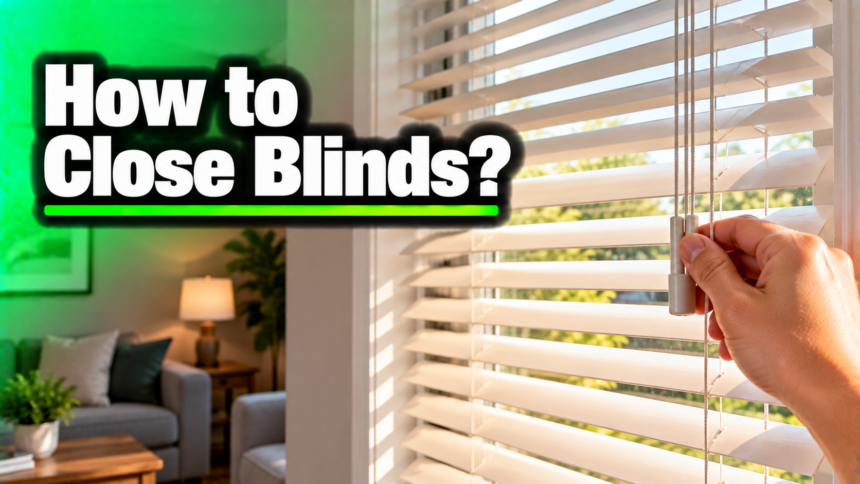
Closing blinds is really two moves. First you lower the blind so it covers the glass, then you tilt the slats until they overlap and shut out the view. Plenty of people do only one and wonder why light still pours in. The direction you tilt the slats matters too.
For the most privacy after dark, turn them so the outer edge of each slat points up toward the window. The exact steps change a little depending on how your blinds are controlled, so here is how to close every common type, which way to turn the slats, and how to fix blinds that will not shut all the way.
The two parts of closing blinds
A blind does two separate jobs, and closing it means handling both. Lowering brings the slats down to cover the window from top to bottom. Tilting rotates those slats so they lie flat against each other instead of sitting open. A blind that is fully lowered but tilted open will still let people see in and let light slip through the gaps, which is why a window can look “closed” and still feel exposed.
The control that lowers your blind and the control that tilts it are usually separate. On older blinds a cord raises and lowers while a thin wand or a second cord handles the tilt. On newer blinds you pull the bottom rail to lower and twist a wand to tilt. Once you know which control does which on your window, the rest takes seconds.
Not sure which type you have? Look at the top corners. A hanging stick means a tilt wand, a loop of cord or chain means a corded blind, and a clean bottom rail with no strings at all means it is cordless. Motorized blinds have a small battery tube or a power cable tucked into the headrail. Knowing the type points you straight to the right steps below.
How to close blinds with a tilt wand?
The wand is the thin plastic or metal stick that hangs at the top corner. Most horizontal blinds sold today use one, so this is the method you are most likely to need.
- Lower the blind first if it is raised. On cordless models, hold the bottom rail and pull it straight down to the sill.
- Take the wand between your fingers and twist it slowly in one direction.
- Watch the slats rotate. Keep turning until they lie flat against each other and the gaps close up.
- If light still shows through, give the wand a small extra turn. Tiny movements make a big difference near the closed position.
Tip: turn the wand gently. Forcing a stiff wand is the fastest way to strip the small gear inside the headrail, and that gear is the whole reason the slats move.
How to close corded blinds?
Corded blinds use two sets of strings: one lifts and lowers, the other tilts. They take a little practice because the lift cord locks in place and has to be released at the right angle.
- Find the lift cord, usually a bundle of strings on one side. Pull it gently toward the center of the window at a slight angle to release the internal lock.
- Keeping that angle, let the blind slide down until it reaches the sill.
- Move the cord back toward the edge of the window to lock the blind at the bottom.
- Now find the tilt cord, a separate thinner cord or a looped chain. Pull one side to rotate the slats closed.
- Pull the opposite side if you need to close them the other way.
If you have young children or pets, loose cords are worth taking seriously. The U.S. Consumer Product Safety Commission recommends going cordless in homes with kids, because pull cords and the inner cords behind the slats are a real strangulation risk. Retrofit kits and cordless replacements are easy to find, and the Window Covering Safety Council offers free repair kits for older blinds.
How to close cordless blinds?
Cordless blinds are the simplest to close, which is a big part of why they have taken over the market. There are no strings to lock or release, just the rail and the wand.
- Place a hand flat on the bottom rail.
- Pull the rail straight down to lower the blind. The internal spring holds it at whatever height you stop.
- Twist the tilt wand in either direction until the slats sit flat and shut.
Because there is nothing to tangle, cordless blinds are safer around small children and give a cleaner look at the window. If the rail feels stuck, do not yank it. Lift it an inch to reset the spring tension, then pull down again in one smooth motion. On wide blinds, pull the rail down with a hand at each end so it drops level. A rail that goes down crooked leaves a slanted gap of light at the bottom.
How to close motorized blinds?
Motorized blinds close with a button, an app, or your voice. The exact buttons depend on the brand, but the pattern is always the same: lower first, then tilt.
- Press the down or close button on the remote to lower the blind, or open the maker’s app and tap the lower control.
- Use the tilt button to rotate the slats shut once the blind is all the way down.
- If your blinds are linked to Alexa or Google Home, a command like “close the living room blinds” can do both at once, as long as you set that up first.
One thing to check: many motorized horizontal blinds only tilt the slats by motor and still need a light hand-pull to lower. If a button does nothing, the usual causes are a flat battery, a remote that needs re-pairing, or a dropped wifi connection.
The real payoff with motorized blinds is a schedule. Most apps let you set the blinds to close on their own at sunset or at a fixed time, so the house looks private in the evening without you touching anything. You can also group several windows into one “close all” command, which is handy in a room with more than one blind.
Which way should the slats face, up or down?
This is the part most people never think about, and it quietly decides how private your room feels. When you close horizontal blinds, the slats can overlap two ways: with the rounded outer edge pointing up toward the ceiling, or pointing down toward the floor.
For nighttime privacy, close them with the slats turned up, so the outer edge points up and the gap faces down toward you. Someone standing outside is usually lower than those gaps, so they cannot see up into a lit room. Turned the other way, the gaps angle down toward the street, and a person outside can look right up through them the moment your lights are on. An easy way to remember it: point the slats up to keep prying eyes out.
The direction also steers light and heat through the day. Here is the quick version.
| Slats turned up (edge points up) | Slats turned down (edge points down) |
| Best privacy at night | Weaker privacy; outsiders can see up through the gaps |
| Sends daylight up to the ceiling, softer glare | Sends light down onto the floor |
| Bounces summer heat back toward the window | Directs warmth into the room in winter |
So in a bedroom or a ground-floor room facing the street, turn the slats up at night. Up also works well in any room where you want soft daytime light without harsh glare. Turn them down when you want a little extra warmth from low winter sun and privacy is not a concern.
How to close blinds to block all the light?
Even fully closed, standard blinds leak a little light around the edges and through the small holes that hold the tilt cords. If you are closing blinds to sleep, a few extra steps make the room noticeably darker.
Start by closing the slats fully with the edge turned up, then look at the sides where the slats meet the frame. Blinds mounted inside the window recess often leave a thin strip of light down each edge. A blind mounted outside the recess, overlapping the frame by an inch or two on each side, covers most of that gap.
For a truly dark room, pair the blind with a blackout curtain, or choose blinds with routeless slats, which skip the cord holes that let pinpricks of light through. Closing the slats fully rather than leaving them a hair open makes a bigger difference than most people expect.
If the side gaps really bother you, some brands sell light-blocking side channels that mount to the frame and hide the edge of the blind. They are more common on roller and cellular shades, but a few horizontal blind lines offer them. Short of that, the cheapest fix is a curtain hung wider than the window, drawn over the closed blind at night.
How to close vertical blinds?
Vertical blinds, the kind common on patio doors and wide windows, work sideways instead of up and down, so the moves are a little different.
- Use the chain or wand to draw the vanes across until they cover the whole window. On some models you pull the vanes to one side; on others they split from the center.
- Once the window is covered, twist the chain or wand to rotate all the vanes at once.
- Keep turning until the vanes lie flat and overlap slightly. As with horizontal slats, a small final turn closes the last gaps.
If a few vanes refuse to line up, gently rotate each stubborn one by hand until it matches the rest. They hang from small clips at the top that can slip out of sync, and nudging them back is usually all it takes.
Why won’t my blinds close all the way?
When slats will not shut fully, the cause is almost always one of a few simple things, and most are quick to fix.
The most common one is turning the wand or cord too far. Past the closed point, the slats start to open again on the other side. Back off slightly and hunt for the flat spot where they sit tightest.
Bent or worn slats also leave gaps. A single kinked slat can stop the whole set from sitting flush. Straighten it gently with your fingers, or swap it out if it is cracked. Dust and grime built up along the edges can keep slats from meeting cleanly too, so a quick wipe sometimes solves it.
A worn tilt mechanism is the other usual suspect. If the wand spins freely without moving the slats, the little gears inside the headrail have probably stripped. On budget blinds a replacement tilt mechanism costs a few dollars and clips straight in.
On corded blinds, a tangled or frayed tilt cord can also block full rotation, so check that it runs freely. Finally, make sure the blind hangs level. A crooked headrail always leaves a wedge of light at one end no matter how you turn the slats.
Conclusion
To close blinds properly, lower them until they cover the window, then tilt the slats until they overlap and the gaps vanish. Use the wand, cord, or button that matches your type, and turn gently to protect the mechanism.
For real privacy after dark, close the slats with the outer edge pointing up so no one outside can see in. Do that and you get a dark, private window every time, from blinds that keep working for years.
Frequently asked questions
Which way do you turn blinds so no one can see in at night?
Turn the slats so the rounded outer edge points up toward the window. The gaps then face down toward you, and a person outside, who stands lower than the gaps, cannot see up into a lit room.
Why do my blinds still let light in when closed?
You have likely turned the wand just past the closed point, which reopens the slats the other way. Ease it back until they lie flat. Bent slats or a crooked headrail can also leave thin gaps.
How do I close blinds without any cords?
Cordless blinds close by hand. Pull the bottom rail straight down to lower them, then twist the tilt wand until the slats shut. There are no strings to lock or release.
Do you lower blinds or tilt them to close them?
Both. Lowering covers the window; tilting shuts the slats. A blind that is down but tilted open still lets people see in, so you need to do both to close it fully.
Can I close motorized blinds with my phone?
Yes. Open the maker’s app and tap the close or lower control, then the tilt control. Many models also respond to Alexa or Google Home voice commands once you link them.
Related Articles
Can a Nest Thermostat Replace Heating and AC?
Can You Use a Propane Heater Indoors? Safety Guide