

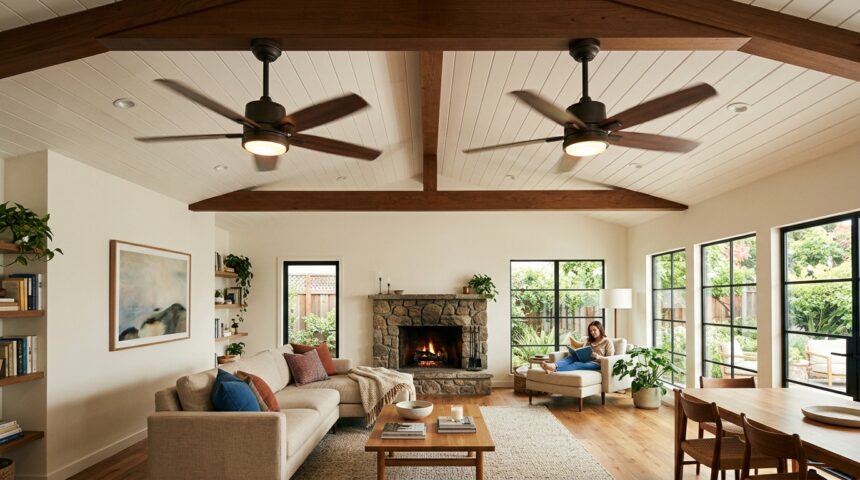
A dual ceiling fan is a single fixture with two fan heads, designed to move more air across a wider space than a standard ceiling fan can alone.
Homeowners with large living rooms, open-concept layouts, or oddly shaped rooms often turn to this style when one fan in the center of the ceiling just cannot cover the whole area evenly.
This guide walks through what a dual ceiling fan actually is, the different styles available, how to size and install one correctly, and what it costs compared to other cooling options.
What Is a Dual Ceiling Fan?
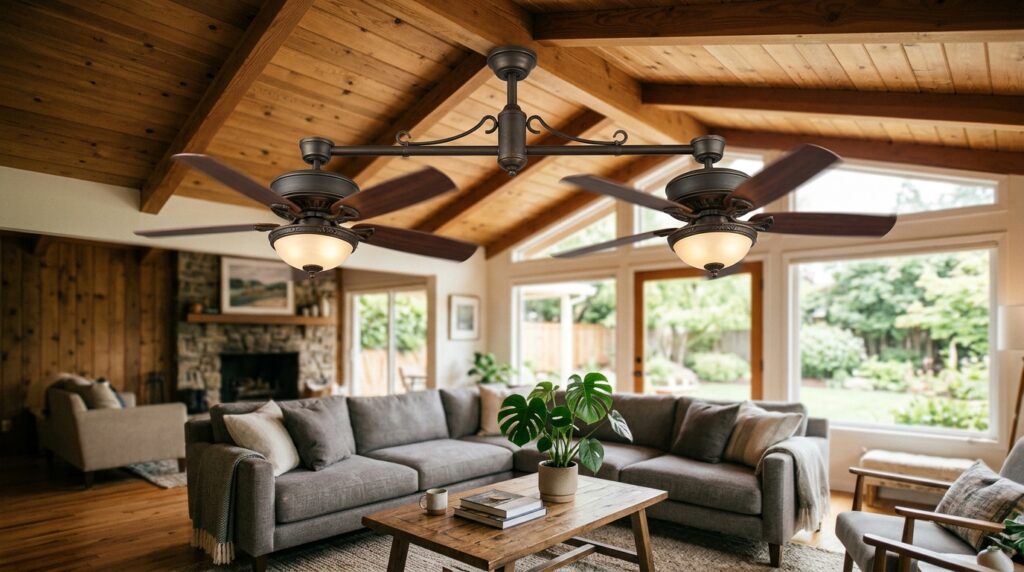
A dual ceiling fan combines two separate fan heads on one mounting system, either on a shared downrod or on two arms extending from a central body. The goal is broader, more even air coverage across a room without needing two separate fixtures wired and installed independently.
How the Two-Head Design Works
Most dual ceiling fans run both fan heads off a single motor housing or, in some models, off two independent motors that can be controlled separately.
Air gets pushed downward from both heads at once, which spreads circulation across a wider footprint than a single fan blade radius could reach on its own.
In models with independent motor control, each head can sometimes be angled or adjusted slightly, letting the airflow be directed toward different parts of an oddly shaped room.
Why Manufacturers Build Fans This Way
Standard ceiling fans are built around the assumption that one central fixture can adequately cool a room shaped roughly like a square or rectangle.
Long, narrow rooms, open-concept living and dining combinations, or unusually large bedrooms often leave one fan working too hard to push air evenly to every corner.
A dual-head design solves this without forcing a homeowner to install two completely separate ceiling fans with their own wiring and switches.
Types of Dual Ceiling Fans
Not every dual ceiling fan is built the same way, and the differences in design affect both performance and how the fixture fits into a room’s existing decor.
Dual Motor Fans
Dual motor fans have two independent motors, each powering its own fan head, which usually means each side can be controlled separately for speed and sometimes direction.
This setup gives the most flexibility, since one side of a room can run faster than the other depending on where people are sitting.
The trade-off is a higher price point and a more involved installation process compared to single-motor designs.
Single Motor, Dual Head Fans
In this configuration, one motor drives both fan heads simultaneously through a shared mechanism, which keeps the manufacturing cost lower and the wiring simpler.
Both heads spin at the same speed at the same time, so there is no option to run one side faster than the other.
This style works well for rooms where even, uniform airflow is the main goal rather than zone-by-zone control.
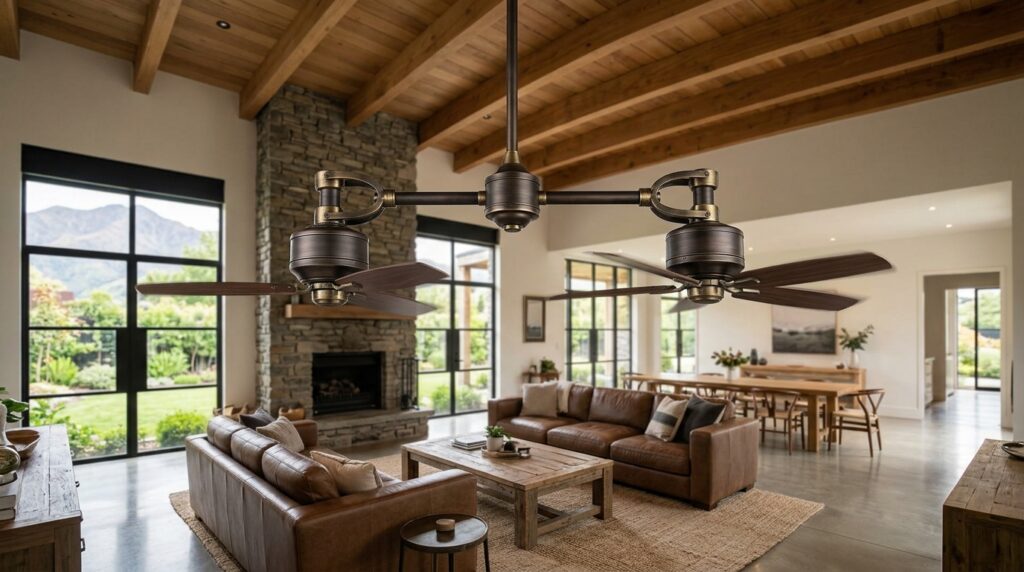
Branching Arm Fans
Branching arm fans extend from a central downrod into two arms that angle outward, placing each fan head over a different section of the room rather than directly next to each other. This design is especially useful in open floor plans where a living area flows into a dining or kitchen space, since each arm can be positioned to cover its own zone.
Comparing Dual Ceiling Fan Styles
| Style | Control Flexibility | Typical Cost | Best Suited For |
| Dual Motor | High (independent control) | Higher | Rooms needing zone-specific airflow |
| Single Motor, Dual Head | Low (synced operation) | Moderate | Long rooms needing even coverage |
| Branching Arm | Moderate to High | Moderate to Higher | Open-concept living and dining areas |
Benefits of Choosing a Dual Ceiling Fan
A dual ceiling fan offers advantages that go beyond simply looking different from a standard single-head fixture.
Better Coverage in Large or Irregular Rooms
A single ceiling fan has a limited radius of effective airflow, and rooms that stretch well beyond that radius often end up with cold or stagnant pockets of air. Splitting airflow across two heads extends that effective coverage significantly, especially in rooms that are long and narrow rather than evenly square.
This matters most in spaces like combined living and dining rooms where one corner can feel noticeably warmer than another without it.
One Fixture Instead of Two Separate Installations
Installing two completely separate ceiling fans means running two sets of wiring, mounting two electrical boxes, and often adding two separate wall switches.
This is particularly useful in rooms where adding a second full electrical box is not practical.
A Distinctive Visual Centerpiece
Beyond functionality, dual ceiling fans often serve as a statement piece in a room, especially in vaulted ceilings or open-concept spaces where a single fan can look small and out of proportion.
The two-head design draws the eye and can complement larger rooms in a way that a standard single fan sometimes cannot.
Many homeowners choose these fixtures specifically because they add visual interest while still being functional.
Sizing a Dual Ceiling Fan for Your Room
Picking the right size dual ceiling fan depends on the total square footage being cooled and how that space is laid out, not just personal preference for the look.
Matching Fan Size to Room Dimensions
Each fan head on a dual model is generally sized smaller than what would be used for a single fan covering the same total area, since the combined airflow from both heads is meant to add up to full coverage.
A room in the range of three hundred to four hundred square feet might call for two heads in the thirty-six to forty-two inch range, while larger spaces may need proportionally bigger blades.
Checking the manufacturer’s specific square footage rating for each model is the most reliable way to confirm proper sizing rather than estimating by eye.
Accounting for Ceiling Height and Shape
Standard ceiling height, generally eight to nine feet, works fine with most dual ceiling fan mounting hardware without any special adjustment.
Vaulted or sloped ceilings, which are common in the larger rooms where dual fans tend to get installed, often require an angled mounting kit to keep both fan heads level and operating safely.
Skipping this step on a sloped ceiling can lead to uneven blade clearance or even contact between the blades and the ceiling itself.
Installing a Dual Ceiling Fan
Installation involves more planning than a standard single-fan setup, mainly because of the added weight and wiring considerations.
Electrical and Structural Requirements
Because dual ceiling fans weigh more than single-head models, the existing electrical box in the ceiling needs to be rated to support that additional weight, which often means upgrading to a fan-rated box if the current one was only intended for a light fixture.
The wiring also needs to handle two motors, or in dual-motor designs, two separate sets of speed controls, which is not always something a standard switch setup is prepared for.
This is generally not considered a simple do-it-yourself swap, and most manufacturers recommend a licensed electrician for the installation.
Mounting and Balancing the Fixture
Both fan heads need to be mounted and balanced correctly so the entire fixture does not wobble or create excess noise during operation, which becomes more complicated with two motors and two sets of blades working at once.
Branching arm models in particular need careful attention to the angle of each arm, since an uneven mount can leave one side of the room with noticeably weaker airflow than the other.
Taking the time to get this right during installation prevents the kind of persistent wobble or rattling that becomes harder to fix once the fixture is fully wired in.
Dual Ceiling Fan vs. Single Ceiling Fan vs. Two Separate Fans
These three options all aim to solve the same basic problem of moving air through a room, but each comes with different trade-offs in cost, installation effort, and performance.
A single ceiling fan is the simplest and cheapest option, but it struggles in rooms beyond its rated coverage area, leaving parts of a large room poorly ventilated.
Two separate ceiling fans installed independently can match or exceed the coverage of a dual-head fixture, but doing so means double the wiring, double the electrical boxes, and often double the installation cost.
A dual ceiling fan sits in between, offering wider coverage than a single fixture while consolidating the wiring and mounting into one job, though it generally costs more upfront than a single standard fan and can be more complex to install than either alternative.
How Much Does a Dual Ceiling Fan Cost
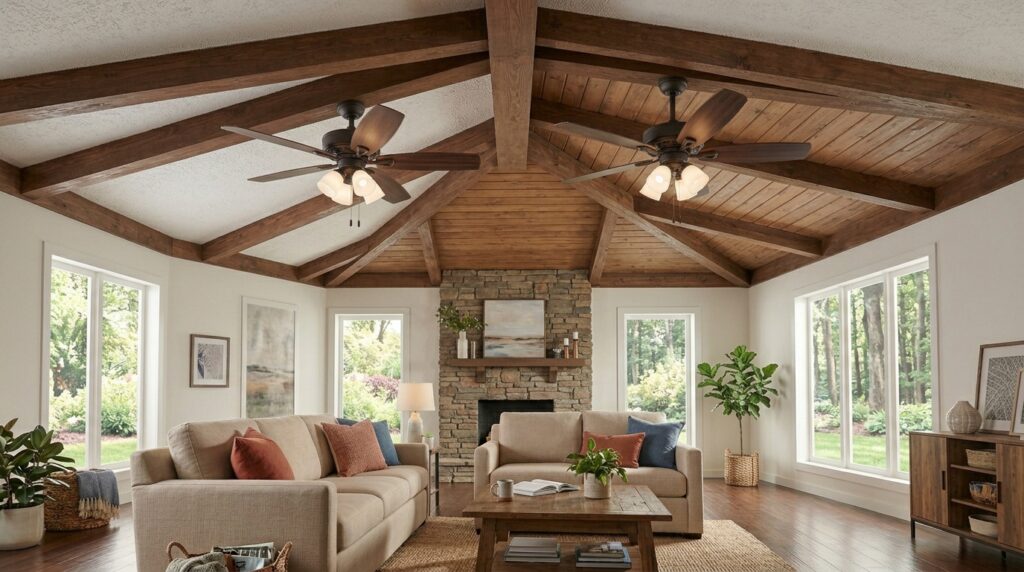
Pricing on dual ceiling fans varies more widely than standard single fans because of the added motor, blade, and design complexity.
What Affects the Price of the Fan Itself
Dual motor models with independent speed control generally cost more than single motor, dual head versions, since they require twice the internal mechanical components and often more sophisticated remote or wall controls.
Branching arm designs with adjustable angles also tend to sit at a higher price point due to the additional hardware needed to allow that flexibility. Material choices, such as premium wood blades versus standard composite, add further variation to the overall price.
What Affects Installation Costs
Because dual ceiling fans often require an electrician rather than a simple do-it-yourself swap, labor costs typically run higher than installing a standard single fan.
If the existing electrical box needs to be replaced with a fan-rated one to support the additional weight, that adds another line item to the total job.
Vaulted or sloped ceilings requiring a specialized mounting kit also push installation costs upward compared to a flat, standard-height ceiling.
Questions to Ask Before Buying a Dual Ceiling Fan
Asking the right questions before purchasing helps avoid buying a fixture that turns out to be the wrong fit for the room or the budget.
Does This Model Match My Room’s Square Footage
Manufacturers typically publish a recommended square footage range for each fan model, and confirming the dual ceiling fan being considered actually matches the room size prevents the common mistake of undersizing for a large open space.
A fan rated for a smaller room than what is actually being cooled will struggle to circulate air effectively no matter how well it is installed.
Can the Two Heads Be Controlled Independently
Knowing whether a model has one shared motor or two independent ones changes how much flexibility there is for directing airflow to different parts of a room.
Buyers who want one side of a long room to run faster than the other need to confirm independent control before purchasing, since not every dual ceiling fan offers this feature.
What Does Installation Actually Require
Asking an electrician or retailer directly whether the existing ceiling box and wiring can support the new fixture, or whether upgrades are needed first, helps avoid a surprise added cost after the fan has already been purchased.
This is especially important on vaulted ceilings, where a mounting kit may need to be bought separately from the fan itself.
Frequently Asked Questions
Can a dual ceiling fan replace two single fans in one large room?
In many cases, yes, since a properly sized dual ceiling fan can cover roughly the same total area as two separate single fans, though very large or unusually shaped rooms may still perform better with two independent fixtures.
Do dual ceiling fans use significantly more electricity than single fans?
They generally use somewhat more power than a single fan because of the second motor or larger combined blade area, but the increase is usually modest compared to running two completely separate fan units.
Are dual ceiling fans louder than standard single fans?
Noise levels depend more on motor quality and balance than on having two heads, so a well-built dual ceiling fan with two motors is not necessarily louder than a poorly balanced single fan, though cheaper dual models can sometimes produce more noise.
Can I install a dual ceiling fan myself?
It is possible for those experienced with electrical work, but because of the added weight and wiring complexity compared to a single fan, most manufacturers and electricians recommend professional installation.
Final Thoughts
A dual ceiling fan is a practical solution for rooms that have outgrown what a single fixture can handle, particularly in open-concept layouts, long rooms, or spaces with vaulted ceilings. Choosing between dual motor, single motor dual head, and branching arm designs comes down to how much control flexibility is needed versus how much budget is available.
Taking the time to size the fan correctly and plan for proper electrical support during installation makes the difference between a fixture that genuinely improves airflow and one that underperforms despite the higher price tag.
Related Articles
How Do You Hang Wall Cabinets? A Complete Step-by-Step Guide
How to Hang a Rug on the Wall: Step-by-Step Methods for Every Rug Type
Roofing Maintenance for Extreme Temperatures : Complete Guide
Metal Roof Overhang: A Complete Guide to Designing Effective Overhangs
How to Make Saltillo Floors Shine Again Expert Tips & Professional Solution