

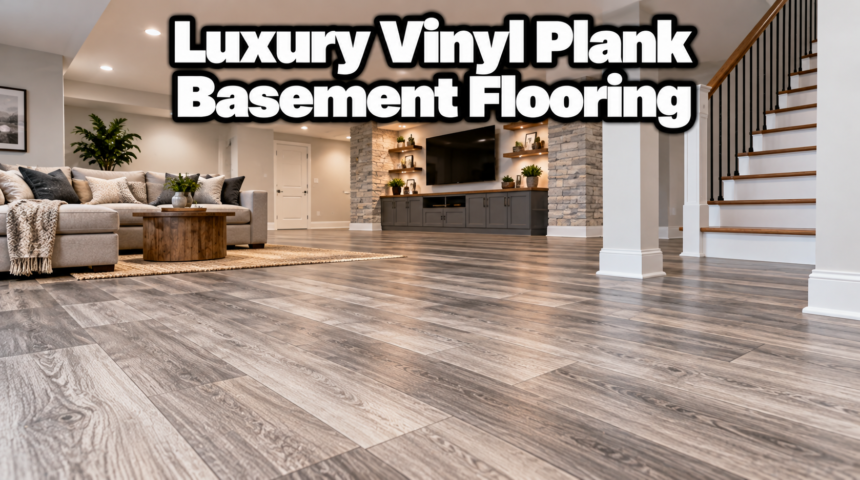
Luxury vinyl plank, or LVP, is one of the best floors you can put in a basement because the planks are waterproof, they handle a damp concrete slab well, and they look like real wood for a fraction of the price.
The right product is a rigid-core plank with a solid wear layer, laid over a slab you have checked for moisture first. Here is how to pick it, prep for it, and put it down so it lasts.
Why luxury vinyl plank works so well below grade?
A basement sits below ground, so its floor deals with cool concrete and moisture that rises up through the slab all year. LVP handles that better than almost any other floor. The plank itself is made of vinyl, which does not soak up water, so a spill or a bit of slab humidity will not swell or warp it.
Laminate and engineered wood both react to moisture, which is why they are a risk in a basement. Quality LVP is rated for below-grade use, meaning the maker approves it for rooms that sit under the surrounding ground. Vinyl also has nothing organic in it for mold to feed on, which matters in a room that can turn humid in summer.
The planks also click together and float over the slab instead of gluing down, so small movements in the concrete do not crack them. They are quieter and warmer underfoot than tile, and a click-lock floor is friendly enough for a weekend DIY job. You end up with a warm wood or stone look, soft enough to stand on, that shrugs off the damp.
SPC or WPC rigid core, and why it matters
Rigid-core vinyl comes in two main types, and for a basement SPC is the safer pick. SPC stands for stone plastic composite. Its core is limestone powder mixed with PVC and stabilizers, which makes it dense, hard, and very stable. That stiffness lets it bridge small dips and bumps in an old slab without showing them, and it stands up to dents from furniture and foot traffic.
WPC is a lighter composite core. It feels a little warmer and quieter underfoot, but it is softer, so it dents more easily and it only works well over a slab that is already flat and dry. For most basements, where the floor is cool and rarely perfectly level, SPC is the default choice. Pick WPC only if comfort matters more to you than toughness and your slab is in good shape.
What to look for when you buy?
A handful of specs tell you whether a plank will last in a basement. Read these off the box or the product page before you commit. A good showroom will also let you take a sample home, which is the best way to judge color and feel under your own basement lighting.
- Wear layer. This clear top layer takes the scratches and scuffs. 12 mil (about 0.3 mm) is entry level and fine for a quiet guest room. 20 mil (0.5 mm) is the mid-range sweet spot for a family basement. Go 22 mil or higher if you have pets or heavy traffic.
- Waterproof, below-grade core. All good LVP has a 100 percent waterproof core. Make sure the maker rates it for below-grade use, not just “water resistant,” which is a weaker claim.
- Thickness. Most basement planks run 4 to 7 mm thick. Thicker planks feel more solid and their click joints lock together better and stay tight.
- Attached pad. Many SPC planks come with a thin cork or foam pad already stuck to the back. It adds a little warmth and cuts the hollow sound a bare slab can give.
- Texture and finish. Embossed, wood-grain surfaces and longer, wider planks read as more real than flat, glossy ones, so look closely at a sample under basement lighting.
- Warranty. A residential wear warranty of 15 years or more signals a plank built to last, and a below-grade clause in that warranty is the proof you want for a basement.
For a busy family basement, a 5 to 6 mm SPC plank with a 20 mil wear layer and an attached pad is a reliable middle ground that balances comfort, strength, and price.
Test the concrete for moisture before anything else
Concrete looks dry, but it is porous, and water vapor keeps moving up through it. Too much of it can push up under the planks and leave them cold, clammy, or loose at the seams. A chalky white powder on the slab, called efflorescence, is a sign that moisture is moving through, and so is a musty smell. Check the slab with a real test before you buy flooring.
Two tests give you numbers you can trust. The calcium chloride test (ASTM F1869) measures how much moisture leaves the surface, and you want 3 to 5 pounds per 1,000 square feet over 24 hours or less. The in-situ probe test (ASTM F2170 relative humidity test) reads deeper into the slab and is the more reliable of the two; 75 to 85 percent relative humidity is the usual safe range, though some rigid-core products allow up to 95 percent when you add a vapor barrier.
A fresh slab needs time as well, roughly one month of drying per inch of thickness and at least 60 days before you test. Always follow the number your plank’s maker sets, since it overrides any general rule.
If the slab reads too wet, fix the cause first. Run a dehumidifier, grade soil away from the house, clear gutters, and seal obvious cracks, then test again. Laying a floor over a slab that is still too damp is the fastest way to ruin it.
Preparing the slab
Once the slab passes its moisture test, flat and clean come next. Scrape off old glue, paint ridges, or lumps, and fill low spots with a patch or self-leveling compound. Most makers want the floor flat within about 3/16 inch over a 10-foot span, because a floating floor telegraphs big dips and high spots over time and the joints can work loose. Knock down any ridges with a scraper or a grinder so the planks sit flat and the joints do not rock.
Sweep and vacuum so no grit sits under the planks. If your slab runs damp or sits deep below grade, lay a 6-mil polyethylene sheet as a vapor barrier first, overlapped and taped at the seams and run a few inches up the walls, as long as your plank’s instructions allow it.
Then let the flooring sit in the room for about 48 hours so it can adjust to the basement’s temperature and humidity before you lay it. You do not have to remove a sound, flat existing floor in every case, but bare, prepped concrete is the simplest base to work from.
Floating or glue-down over the slab
In a basement you have two ways to lay LVP, and floating click-lock is the right default. Floating planks lock to each other and rest on the slab, so nothing is stuck to concrete that might stay slightly damp.
If one plank gets damaged, you can lift the floor back to it and swap it out. Glue-down planks bond to the slab with adhesive, which gives a very flat, solid feel and suits large or high-traffic rooms, but the slab has to be dry and clean enough for the glue to grip, and repairs are harder. For most finished basements, float it. Save glue-down for a slab you know is dry and dead flat.
Installing luxury vinyl plank in a basement
Most basement LVP is a floating click-lock floor, which is the friendliest kind for a first-time job. The planks snap edge to edge and lie loose over the slab, held in place by their own weight and the walls. Nothing glues to the concrete, so there is nothing for slab moisture to break loose later. Start along the longest, straightest wall and check your first row against a chalk line, because the whole floor follows that first run.
Leave an expansion gap of about 1/4 inch around the whole room, including posts, pipes, and the bottom of the stairs, so the floor can move with the seasons. Lay out, or rack, a few rows ahead of yourself and stagger the end joints by at least 6 inches for strength and a natural look.
Cut planks by scoring the surface with a utility knife and snapping them, which keeps dust down in a closed basement. Skip a separate underlayment if your planks already have a pad, since doubling up makes the floor too spongy and can stress the joints.
Cover the perimeter gap with baseboard or quarter-round, and use transition strips where the basement meets another room or a different floor height. A major maker’s own luxury vinyl installation guide is worth a read first, since layout and underlayment rules shift a little from one product to the next.
What it costs
LVP is a mid-priced floor, which is a big part of its appeal. As of 2026, the planks themselves commonly run about $2 to $5 per square foot, with premium rigid-core lines reaching $5 to $8. If you hire a pro, installation usually adds around $1 to $3 per square foot, depending on how much prep and leveling the slab needs.
A 500-square-foot basement in mid-range SPC, done yourself, often lands near $1,500 to $2,500 in materials, and roughly double that once you add professional labor.
Doing the install yourself is where most of the savings sit, since click-lock planks need only basic tools and a spare weekend. Budget a little extra for a moisture test kit, trim, and underlayment if your planks do not already have a pad.
Comfort, warmth, and upkeep
Over a cold slab, any hard floor feels cool, and LVP is no exception. A plank with an attached pad, a vapor barrier underneath, and a few area rugs takes most of the chill off. If warmth is a real priority, some rigid-core planks can go over low-voltage electric radiant mats that are rated for vinyl, so check the plank’s temperature limit before you add heat.
Upkeep is light. Sweep or vacuum to keep grit off the surface, and damp-mop with a little mild cleaner. The waterproof top wipes clean and never needs wax or polish. Put felt pads under furniture legs, drag heavy items rather than letting them gouge, and skip steam mops, which can drive heat and moisture down into the seams over time.
How it stacks up against other basement floors?
Against the other common basement options, LVP wins on the mix of water resistance, comfort, and cost. The table below sums up the trade-offs at a glance.
| Floor | Water in a basement | Comfort underfoot | Rough cost per sq ft |
| LVP (rigid core) | Waterproof, below-grade rated | Warm-ish, slightly soft | $2 to $8 |
| Ceramic or porcelain tile | Waterproof | Hard and cold | $3 to $10+ |
| Laminate | Swells if water gets in | Warm | $1 to $4 |
| Carpet | Traps damp, mold risk | Warmest | $1 to $5 |
| Epoxy or sealed concrete | Waterproof | Hard and cold | $2 to $7 |
Tile is just as waterproof but colder, harder, and slower to lay. Laminate costs less, yet its fiberboard core swells if water reaches it, so it is a gamble below grade. Carpet is the coziest choice but it holds the damp a basement gives off and can grow mold. Sealed or epoxy concrete is tough and cheap but stays cold and plain. LVP sits in the middle on price while giving you a warm, water-safe, wood-look floor, which is why it has become the go-to basement surface.
Conclusion
Luxury vinyl plank is a strong basement floor because it is waterproof, forgiving over an imperfect slab, and warm-looking without the cost of wood.
Test your concrete for moisture first, pick an SPC plank with at least a 20 mil wear layer, flatten and clean the slab, then float a click-lock floor with the right expansion gap. Do that and you get a basement floor that looks good, stays put, and lasts for years.
Frequently asked questions
Can you put luxury vinyl plank directly on concrete in a basement?
Yes. LVP is made to float right over a concrete slab. Just test the slab for moisture first, make sure it is flat and clean, and add a vapor barrier if the maker recommends one for below-grade use.
Do you need an underlayment under LVP in a basement?
Often no. Many rigid-core planks have a pad already attached. If yours does not, a thin vapor-barrier underlayment made for vinyl adds warmth and quiet. Never stack two pads, as it makes the floor unstable.
Is SPC or WPC better for a basement?
SPC is the better basement choice. Its dense, stone-based core resists dents and hides small dips in the slab. WPC feels a touch warmer but is softer and needs a flatter, drier floor to perform well.
Will luxury vinyl plank be cold in a basement?
It can feel cool over a slab, like any hard floor. A plank with an attached pad, a vapor barrier below, and area rugs helps a lot. Some rigid-core planks also work with radiant heat mats rated for vinyl.
How thick should basement vinyl plank be?
Most basement planks run 4 to 7 mm thick with a 12 to 22 mil wear layer. For a family basement, aim for a 5 to 6 mm SPC plank with a 20 mil wear layer, which balances comfort, strength, and cost.
Related Articles
How Far Apart Should Roof Rafters Be? 16 vs 24 Inch Guide
Fiberglass Attic Insulation: R-Value, Cost, and How to Get It Right
Can You Line Your Garage in Plywood?
Cracks in Garage Floor: Causes, Types & Complete Repair Guide