
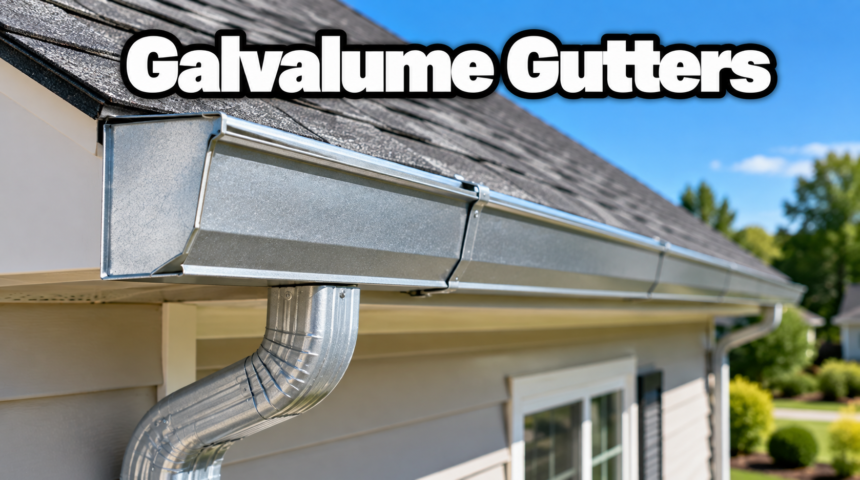
Galvalume gutters are steel gutters coated with a blend of aluminum, zinc, and silicon that resists rust far longer than plain galvanized steel. You get the strength of steel with much better corrosion protection, and in the right climate they can last 40 to 70 years. Here is what they are made of, what they cost, how they stack up against aluminum and copper, and when they make sense for your home.
What are galvalume gutters?
Galvalume gutters are made from steel that has been hot-dipped in a coating of 55 percent aluminum, 43.4 percent zinc, and 1.6 percent silicon. The steel core gives the gutter its strength and shape. The coating is what keeps that steel from rusting out.
The two metals in the coating protect in different ways. The aluminum forms a tight barrier that seals the steel from air and water. The zinc is sacrificial, which means it gives itself up to corrosion first and shields any small scratches or cut edges where bare steel is exposed. Working together, they guard the metal far better than either one could alone. You can see how this aluminum-zinc coated steel is made and why the mix matters.
The coating was first produced in 1972 and has been used on metal roofs, siding, and gutters ever since. On a gutter coil you will often see it sold as “Galvalume Plus,” listed with a gauge number such as 26 gauge, which tells you the thickness of the steel underneath. A lower gauge number means thicker, stronger metal.
Like other gutters, galvalume comes in the usual profiles. K-style has a flat back and a decorative front edge that looks like crown molding, and it carries the most water, which makes it the common pick for homes. Half-round has a simple curved shape that suits older and period houses. Both profiles can be cut from galvalume coil, so the material does not lock you into one look.
How long do galvalume gutters last?
Galvalume gutters usually last 40 to 70 years, depending on your climate. That is roughly twice the life of plain galvanized steel, which tends to give out in 20 to 30 years.
The difference comes down to the aluminum. Galvanized gutters rely on a zinc-only coating that slowly wears away, and it wears fastest in wet or salty air. The aluminum in galvalume slows that wear to a crawl, so the steel stays sealed for decades longer. Many galvalume products carry a perforation warranty of around 25 years, and real-world service life often runs well past the warranty.
Your conditions still matter. Constant moisture, heavy pollution, and salt air near the coast will shorten the life of any gutter. Even so, galvalume holds up better than most steel options in those tough spots, which is a big part of why people pick it over cheaper galvanized.
How you install and care for them changes the number too. Gutters that drain fully and stay clear of trapped leaves last the longest, because standing water and rotting debris are hard on any metal. Keep the run sloped so water moves to the downspouts, clean it out each season, and a galvalume system will reach the top of its range rather than the bottom.
Galvalume vs aluminum, galvanized, and copper
Each gutter metal has a job it does best. Here is how galvalume compares with the three materials people usually weigh against it.
| Material | Typical lifespan | Rust resistance | Relative cost | Best for |
| Galvalume steel | 40 to 70 years | Very high | Low to mid | Long life on a budget, strength |
| Aluminum | 20+ years | High, will not rust | Low | Most homes, light weight, color choice |
| Galvanized steel | 20 to 30 years | Moderate | Low to mid | Strength when budget is tight |
| Copper | 50 to 100 years | Very high | Very high | High-end looks, historic homes |
Aluminum is the most common choice because it is light, affordable, never rusts, and comes in many colors. It dents easily, though, and can crack when temperatures swing hard between hot and cold. Galvalume is the stronger metal and stands up to hail and heavy roof debris better.
Copper outlasts everything and takes on a soft green patina as it ages, but it costs several times more than steel. That puts galvalume in a sweet spot: it offers steel strength and a very long life without the copper price, which is why it appeals to owners who want their gutters to last but do not want to spend like it.
How much do galvalume gutters cost?
Galvalume gutters cost roughly 4 to 9 dollars per linear foot for the material, plus about 3 dollars per foot for installation. A typical home with 140 feet of gutter runs somewhere around 1,000 to 1,700 dollars installed.
A few things push that number up or down. Gauge is the first one: a 26 gauge coil is a common thickness for seamless gutters, and heavier steel costs more. Home size and the number of stories matter too, since tall or complex rooflines take more labor. Extra downspouts, corners, and add-ons like gutter guards each add to the total.
Seamless gutters, formed on site in one continuous run, cost more to install than sectional ones because the work takes more skill and special equipment. They are worth it for most homes, though, because they have far fewer joints, and joints are where leaks usually start.
For comparison, aluminum lands in a similar material range of 4 to 8 dollars per foot, while copper can run several times higher. So galvalume gives you a much longer lifespan than aluminum for a price that sits right next to it. If you want to price the raw material yourself, suppliers sell galvalume gutter coil by the foot.
It helps to think in cost per year of service rather than price on day one. A gutter that costs a touch more but lasts 50 years can be cheaper over time than one you replace twice in that span, once you count the labor for each new install. That math is where galvalume often pulls ahead, especially in climates that are rough on cheaper metal.
Which gauge and style should you choose?
For most homes, 26 gauge galvalume in a K-style profile covers the job well. It carries plenty of water, holds its shape, and keeps the material cost reasonable. Step up to a heavier gauge if your area sees frequent hail or you get large branches and debris off the roof, since the thicker steel shrugs off dents and dings.
Pick the profile by your roof and your taste. K-style fits most modern and traditional homes and moves the most water, so it is the safe default in rainy regions. Half-round looks right on older, classic houses and is a little easier to rinse clean, though it holds slightly less water for the same width.
Then decide between seamless and sectional. Seamless is formed to the exact length of each run, so the only joints are at corners and downspouts, which cuts down on leaks. Sectional pieces snap together and cost less to put up, but every seam is a spot to watch over the years. For a gutter you want to last decades, seamless is usually the better long-term buy.
Where galvalume gutters work best, and where they struggle
Galvalume performs well in most climates, but it has a few weak spots worth knowing before you commit. Here is where it earns its keep:
- Humid and coastal areas, where the aluminum in the coating resists salt and moisture.
- Hot, sunny regions, since the surface reflects heat and handles big temperature swings well.
- Homes that need toughness, such as places with hail storms or heavy debris off the roof.
There are two situations where galvalume is a poor fit:
- Contact with alkaline materials. Wet concrete, fresh mortar, and some pressure-treated lumber can attack the coating, so galvalume should never sit directly against them.
- Trapped, airless spots. The coating needs to dry out between wettings, so any area that stays damp with no airflow can corrode sooner than the rest of the run.
Cut edges are the other thing to watch. Wherever the coil is trimmed, a thin line of bare steel is exposed. The zinc in the coating protects those edges, but in harsh salt air that protection is thinner than it would be on galvanized steel. A clean fabrication job keeps the edges tidy and stretches the life of the whole system.
A couple of small choices help galvalume last even longer. Size the downspouts and outlets so water clears fast after a storm instead of pooling, and add gutter guards if you have trees nearby, so wet leaves do not sit in the channel. Where the gutter meets other metals, keep it away from bare copper, since the two together in wet conditions can speed up corrosion.
Can you paint galvalume gutters?
Yes, you can paint galvalume gutters, and many come pre-painted straight from the factory. Bare galvalume has a bright, lightly spangled finish. Some owners like that look, and others prefer to cover it to match the house.
If you paint bare galvalume yourself, give the surface about six months to weather first, or use a primer made for bare metal, so the paint can grip. Unpainted galvalume also chalks as it ages, which is a light powdery film that forms on the surface over the years. A quick rinse clears it. Painted galvalume skips the chalk but will need a fresh coat eventually, usually every several years depending on sun and weather.
Day-to-day care is simple. Clear leaves and debris a couple of times a year, rinse the inside of the channel, and check the fasteners and seams at the start of each season. Keep the metal away from fresh concrete and treated wood, and the coating handles the rest on its own.
Are galvalume gutters worth it?
Galvalume gutters are worth it when you want steel strength and a long life without paying for copper. They are a strong match for homeowners who plan to stay in the house for years, who deal with hail or heavy debris, or who live in humid and coastal spots where cheaper steel rusts out fast.
Aluminum may be the better call if you want the widest range of colors, the lightest weight, or the lowest upfront price, and you do not mind replacing the gutters a bit sooner. Copper makes sense only when looks are the top priority and budget is not a concern. For most people who simply want gutters that last decades and shrug off bad weather, galvalume gives you the most life for the money.
If your roof is already metal or galvalume, matching the gutters keeps the whole system consistent in both looks and lifespan, so the two age together instead of one wearing out first.
Conclusion
Galvalume gutters are rust-resistant steel gutters that can last 40 to 70 years, about double plain galvanized, for a price that sits close to aluminum. They suit humid, coastal, and hail-prone homes and anyone who wants steel strength without the cost of copper. Keep them off wet concrete and treated wood, clear debris twice a year, and they will protect your home for decades. For long life and real value, they are one of the smartest gutter choices you can make.
Frequently asked questions
Are galvalume gutters the same as galvanized gutters?
No. Galvanized gutters have a zinc-only coating and last about 20 to 30 years. Galvalume gutters use an aluminum-zinc coating that resists rust much longer, often 40 to 70 years in the right climate.
Do galvalume gutters rust?
They resist rust for decades thanks to the aluminum-zinc coating. Bare steel can appear at cut edges or deep scratches, but the zinc in the coating protects those spots, so rust is slow to take hold.
Can galvalume gutters be seamless?
Yes. Galvalume comes in coils that installers form into seamless gutters right on site. Seamless runs have fewer joints, which means fewer places for leaks to start.
What gauge are galvalume gutters?
26 gauge is common for home galvalume gutters. Thicker steel, shown by a lower gauge number, adds strength and cost, and it is worth it in hail-prone or high-debris areas.
Are galvalume gutters more expensive than aluminum?
The materials cost about the same, roughly 4 to 9 dollars per foot. Galvalume usually lasts longer, so you often get more years per dollar than you would with aluminum.
Related Articles
How to Make Your Home Smell Good: A Complete Room-by-Room Guide
Lamp Floor Arc: A Complete Guide 2026
Basement Floor Drainage System: Complete Guide
How to Choose the Best Flooring for Kids: Complete Buying Guide