

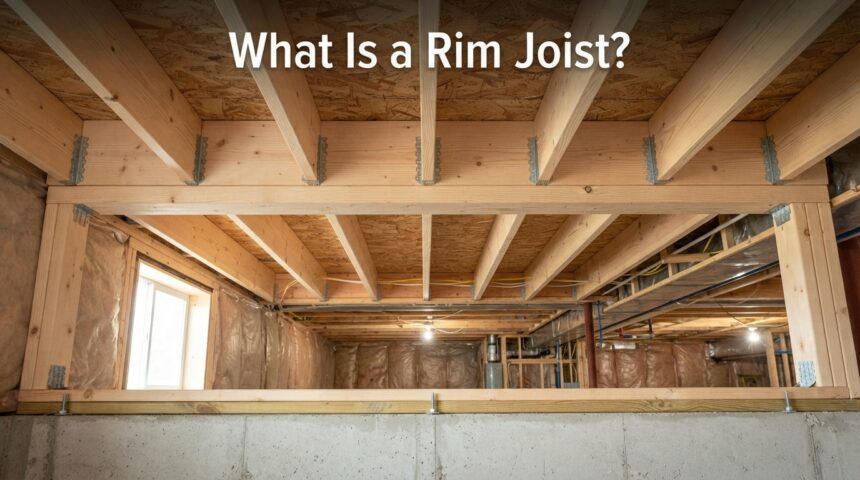
A rim joist is the board that runs around the outer edge of a house’s floor frame. It sits on top of the foundation’s sill plate. It closes off the open ends of the floor joists. It keeps those joists upright and evenly spaced. It also passes the weight of the walls above down to the foundation. Builders may call it a band joist, header joist, or rim board.
Many homeowners never think about this board until an inspector mentions it or a cold draft points to it. If you have ever asked yourself what is a rim joist and why it matters, you are in the right place. This guide explains its location, purpose, materials, common problems, and care in plain language. You will also learn how to insulate it, when to repair it, and what the work may cost.
Where Is a Rim Joist Located?
The rim joist sits at the very edge of the floor system, just above the foundation. You can usually spot it from inside a basement or crawl space.
On the Sill Plate
The sill plate is a treated board bolted to the top of the foundation wall. The rim joist rests directly on it and runs the full length of each wall. Together they form the base from which the whole floor frame is built.
In Basements and Crawl Spaces
Look up along the outer wall of an unfinished basement and you will see a row of boards just above the concrete. Those boards are the rim joist. Finished ceilings often hide it, so you may need an access panel or a utility corner to see it.
On Upper Floors
Multi-story homes have a rim joist at every floor level, not only at the bottom. The upper ones sit between floors, hidden behind drywall and siding. They do the same job as the lowest one.
What Does a Rim Joist Do?
A rim joist does far more than cover the ends of the floor joists. It handles four jobs that keep a floor strong and steady.
Keeps Floor Joists Upright
Floor joists are tall, narrow boards that tend to tip or twist under load. The rim joist is fastened across their ends and holds them vertical. This keeps the spacing even and the floor flat.
Carries Wall Loads
The walls, roof, and upper floors push weight downward along the edge of the house. The rim joist takes part of that load and passes it to the sill plate and foundation. Without it, the weight would rest on the thin ends of the joists.
Ties the Frame Together
The board links every joist end into one continuous ring around the house. This ring helps the structure resist wind and sideways forces. It is one reason a well-built floor feels solid underfoot.
Gives a Nailing Surface
Builders fasten the subfloor along the top of the rim joist. The bottom plate of the exterior wall is nailed there as well. This gives both parts a secure connection to the frame.
Rim Joist vs. Other Framing Parts
People often confuse the rim joist with the boards around it, since they all sit close together near the foundation. The table below shows how each part differs in position and purpose.
| Part | Position | Main Job |
| Rim joist | Along the outer edge, across joist ends | Closes the frame and carries wall loads |
| Floor joist | Runs across the span, inside the frame | Supports the subfloor and floor loads |
| Sill plate | Directly on the foundation wall | Anchors the frame to the foundation |
| Header | Above windows and doors | Carries loads over wall openings |
| Beam or girder | Under the floor, spanning supports | Supports the middle of the floor joists |
The main point to remember is that floor joists run parallel to the short direction of the floor, while the rim joist runs along the perimeter and caps them.
Rim Joist Materials and Sizes
The rim joist is normally the same depth as the floor joists so the top surface stays level. Two material families are common today.
Dimensional Lumber
Standard boards such as 2×8, 2×10, or 2×12 lumber are the traditional choice, especially in older homes. They are easy to cut and widely available. Their weak point is moisture, since untreated wood absorbs water and can rot.
Engineered Rim Board
Newer homes often use plywood, OSB, or laminated veneer lumber cut to match engineered floor joists. These boards are made to carry heavy loads and stay uniform in size. They resist warping better than sawn lumber, though they still need protection from water.
Common Rim Joist Problems
The rim joist sits at the boundary between inside and outside, which makes it more exposed than most framing. Three problems appear most often.
Moisture and Rot
Water can reach the board through leaky siding, poor flashing, or condensation on cold surfaces. Constant dampness leads to mold, dark stains, and soft, crumbly wood. Rot here can weaken the support under your walls.
Termites and Carpenter Ants
Pests enter easily where wood sits close to soil or stays damp. Termites leave mud tubes and hollow-sounding wood, while carpenter ants leave clean tunnels and sawdust-like piles. Both can damage the board long before the surface looks bad.
Air Leaks
Gaps between the rim joist, sill plate, and subfloor let outdoor air pass straight into the house. This causes cold floors, drafts, and higher energy bills. The leaks can also carry moist air that feeds mold growth.
How to Inspect a Rim Joist
A yearly check takes about half an hour and can catch problems early. Bring a flashlight, a screwdriver, and, if you have one, a moisture meter.
- Scan the full length of the board for dark stains, mold, or peeling finish.
- Press a screwdriver tip into the wood in several places; healthy wood resists and rot feels soft.
- Look for mud tubes, sawdust piles, or tiny exit holes that suggest pests.
- Feel for drafts around the edges on a windy day.
- Check nails and metal connectors for rust.
Call a professional if you find soft areas, active pests, or any sagging in the floor above. Structural damage should not be a guess.
Rim Joist Insulation and Air Sealing
Because the rim joist is one of the leakiest spots in a house, sealing and insulating it often pays back through lower heating and cooling costs. It also makes floors warmer and reduces the moisture that leads to mold. Three materials are commonly used.
Spray Foam
Closed-cell spray foam seals air leaks and adds insulation in one step, and it also blocks moisture. It costs more and is best applied by a trained installer. This makes it a strong choice for uneven or hard-to-reach areas.
Rigid Foam Board
Foam boards are cut to fit each joist bay and sealed at the edges with caulk or canned foam. This is the most popular do-it-yourself method because it is affordable and easy to handle. Careful sealing matters more than the board thickness.
Fiberglass Batts
Fiberglass is cheap, but on its own it does not stop air movement and can trap moisture against the wood. It works only when paired with a proper air barrier. Most experts prefer foam for this location.
Whichever material you choose, wear gloves, eye protection, and a mask, and keep the space ventilated while you work.
Repair, Replacement, and Cost
Minor damage, such as small soft spots, can often be treated by cutting out the affected area, applying wood hardener, or reinforcing the board with a matching piece. Widespread rot or pest damage usually calls for replacement. That work requires temporary support of the walls above, so it is best handled by a contractor or structural professional. Local codes may require a permit for structural repairs.
Prices vary with home size, access, and damage level. The figures below are general estimates and can differ by region.
| Service | Typical Range (USD) |
| Professional inspection | $100 – $400 |
| DIY rigid foam insulation | $200 – $600 |
| Spray foam by a professional | $1,000 – $3,000 |
| Repair of a small section | $300 – $1,500 |
| Full replacement | $2,000 – $8,000+ |
Frequently Asked Questions
Here are quick answers to the questions homeowners ask most about this part of the house.
Is a rim joist load-bearing?
Yes. It helps carry the weight of the walls and upper floors down to the sill plate and foundation. Cutting or removing it without support can cause serious damage.
Is a rim joist the same as a band joist?
Yes. Band joist, header joist, and rim board are different names for the same board. The name used often depends on region or builder habit.
Should I insulate my rim joist?
In most cases, yes. Sealing and insulating it reduces drafts and energy loss. Check the board for moisture or rot first, and fix any problems before covering it.
Can I replace a rim joist myself?
Small repairs are possible for experienced DIYers. A full replacement involves supporting the structure above and is safer with a professional.
Conclusion
So, what is a rim joist? It is the perimeter board that closes and stabilizes your floor frame while carrying wall loads to the foundation. Because it sits where the house meets the outdoors, it is also a common spot for moisture, pests, and heat loss. A yearly inspection, quick fixes, and proper insulation will protect both the board and your home. Take a look at yours this season.
Related Articles
Can You Paint Gutters? (Yes — Here’s Everything You Need to Know)
What Length of Fencing Is Needed to Surround This Yard?
How to Insulate Basement Ceiling