

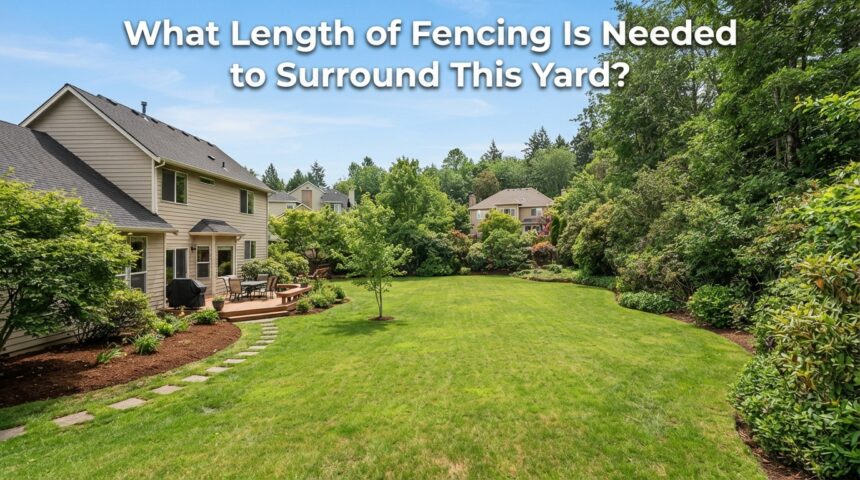
Figuring out what length of fencing is needed to surround this yard is one of the most important steps before starting any fencing project. Many homeowners either underestimate or overestimate the amount of fencing required, leading to wasted money or an incomplete boundary.
The good news is that calculating the correct length is not complicated once you understand the basic measuring and calculation steps. In this guide, you will learn how to measure your yard properly, calculate its perimeter, and account for gates, corners, and extra materials. By the end, you will know exactly how to determine the right fencing length for a yard of any shape or size.
Why Getting the Right Fencing Length Matters
Getting an accurate measurement before buying fencing materials helps you avoid overspending or running short halfway through installation. This section explains the financial, safety, and practical reasons why precise calculations are worth the extra time.
Cost Implications of Miscalculating Fencing
Buying too much fencing means spending money on materials that sit unused, while buying too little often results in a second trip to the store and inconsistent panel matching.
Either mistake adds unnecessary cost to a project that could have been planned accurately from the start. Taking the time to measure correctly the first time saves both money and effort in the long run.
Safety and Security Reasons to Measure Accurately
A fence that falls short of fully enclosing a yard leaves gaps that compromise both safety and security, especially in homes with children or pets.
Incomplete fencing can also create legal or liability concerns if someone wanders off the property through an unfenced section. Accurate measurements ensure the entire boundary is protected without weak points.
Common Mistakes Homeowners Make When Estimating
Many people estimate fencing length by eye or rely on rough guesses based on lot size documents, which rarely match the actual walkable perimeter.
Others forget to account for slopes, existing structures, or gate openings when calculating totals. Avoiding these common errors starts with using a proper measuring method rather than guesswork.
How to Measure Your Yard for Fencing
Before any calculation can happen, the yard itself needs to be measured using reliable tools and a consistent method. This section covers the practical steps involved in measuring different yard shapes.
Tools You’ll Need (Tape Measure, String Line, Measuring Wheel)
A long tape measure works well for smaller yards, while a measuring wheel is more efficient for larger properties with long straight edges.
A string line pulled taut between two points helps keep measurements straight, especially along uneven ground. Having stakes or flags to mark corners also makes the process faster and more accurate.
Measuring a Rectangular Yard
For a rectangular or square yard, measure the length and width of each side individually rather than assuming both sides are identical. Walk the full length of each boundary line and record the numbers in feet or meters. This straightforward method forms the foundation for calculating the total perimeter later.
Measuring an Irregularly Shaped Yard
Irregular yards with angled corners or curved sections require breaking the boundary into smaller straight segments that can be measured individually.
Each segment should be recorded separately and later added together to get the full perimeter. This segmented approach works for L-shaped, pie-shaped, or oddly angled properties.
Measuring a Yard with Slopes or Uneven Ground
Sloped yards add extra length to the actual fencing needed compared to a flat measurement, since fencing follows the ground’s contour rather than a straight horizontal line.
Using a string line level or a laser level can help estimate the additional length caused by elevation changes. Ignoring slope can lead to purchasing slightly less fencing than what is actually required on-site.
Calculating the Perimeter of Your Yard
Once measurements are collected, the next step is turning them into a usable perimeter total. This is where the actual formula for what length of fencing is needed to surround this yard comes into play.
Perimeter Formula for Rectangular and Square Yards
For a rectangle or square, the perimeter formula is simply two times the length plus two times the width, written as P = 2(L + W). This formula works for most standard suburban yards with four straight sides. Plugging in your measured length and width instantly gives the base fencing length needed.
Perimeter Formula for L-Shaped or Multi-Sided Yards
For yards with more than four sides, the calculation involves adding together the length of every individual segment measured earlier.
There is no single formula here since each property shape is unique, so accuracy depends entirely on how carefully each side was measured. Double-checking each segment before adding them together helps avoid small errors that add up over a long boundary.
Using Online Perimeter Calculators
Several free online tools allow you to input yard dimensions or draw your property outline to automatically calculate the perimeter. These calculators are especially useful for irregular shapes where manual math feels overwhelming. They also reduce the chance of arithmetic mistakes when adding multiple segments together.
Converting Measurements (Feet, Meters, Yards)
Fencing materials are often sold in specific units, so converting your measurements to match the store’s system prevents confusion during purchase.
One meter equals roughly 3.28 feet, which is useful when comparing local measurements to international product listings. Keeping all measurements in a single consistent unit throughout the calculation avoids costly conversion errors.
Accounting for Gates, Corners, and Extra Materials
The raw perimeter number is not always the final figure you should buy, since real installations require some additional allowances. This section explains what extra length to factor in beyond the basic perimeter.
Adding Space for Gates and Entry Points
Gates require dedicated framing and hardware space that is different from standard fence panels, so this width should be subtracted from the panel count but still included in the total boundary length.
Most residential gates range between three and four feet wide for walk-through access. Larger driveway gates may require ten feet or more depending on vehicle access needs.
Extra Fencing for Corner Posts and Overlap
Corner posts and panel overlaps can consume a small amount of additional material that isn’t obvious from a simple perimeter calculation.
This is especially true with panel-style fencing, where panels are cut or adjusted to fit around corners precisely. Accounting for a few extra inches per corner keeps the final layout clean and properly aligned.
Recommended Waste Buffer (5–10%)
Adding a five to ten percent buffer to your total calculated length helps cover cutting waste, installation errors, or unexpected obstacles discovered during setup.
This buffer is a standard practice recommended by most fencing suppliers and contractors. It is far easier to have a small surplus than to pause a project for a last-minute material run.
Factors That Affect How Much Fencing You’ll Need
Beyond the basic perimeter, several outside factors can influence the final amount of fencing required for a project. Each of these should be considered before finalizing your order.
Fence Panel or Picket Width
Fencing is typically sold in fixed panel widths, so your total perimeter needs to be divided by the panel size to determine how many full panels are required.
Leftover partial sections often need custom cutting, which can slightly increase material waste. Choosing panel sizes that divide evenly into your perimeter can reduce this extra cutting.
Terrain and Slope Adjustments
As mentioned earlier, sloped terrain increases the actual fencing length compared to a flat-ground measurement, since materials must follow the rise and fall of the land.
Stepped fencing installations, common on hills, may also require additional posts and connectors. Factoring in terrain early prevents underordering materials for uneven properties.
Local Building Codes and Setback Requirements
Many municipalities require fences to be set back a certain distance from the property line, which can slightly change the effective perimeter being fenced.
Checking local zoning rules before measuring ensures your fence location is both legal and accurately calculated. Ignoring setback rules can lead to needing to redo the entire installation later.
Existing Structures or Trees Along the Boundary
Sheds, large trees, or utility boxes along the property line may require the fence to route around them rather than follow a straight edge.
These detours add extra length that a simple rectangular calculation would miss entirely. Walking the property boundary in person helps identify these obstacles before finalizing your material order.
Fencing Length by Yard Size (Quick Reference)
For homeowners who want a general idea before doing exact math, yard size can offer a helpful starting estimate. The table below gives rough perimeter ranges based on common yard categories.
| Yard Size | Approximate Perimeter | Recommended Fencing (with Buffer) |
| Small (under 1,000 sq ft) | 120–160 feet | 130–175 feet |
| Medium (1,000–5,000 sq ft) | 160–300 feet | 175–330 feet |
| Large (5,000+ sq ft) | 300+ feet | 330+ feet |
These figures are only general references, since actual yard shapes vary significantly. Always rely on your own measurements rather than these averages for a final purchase decision.
Tools and Apps to Simplify the Calculation
Technology can make measuring and calculating fencing length faster and more accurate than manual methods alone. This section highlights a few practical digital options.
Fencing Calculator Apps
Several mobile apps allow users to input yard dimensions and instantly receive material estimates, including panel counts and post spacing. These apps often include cost estimators as well, helping with budgeting alongside measurement. They are especially helpful for first-time DIY fence installers.
Satellite/Map-Based Measuring Tools
Online mapping tools let you trace your property boundary using satellite imagery, automatically calculating the total perimeter length. This method is useful for getting a rough estimate before physically measuring the yard. It works particularly well for larger or irregular properties that are time-consuming to measure by hand.
When to Hire a Professional Surveyor
For properties with unclear boundary lines or legal disputes over property edges, hiring a licensed surveyor ensures complete accuracy. Surveyors provide official documentation that can also be useful for permits or future property transactions. This option is generally reserved for larger projects or properties with boundary uncertainty.
Tips for Buying the Right Amount of Fencing
Once the exact length is calculated, smart purchasing decisions can further reduce waste and unnecessary cost. This section covers practical buying advice.
Ordering Panels vs. Rolls
Panel fencing is easier to calculate exactly since each panel has a fixed width, while roll fencing like chain-link offers more flexibility for irregular perimeters. Choosing the right type depends on the yard’s shape and how much cutting flexibility is needed. Roll fencing generally results in less waste for curved or angled boundaries.
Where to Buy Extra Materials Locally
Keeping a local supplier in mind for last-minute additional materials can prevent project delays if measurements were slightly off. Many hardware stores also allow returns on unused, unopened fencing panels. Building a relationship with a local supplier can make future adjustments much easier.
Returning or Reselling Unused Fencing
If you purchased a buffer amount and ended up with leftover materials, most retailers accept returns within a set timeframe as long as materials are undamaged. Unused fencing can also be resold locally through online marketplaces if a store return isn’t possible. This helps recover some of the cost from the recommended waste buffer.
FAQs
How do I calculate fencing for an irregular yard?
Break the boundary into straight segments, measure each one individually, and add all segments together for the total length.
Do I need extra fencing for gates?
Gate openings should be subtracted from panel counts but still included in the total perimeter measurement for planning purposes.
How much does a waste buffer typically add?
A five to ten percent buffer on top of your calculated perimeter is the standard industry recommendation.
Can I measure fencing length without a professional?
Yes, most standard yards can be measured accurately using a tape measure or measuring wheel without hiring a surveyor.
What’s the best tool for measuring large yards?
A measuring wheel or satellite-based mapping tool is typically most efficient for larger properties.
Conclusion
Knowing what length of fencing is needed to surround this yard comes down to accurate measuring, correct perimeter calculation, and factoring in gates, corners, and a reasonable waste buffer.
Whether your yard is a simple rectangle or an irregular multi-sided shape, breaking the process into these clear steps removes the guesswork. With the right measurements and a small material buffer, you can confidently order fencing that fits your property perfectly the first time.
Related Articles
What Is a Galley Kitchen? A Complete Guide to Layout, Pros, and Design
How to Lock a Garage Door: Complete Step-by-Step Guide
Why Does My Ceiling Fan Click? Causes & Fixes
How to Insulate Basement Walls: Step-by-Step Guide 2026
Brass Kitchen Faucets: Types, Benefits, Buying Guide, and Maintenance Tips