

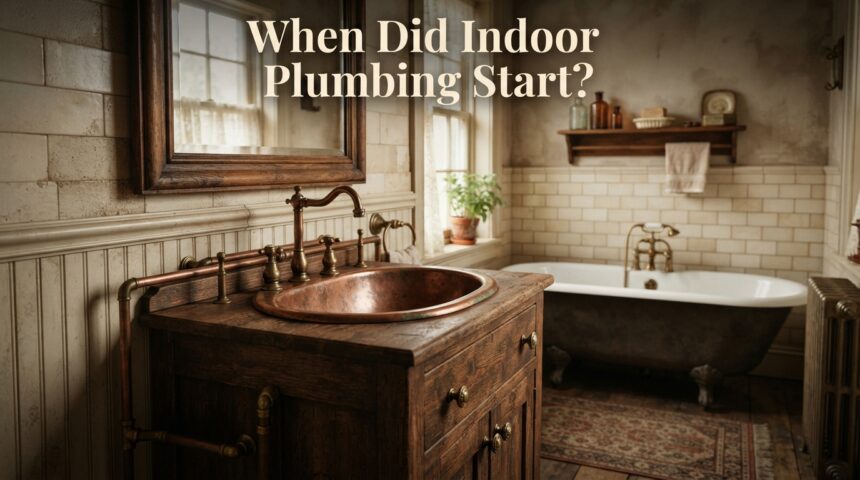
Many people search online to know when did indoor plumbing start because it is closely tied to human civilization and public health development. The honest answer is that indoor plumbing did not begin at one single point in time, but developed slowly across thousands of years.
Ancient societies built the earliest water systems, while modern indoor plumbing as we recognize it today became common only in the 19th and 20th centuries. This article explains the complete journey, step by step, in simple words so that anyone can understand it easily.
Ancient Beginnings of Indoor Plumbing (3000 BCE – 500 CE)
The earliest forms of indoor plumbing appeared thousands of years before modern history. Several ancient civilizations independently discovered ways to bring water into buildings and remove waste from them.
Indus Valley Civilization
The city of Mohenjo-daro, built around 3000 BCE, had one of the earliest known drainage systems in the world.
Homes were connected to covered drains that carried wastewater away from living areas. This early planning shows that organized plumbing systems existed far earlier than most people assume.
Ancient Egypt
Ancient Egyptians used copper pipes to carry water into temples and wealthy households around 2500 BCE. These pipes were mainly used for religious rituals and royal comfort rather than everyday use. Archaeologists have found copper piping remains that prove Egyptians understood basic water engineering.
Minoan Civilization in Crete
The Minoan palace of Knossos, dating back to around 1700 BCE, featured one of the first known flushing toilet systems. Clay pipes carried water through the palace for bathing and waste removal. This system was surprisingly advanced for its time and influenced later engineering ideas.
The Roman Empire
Rome took ancient plumbing to a much larger scale through aqueducts, public baths, and underground sewage systems. Lead pipes, known as “fistulae,” distributed water throughout cities to homes, fountains, and bathhouses. Roman engineering remained unmatched for centuries and became a foundation for future plumbing development.
The Decline During the Middle Ages (500 – 1500 CE)
After the fall of the Roman Empire, much of the advanced plumbing knowledge was lost across Europe. Sanitation conditions worsened significantly during this long period.
Loss of Roman Engineering Knowledge
When Roman infrastructure collapsed, most European cities lost access to organized water systems. Skilled engineers and maintenance practices disappeared along with centralized governance. As a result, clean water access became inconsistent and unreliable for ordinary people.
Chamber Pots and Cesspits
During medieval times, most households relied on chamber pots for daily waste disposal. Waste was often thrown into streets or nearby rivers, causing serious health problems. This lack of sanitation contributed heavily to the spread of diseases throughout medieval towns.
Monastery Plumbing Systems
Interestingly, some monasteries maintained basic plumbing systems for religious and practical purposes. Monks built simple pipelines to bring water into kitchens and washrooms. These isolated examples kept minor plumbing knowledge alive during an otherwise stagnant period.
Renaissance Innovations (1500s – 1700s)
The Renaissance period brought a renewed interest in science, engineering, and innovation, including early plumbing experiments.
Sir John Harington’s Flush Toilet
In 1596, Sir John Harington invented an early flush toilet design for Queen Elizabeth I. His invention used a valve system to release water and clear waste effectively. Although clever, this invention was not widely adopted due to high costs and limited infrastructure.
Slow Adoption Challenges
Despite promising inventions, most European cities still lacked proper sewage systems during this era. Without a way to safely dispose of wastewater, flush toilets created more problems than they solved. This gap explains why true progress in indoor plumbing had to wait for industrial development.
Industrial Revolution Breakthroughs (1800s)
The Industrial Revolution created the technology and urgency needed to modernize plumbing systems across Europe and America.
Cast Iron Pipes
New manufacturing techniques allowed for durable cast iron pipes to be produced on a large scale. These pipes were stronger and more reliable than earlier materials like lead or clay. Cities began using them to build wider water distribution networks.
The S-trap and U-bend Invention
Alexander Cumming patented the S-trap in 1775, which was later improved into the U-bend design. This simple invention trapped water inside pipes, blocking bad odors and sewer gases from entering homes. It remains a core plumbing principle used in bathrooms even today.
Cholera Outbreaks and Sanitation Reform
Deadly cholera outbreaks in the 1800s forced governments to take sanitation seriously. Dr. John Snow’s famous 1854 investigation linked contaminated water to disease outbreaks in London. This discovery pushed cities worldwide to invest heavily in clean water and sewage infrastructure.
The Birth of Modern Indoor Plumbing (1840s – 1870s)
This is the exact period most historians point to when explaining when did indoor plumbing start in its modern form. Real, functional indoor plumbing systems began appearing in wealthier homes during this specific timeframe.
First Indoor Bathrooms
Wealthy households in cities like London, New York, and Paris began installing dedicated indoor bathrooms during the 1840s. These early bathrooms included basic sinks, bathtubs, and connected toilets. It marked a major shift from outdoor privies to private, in-home sanitation.
Pressurized Water Systems
New pump technology allowed water to be pushed through pipes under pressure rather than relying only on gravity. This innovation made multi-story plumbing possible for the first time in history. Homes could now have running water on upper floors, not just the ground level.
Mass Adoption Era (Late 1800s – Early 1900s)
Once the wealthy proved indoor plumbing worked safely, it gradually spread to middle-class families as well.
Plumbing Codes and Regulations
Governments introduced formal plumbing codes to ensure safety and consistency across construction projects. These regulations reduced contamination risks and standardized pipe materials and installation methods. Licensed plumbers became a recognized and respected profession during this period.
Middle-Class Bathroom Adoption
As urban populations grew, city planners expanded water and sewage networks to serve more households. Middle-class families slowly began adding bathrooms to their homes as costs decreased. Public health campaigns also encouraged people to prioritize hygiene and sanitation.
20th Century Standardization
By the 1900s, indoor plumbing was no longer a luxury but an expected feature of modern homes.
Post-War Housing Boom
After World War II, massive housing developments included indoor plumbing as a standard requirement. Government housing programs in the United States and Europe made bathrooms mandatory in new construction. This period cemented indoor plumbing as a basic living necessity.
The Shift to PVC Pipes
Lead and cast iron pipes were gradually replaced by lighter, cheaper, and safer PVC piping. PVC resisted corrosion and was easier to install than older materials. This shift improved water safety and reduced long-term maintenance costs significantly.
Global Perspective on Plumbing Access
While developed nations achieved widespread plumbing access, many parts of the world still face challenges today.
Access Gaps in Developing Nations
Millions of people in developing countries still lack access to safe, indoor plumbing systems. Rural areas often depend on wells, shared taps, or outdoor sanitation facilities. Economic and infrastructure limitations continue to slow progress in these regions.
United Nations Water Initiatives
The United Nations has actively promoted clean water and sanitation as a basic human right. Programs under Sustainable Development Goal 6 aim to provide universal access by 2030. International cooperation continues to play a major role in closing global plumbing gaps.
Modern Plumbing Innovations
Today’s plumbing systems focus on efficiency, sustainability, and smart technology integration.
Smart Plumbing Systems
Modern homes now use smart leak detectors, automated shut-off valves, and app-controlled water monitoring. These systems help homeowners save water and prevent costly damage from leaks. Smart plumbing represents the next evolution beyond traditional indoor systems.
Eco-Friendly Water Fixtures
Low-flow toilets, water-saving showerheads, and greywater recycling systems are becoming increasingly common. These fixtures reduce water waste without sacrificing daily comfort or convenience. Sustainability has become a central focus for plumbing innovation worldwide.
Quick Timeline Reference Table
| Time Period | Major Development |
| 3000 BCE | Indus Valley drainage systems |
| 2500 BCE | Egyptian copper piping |
| 1700 BCE | Minoan flushing systems in Crete |
| 500 BCE – 400 CE | Roman aqueducts and lead pipes |
| 1596 | Harington’s early flush toilet |
| 1775 | S-trap invention |
| 1840s–1870s | Modern indoor plumbing begins |
| Early 1900s | Mass middle-class adoption |
| Post-1945 | Standard feature in new housing |
Frequently Asked Questions
When did indoor plumbing start exactly?
Modern indoor plumbing started becoming common between the 1840s and 1870s, although basic plumbing systems existed thousands of years earlier in ancient civilizations.
Which ancient civilization had the first plumbing system?
The Indus Valley Civilization is credited with one of the earliest organized drainage and plumbing systems, dating back to around 3000 BCE.
Why did plumbing decline during the Middle Ages?
The fall of the Roman Empire caused a loss of engineering knowledge and centralized infrastructure, which led to poor sanitation across medieval Europe.
When did indoor plumbing become common in average homes?
Indoor plumbing became widely common for middle-class households in the late 1800s and early 1900s, following improved infrastructure and lower costs.
Conclusion
Indoor plumbing has a long and layered history that spans ancient civilizations, dark periods of decline, and rapid modern progress.
While early systems existed thousands of years ago, the real turning point for when did indoor plumbing start in its modern sense came during the 1840s to 1870s. Since then, continuous innovation has made clean, safe indoor plumbing a standard part of everyday life for most of the world.
Related Articles
What Are the Benefits of Custom Furniture? Complete Guide 2026
How to Choose Furniture for a Bathroom: Complete Buying Guide
Can You Paint Vinyl Cladding? Prep and Paint Like a Pro
Metal Roof Overhang: A Complete Guide to Designing Effective Overhangs